
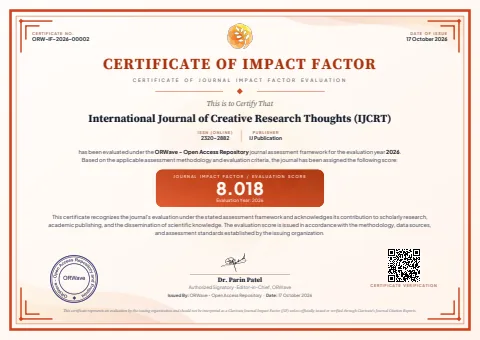
Impact factor
Certificate of Impact Factor
8.018ORWave evaluation score · 2026
Peer Review, Refereed, Indexed, Multidisciplinary, Multilanguage, UGC CARE Approved, Open Access Journal ★ ISSN 2349-5162 ESTD 2014 Call for Paper All Policy Track Journal List WhatsApp Email
The complete record, document by document — from UGC-Approved Journal No. 63975 (2019), through the May 2018 re-evaluation, UGC-CARE and its discontinuation on 16 July 2025, to where JETIR stands against all 35 suggestive parameters today. Every claim on this page points at a PDF you can open.
Every figure below is restated with its evidence further down the page.
No body approves or lists journals in 2026. UGC discontinued CARE listing and states that inclusion in the archived list “does not imply validation or endorsement by the Commission”. So this page does not ask you to take a badge on trust — it sets out JETIR’s full record, including the parts that do not flatter it, and answers every one of the 35 parameters that replaced the list. See also the full UGC CARE journal list and notices.
Each step embeds or links the official PDF it rests on. Files of 600 KB or less load as you reach them; larger ones load only when you ask, so opening this page downloads no PDF at all.
Every status below was checked against UGC’s own PDFs, which are embedded on this page, so you can repeat each check yourself.
What cannot be checked is not claimed: the final UGC-CARE list (10 February 2025) is a scan with no text layer, so JETIR’s presence in it is not asserted either way.
UGC re-evaluated every title on the approved list after complaints about poor-quality and questionable journals. In its own words, 4,305 journals were removed from the UGC-Approved List of Journals because of “poor quality / incorrect / insufficient information / false claims”.
Journal No. 63975 is not in that list. All 266 pages of the removal document were searched by journal name, by ISSN 2349-5162 and by the number 63975 — JETIR was not removed. The PDF below is that document, so the same search can be repeated by anyone.
Journal of Emerging Technologies and Innovative Research is UGC Approved Journal No. 63975 (2019). Page 215 of the 2019 UGC approved journal list reads: 63975 · Journal of Emerging Technologies and Innovative Research · UNIV · Science · IJ Publication · 23495162 · India.
The entry is recorded against ISSN 2349-5162, publisher JETIR Publication (IJ Publication), in the broad subject category Science, with the source marked UNIV — meaning the title reached the list on a university recommendation.
UGC set up the Consortium for Academic and Research Ethics and moved from an approved list to the CARE reference list. The remaining old list — 3,153 journals — was carried forward as a cancelled record; every page of it is watermarked “Cancelled”.
JETIR’s entry, Journal No. 63975, is in that 2019 list (page 215), which is why its record reads UGC Approved Journal No. 63975 (2019).
The last state of the CARE list, later published by UGC for reference. It holds 1,474 journals as on 10 February 2025.
This file cannot be searched. It is 100 pages of scanned images with no text layer at all, so no automated check can establish which journals it contains. JETIR therefore makes no claim either way about its presence in the final CARE list on the strength of this document. The PDF is provided in full so you can read it yourself.
In supersession of the 2018 notice, and acting on the decision of the 584th Commission meeting held on 3 October 2024, UGC announced that it would discontinue UGC-CARE listing of journals and develop suggestive parameters for choosing peer-reviewed journals instead. Draft parameters were put into the public domain for feedback until 25 February 2025.
After the feedback period the 591st Commission meeting of 24 June 2025 approved the final Suggestive Parameters for Peer-Reviewed Journals (Annexure-I) and the publication of the 1,474-journal list for referencing purposes.
The notice is explicit: the archived list “is intended to serve as a reference resource only; the inclusion or exclusion of a journal in this list does not imply validation or endorsement by the Commission.” From this date no body approves or lists journals — neither UGC nor UGC-CARE.
JETIR is a Transparent, Peer-Reviewed, Open Access Journal (Refereed Journal). Following the discontinuation of UGC and UGC-CARE journal listing, JETIR is aligned with UGC’s Suggested Parameters for Choosing Peer-Reviewed Journals.
Because there is no list to be on, the only meaningful question is whether a journal stands up to the parameters one by one. The table further down answers all 35 of the final Annexure-I for JETIR — including the three where nothing is published and the two that do not apply, which are marked as such rather than filled in. (The February 2025 draft had 36; “Online Availability” was dropped in the final list.)
The same timeline as a table — each row naming the document it comes from.
| Date / Period | Status | Evidence |
|---|---|---|
| May 2018 |
On record
Not removed in the Standing Committee re-evaluation
|
0. removed list 2018.pdf — all 266 pages searched by name, ISSN and number |
| 2019 |
On record
UGC Approved Journal No. 63975 (2019) — entry 63975, ISSN 2349-5162, Science, UNIV
|
1. 2019 Old UGC Approved Journals List.pdf, page 215 |
| 2019 – 2024 |
Not verifiable
UGC-CARE operated the reference list
|
No CARE list for these years is in this document set, so no status is asserted |
| 10 Feb 2025 |
Not verifiable
Final CARE list, 1,474 journals — not machine-checkable
|
4. Final UGC-CARE List – 10 Feb 2025.pdf — a scan with no text layer |
| 11 Feb 2025 |
Changed
UGC discontinues CARE listing
|
5. UGC Public Notice – 11 Feb 2025.pdf |
| 16 Jul 2025 |
Changed
Discontinuation confirmed; 35 suggestive parameters approved
|
6. UGC Public Notice – 16 July 2025.pdf |
| 2026 |
On record
No UGC or UGC-CARE list exists. JETIR meets 28 of the 35 suggestive parameters outright, 2 partly, publishes no figure for 3 and 2 do not apply
|
The parameter table on this page, each row naming where it is published |
No UGC-CARE list for 2019–2024 is part of this document set, and the final CARE list of 10 February 2025 is a scanned PDF with no text layer — nothing in it can be searched by machine. Rather than fill those rows with a status that sounds right, they say what is actually known. The scanned list is embedded above in full so you can read it directly.
Annexure-I to the UGC public notice of 16 July 2025, answered one parameter at a time. 28 met, 2 partial, 3 with no published figure, 2 not applicable.
The five gaps are marked, not filled in. Acceptance rate, print continuum, self-citation score, total citation rate and CiteScore are stated as unpublished or not applicable, with the reason. A journal asking to be judged on verifiable parameters does not get to invent the numbers it cannot show — and an internal committee applying these parameters can see exactly where the gaps are.
| No. | Suggestive parameter | Status | JETIR position |
|---|---|---|---|
| 1. Journal Preliminary Criteria | |||
| 1.1 | Journal Title | Met | Journal of Emerging Technologies and Innovative Research (JETIR), used consistently across the site, the DOI metadata and every issue. |
| 1.2 | ISSN Number | Met | ISSN 2349-5162, verifiable on the official ISSN Portal and consistent with the ROAD registration. |
| 1.3 | Periodicity and Continuity | Met | Monthly issues on a published schedule, with every past issue archived and reachable. |
| 1.4 | Contact and Publication Details | Met | Published by JETIR Publication, with a verifiable postal address, a professional email domain (editor@jetir.org) and a published phone number. |
| 1.5 | Transparent Review Policy | Met | A published review policy with double-blind evaluation and reports issued to authors. |
| 1.6 | Website on a Certified Domain | Met | An official .org domain secured with HTTPS and verifiable WHOIS ownership. |
| 1.7 | Open Access or Subscription-Based Policy | Met | Fully open access — free to read and download, with no reader paywall and the charge disclosed before submission. |
| 1.8 | Integration with National/International Repositories | Partial | Articles are discoverable in Google Scholar and archived in Zenodo, with Crossref DOI metadata. ONOS covers subscription titles, so it does not apply to a fully open access journal. |
| 1.9 | Archival Policy | Met | Permanent article URLs, DOI-backed metadata and long-term preservation of every issue. |
| 2. Editorial Board Criteria | |||
| 2.1 | Editorial Board Details | Met | Editors and reviewers published with full names, affiliations and verifiable credentials. |
| 2.2 | Editorial Board Composition | Met | Subject expertise across the disciplines the journal accepts, drawn from Indian and foreign institutions. |
| 2.3 | Efficient Editorial/Review Process | Met | Double-blind peer review against reviewer recommendations, with published timelines. |
| 3. Journal Editorial Policy | |||
| 3.1 | Aims, Objectives, and Scope | Met | Stated in full on the About page, with the scope defined per discipline. |
| 3.2 | Subject Areas | Met | Every accepted discipline is listed, including regional-language submissions. |
| 3.3 | Article Processing Charges (APC) | Met | Rs 1501 for Indian authors and $59 for international authors, disclosed upfront and invoiced only after acceptance. |
| 3.4 | Publishing Timeline | Met | The submission-to-publication turnaround is published, and each step is tracked. |
| 3.5 | Acceptance Rate | Not published | No acceptance-rate figure is published. Rather than estimate one, this is stated as unpublished. |
| 4. Journal Quality Criteria — Content | |||
| 4.1 | Academic Contribution | Met | Reviewers assess motivation, advancement of existing knowledge and applicability, and the report is shared with the author. |
| 4.2 | Conformity to Journal Scope | Met | Submissions are desk-checked against the stated aims and scope before review. |
| 5. Journal Standards | |||
| 5.1 | Bibliographic Data & Literature Citation | Met | A standard referencing format is required and checked at copy-edit. |
| 5.2 | Font & Design | Met | A published paper template fixes the layout, fonts and structure of every article. |
| 5.3 | Infographics & Exhibits | Met | Figures, tables and supplementary material are accepted at publication quality. |
| 5.4 | Citation Record | Met | Articles carry a public Google Scholar citation record, which is the basis of the journal's Impact Factor. |
| 5.5 | Print Continuum | Not applicable | Not applicable: the journal is online-first and does not run a print edition. A hard copy of a certificate or issue is available on request; there is no print continuum to report. |
| Draft | Online Availability (Feb 2025 draft only) | Draft only | Dropped from the final Annexure-I of 16 July 2025, so it is not counted. Full text of every article is still free to read and download, with no registration. |
| 5.6 | Quality of Website | Met | Maintained over HTTPS, with the current issue updated on the monthly schedule and every archive link live. |
| 5.7 | Multilingual Availability | Met | Submissions in regional languages are accepted alongside English, which is what this parameter asks of an Indian journal. |
| 6. Research Ethics | |||
| 6.1 | Ethical Guidelines for Authors | Met | Authorship, ethics and disclosure policies aligned with COPE and ICMJE guidance. |
| 6.2 | Plagiarism Prevention | Met | Every submission is screened before review and the similarity report is shared with the author; the accepted threshold is below 15% (with sources properly quoted and referenced). |
| 6.3 | Conflict of Interest Disclosure | Met | A published conflict-of-interest policy covering governance, editors, reviewers and authors. |
| 6.4 | AI Generated Content Policy | Met | A specific AI-disclosure policy applies to authors, and AI writing detection is available on the similarity check. |
| 7. Journal Visibility | |||
| 7.1 | Impact Factor or Similar Factor (if applicable) | Met | Impact Factor 12.95, calculated from Google Scholar citation data — not a purchased metric. |
| 7.2 | Indexation in Reputed Databases | Partial | Indexed in Google Scholar; registered with Crossref and ROAD (ISSN); archived in Zenodo. The journal's own indexing table states plainly that it is not indexed in Scopus, Web of Science or DOAJ. |
| 8. Journal Impact Criteria | |||
| 8.1 | Self-Citation Score | Not published | No self-citation score is computed or published for this journal. |
| 8.2 | Total Citation Rate | Not published | The citation record is public on Google Scholar, but no total citation rate is published as a comparable figure. |
| 8.3 | Cite Score | Not applicable | Not applicable: CiteScore is computed by Scopus for the titles it indexes. As the journal's indexing table states, JETIR is not Scopus-indexed, so no CiteScore exists. |
Everything an author, a reviewer or an institutional committee normally asks for, in one table.
| Journal name | Journal of Emerging Technologies and Innovative Research |
| Abbreviation | JETIR |
| ISSN | 2349-5162 (Online) |
| UGC Approved Journal No. | 63975 (2019) — on the 2019 UGC approved list, page 215 (see the timeline above) |
| Publisher | JETIR Publication |
| Established | 2014 |
| Frequency | Monthly |
| Language | English, with submissions in regional languages accepted |
| Access model | Open access — free to read and download, no reader paywall |
| Peer review | Double-blind, refereed |
| Impact Factor | 12.95 (calculated from Google Scholar citation data) |
| DOI | Crossref DOI issued on request |
| Plagiarism screening | Every submission screened before review; similarity below 15% (with sources properly quoted and referenced) |
| Indexed in | Google Scholar, Crossref, ROAD (ISSN), Zenodo |
| Not indexed in | Scopus, Web of Science, DOAJ |
| Publication charge | Rs 1501 (Indian authors) / $59 (international authors), invoiced only after acceptance |
| UGC status 2026 | No UGC or UGC-CARE journal list exists. Aligned with the 35 UGC suggestive parameters — 28 met, 2 partly, 3 not published, 2 not applicable |
| Editorial contact | editor@jetir.org · +919426033211 |
Peer-reviewed, open access, monthly issues, Crossref DOI, and every one of the 35 UGC suggestive parameters answered above — including the ones with nothing to show. The publication charge is Rs 1501 for Indian authors and $59 for international authors, invoiced only after acceptance.
JETIR editorial desk: editor@jetir.org · +919426033211
UGC’s own copies of the documents embedded above, on ugc.gov.in. Each full URL is printed so you can check it before you click.
The UGC list of journals, as published on ugc.gov.in.
The cancelled list — UGC's own copy of the journals withdrawn from the approved list.
The public notice on UGC-CARE.
Same date as 3. UGC CARE Notice – 14 Jan 2019 embedded above.
The 1,474-journal reference list. This is the URL named in the 16 July 2025 public notice itself.
The public notice on CARE journals.
The PDFs embedded in the timeline are copies held on this site so the page stays readable if ugc.gov.in reorganises its files. The links above are the originals. If a UGC link has moved, search the UGC website for the document name — the local copy on this page carries the same content and the same date.
Certificates · ORWave · 2026
With the CARE list discontinued, authors check journals against UGC’s suggestive parameters. ORWave’s letter of appreciation includes such a checklist for IJCRT, alongside its peer-reviewed journal and impact factor certificates.
8.018ORWave evaluation score · 2026
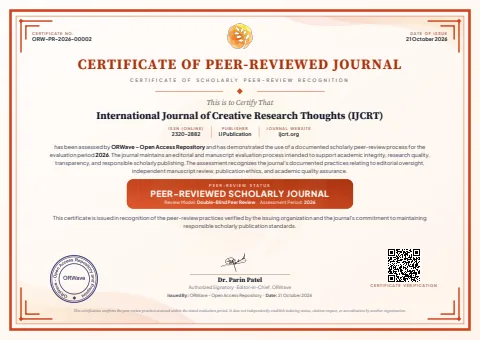
Peer-reviewedDouble-blind review · assessment period 2026
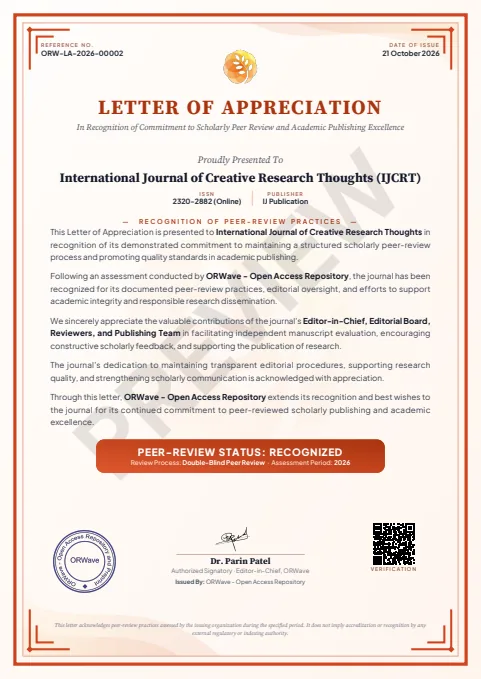
RecognizedPeer-review status · with a 35-point UGC parameters checklist
How to read these. 8.018 is ORWave’s own evaluation score for 2026. It is separate from the 9.17 impact factor IJCRT calculates from Google Scholar data, and, as the certificate itself says, it is not a Clarivate Journal Impact Factor. The peer-review certificate and the letter cover the 2026 assessment period. The UGC checklist inside the letter is ORWave’s assessment against UGC’s suggestive parameters for peer-reviewed journals, not a listing by UGC. ORWave (orwave.org) is one of the platforms of the Journey & Wisdom Publications network.
No journal is. UGC discontinued CARE listing — decided at the 584th Commission meeting on 3 October 2024, published on 11 February 2025 and confirmed on 16 July 2025. UGC states that inclusion in the archived list does not imply validation or endorsement. What applies now is the set of 35 suggestive parameters, and this page answers all of them for JETIR.
JETIR is UGC Approved Journal No. 63975 (2019), recorded against ISSN 2349-5162 in the Science category on a university recommendation. The entry is on page 215 of the 2019 old UGC approved journal list, and it is not in the May 2018 removal list, in which 4,305 journals were removed. Both documents are embedded on this page so the entry can be read in full.
That cannot be established from the documents on this page. The final UGC-CARE list published by UGC is a 100-page scan with no text layer, so it cannot be searched by any automated method. JETIR makes no claim either way on the strength of it. The complete PDF is embedded above so you can check it yourself.
Three of the 35 carry no published figure: acceptance rate (3.5), self-citation score (8.1) and total citation rate as a comparable figure (8.2). Two do not apply: print continuum (5.5, the journal is online-first) and CiteScore (8.3, a Scopus metric — JETIR is not Scopus-indexed). Two more are partial: repository integration (1.8) and indexation (7.2). The rest are met, each with where it is published.
That is your institution's decision, and under the current framework it is meant to be. UGC has asked higher educational institutions to apply the suggestive parameters — and, where useful, to set up internal committees that adapt them to their own disciplines. This page is laid out so a committee can check JETIR against each parameter directly rather than take a claim on trust.
Because it is the public record of which journals UGC removed in May 2018 — anyone can search it for entry 63975 or ISSN 2349-5162 and see that JETIR is not in it. A journal asking to be judged on verifiable parameters shows the records that let readers check its history. The current position is set out in the parameter table, and it stands on evidence rather than on a list membership that no longer exists for anyone.



















