Digital Object Identifier (DOI)

Crossref & DataCite • Both under doi.org

A Permanent Address for Your Research

A URL can break. A DOI cannot. It resolves to your paper for as long as the paper exists, which is what makes it citable in a reference list years after publication — and it is the identifier indexing databases match on.

https://doi.org/10.XXXXX/JETIR.2026.0142
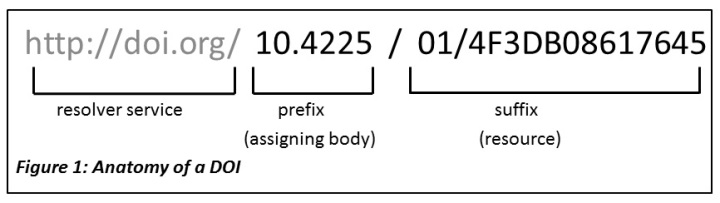
PrefixIdentifies the publisher. Assigned once by the registration agency.
SuffixIdentifies the individual article. Assigned by the journal.
Resolverdoi.org sends the reader to wherever the paper currently lives.

DOI Charges

One-time charge per research paper, payable after your paper has been accepted. The same charge covers Crossref or DataCite registration.

Indian Authors
₹300INR
Per research paper • one-time Pay DOI Charge
Foreign / International
$20USD
Per research paper • one-time Pay DOI Charge

Journal of Emerging Technologies and Innovative Research (JETIR) is a registered Crossref member and offers Digital Object Identifier (DOI) services for published articles on request (additional charges apply). The journal provides low cost journal publication with a transparent Peer Review Journal Publication system, recognized UGC CARE Approved Journal Publication, and publishing practices meeting Scopus Journal indexing standard expectations.

A Digital Object Identifier (DOI) is a permanent and unique alphanumeric identifier assigned to scholarly content such as journal articles. Operated by the International DOI Foundation since 2000, the DOI system ensures long-term, stable, and reliable access to digital research outputs.

Unlike standard web URLs that may change or become inactive over time, a DOI remains constant throughout the lifetime of the document. If the location of the content changes, only the associated metadata is updated, allowing uninterrupted access and accurate citation.

Each DOI is linked with structured metadata, including the article title, author details, publication information, and the current online location. This makes DOI-enabled content actionable, discoverable, and interoperable across academic databases and citation systems. Only authorized publishers registered through official DOI agencies such as Crossref are permitted to assign DOIs.

Today, the DOI system is an essential component of global Journal Publication, widely adopted in academic publishing with tens of millions of identifiers assigned worldwide, supporting citation integrity, research visibility, and long-term scholarly access.

Digital Object Identifier logo How a DOI resolves to a research paper

Crossref and DataCite — Both Under doi.org

A DOI is not issued by doi.org directly. The International DOI Foundation accredits registration agencies, and both of the agencies that matter for scholarly work resolve through the same doi.org system. A Crossref DOI and a DataCite DOI are equally permanent and equally citable — they differ in what they are built to describe.

doi.orgInternational DOI Foundation • ISO 26324

Crossref

For journal articles & conference papers

The registration agency used by academic publishers. JETIR is a registered Crossref member, and this is the default choice for a published research paper.

  • Built for articles, proceedings, books and chapters
  • Powers reference linking between published papers
  • Feeds cited-by counts and citation databases
  • What most journals and indexers expect to see

DataCite

For datasets, software & theses

The registration agency for research outputs that are not journal articles. Available on request where your output needs its own citable identifier.

  • Built for datasets, software, samples and models
  • Used by repositories and theses collections
  • Makes data citable in its own right, separately from the paper
  • Increasingly required by funders as a condition of a grant

Not sure which applies? For a research paper published here, Crossref is almost always the right answer. If you also need a citable identifier for an underlying dataset — see the Data Availability Policy — ask about DataCite when you order.

What Happens When Someone Clicks Your DOI

A DOI is not a web address for one server — it is a lookup. The reader clicks the DOI, the global resolver at doi.org reads the current location from the registered metadata, and forwards the reader there. If the paper ever moves, only that one record is updated, and every DOI link already printed in a reference list keeps working.

A reader clicks a DOI, doi.org looks up the registered metadata, and the reader is forwarded to the paper's current page. If the paper moves, the publisher updates the record. doi.org/10.xxxx/… 1. Reader clicks in a reference list doi.org 2. looks up the registered record current page 3. Paper opens If the paper moves, the record is updated — the DOI stays the same

How to Cite a Paper With Its DOI

Most citation styles now ask for the DOI written as a full link. Put it at the end of the reference, and do not add a full stop after it — that would become part of the link. The examples below use placeholders; replace them with your paper’s own details.

APA 7Author, A. A., & Author, B. B. (Year). Title of the article. Journal of Emerging Technologies and Innovative Research, Volume(Issue), pages. https://doi.org/10.xxxx/xxxxx
MLA 9Author, A. A., and B. B. Author. “Title of the Article.” Journal of Emerging Technologies and Innovative Research, vol. X, no. X, Year, pp. xx–xx, https://doi.org/10.xxxx/xxxxx
TipPaste the DOI into a reference manager (Zotero, Mendeley, EndNote) and it fills in the title, authors, journal and year from the registered metadata.

What a DOI Actually Does for You

The link never breaksIf the paper moves, the metadata is updated and the DOI keeps resolving. A raw URL in someone's reference list would already be dead.
Citable with confidenceJournals and thesis committees increasingly expect a DOI in the reference. It removes any ambiguity about which paper is meant.
Found by indexersCitation databases match on DOIs. Without one, a citation to your work may never be connected back to it.
Citations get countedCited-by tracking is driven by DOI matching, so a registered paper accrues visible citation counts a bare URL never would.
Structured metadataTitle, authors, affiliations, ISSN and publication date travel with the DOI, so reference managers import your paper correctly in one click.
Proof it was publishedA resolvable DOI is independently verifiable evidence for appraisals, promotions and funding applications.
Links to your ORCIDDOI metadata can carry author identifiers, so the work attaches to you rather than to someone who shares your name.
Works everywhereISO 26324 standardised and recognised by every major database, repository and publisher worldwide.

With a DOI vs. Without One

SituationPlain URL onlyWith a DOI
If the site is reorganisedThe link diesStill resolves
Citation matchingManual, often missedAutomatic
Reference manager importTyped by handOne click, correct fields
Cited-by countsNot trackedTracked and visible
Accepted in a thesis reference listSometimes queriedStandard practice
Verifiable for an appraisalNeeds explainingResolves on its own

How to Get a DOI for Your Paper

A DOI validates and locates your research paper, which is what makes it identifiable. Four steps, once your paper has been accepted.

  1. Confirm acceptanceA DOI is registered against a published paper, so this comes after your paper has been accepted.
  2. Pay the charge₹300 INR for Indian authors, $20 USD for international authors — use a button above or below.
  3. Send the payment proofEmail it to editor@jetir.org with your registration ID in the subject.
  4. DOI issued in 4–5 working daysThe DOI is registered, added to your paper's metadata and starts resolving.

DOI — Frequently Asked Questions

Is a DOI included in the publication charge?

No. A Crossref DOI is available on request for an additional one-time charge of ₹300 for Indian authors or $20 USD for international authors, paid after acceptance.

How long does it take to get a DOI?

Once the payment proof is received, the DOI is registered and added to your paper's metadata in 4–5 working days.

Does a DOI mean my paper is indexed in Scopus or Web of Science?

No. A DOI is a permanent identifier, not an indexing listing. It helps databases match citations to your paper, but inclusion in any index is decided by that index.

Can a DOI change or expire?

No. Once registered, a DOI is permanent. If the paper moves to a new web address, the publisher updates the registered location and the same DOI keeps resolving.

Crossref or DataCite — which do I need?

For a journal article, Crossref. DataCite is for datasets, software and theses that need their own identifier, and is available on request.

DOI Charges

Indian Authors
₹300INR
Per research paper • one-time Pay DOI Charge
Foreign / International
$20USD
Per research paper • one-time Pay DOI Charge
Anatomy of a DOI

One string that always leads back to your paper

Every JETIR DOI has two parts. The prefix names the publisher on Crossref; the suffix names the paper. Put https://doi.org/ in front and it becomes a link that keeps working even if the page ever moves.

Example format, as shown on published JETIR papers.

  1. Reader clicksthe DOI in a citation, a reference list or a search result
  2. doi.org resolvesthe global resolver looks the DOI up
  3. Crossref recordholds the title, authors and current address
  4. Your paper opensits page on jetir.org, every time
Request Services

Order your DOI online — no e-mail back-and-forth

Sign in to Request Services with your paper’s Registration ID, tick DOI and submit. The request is attached to your paper, so the editorial office knows exactly which paper the DOI is for.

  • Who can requestThe author of a paper accepted for publication in JETIR.
  • What you needThe 6-digit Registration ID, plus the registered e-mail address or the private key.
  • Charge₹300 INR for Indian authors · $20 USD for international authors, one-time.
  • When it is issuedRegistered and added to your paper’s metadata in 4–5 working days after payment.
  1. Sign inwith your Registration ID and e-mail or private key.
  2. Tick DOIon its own, or in the bundle with hard copies and certificates.
  3. Submit & paythe amount shown; the DOI follows in 4–5 working days.

The same page also takes requests for a hard copy of the certificate or the journal, a plagiarism report, a transparent peer review report and the Best Paper Award.

Make Your Paper Permanently Citable

Register a Crossref DOI against your published paper and it stays findable, citable and countable for as long as the record exists. Not yet published with JETIR? Start there — the DOI follows acceptance.

DataCite registration for a dataset, thesis or software output is available on request — email editor@jetir.org with details of the output you need identified.

Research & Publication Timeline
Indexed, Abstracted & Author Benefits
Just ₹1501
Publish in a UGC CARE Approved Journal | Low Cost ₹1501 Indian Author | 🌐 $59 USD International
CrossRef DOI Google Scholar Transparent Review ISSN Registered 1–2 Days UGC CARE
Submit Paper →