
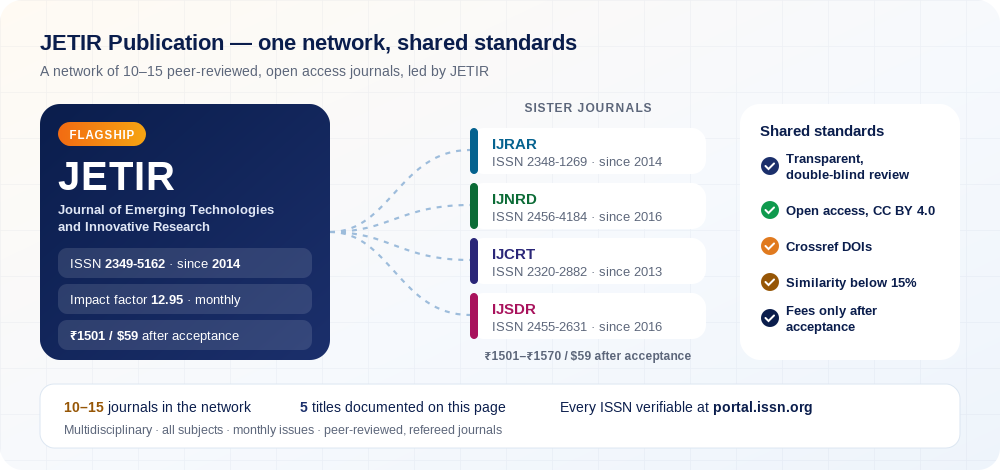
This page gives the full, verifiable record of JETIR, the flagship journal of JETIR Publication, whose network publishes 10–15 journals. The sister journals IJRAR, IJNRD, IJCRT and IJSDR are listed below, and every title is compared side by side in the Journal Directory.

JETIR
Journal of Emerging Technologies and Innovative ResearchA peer-reviewed, open-access, multidisciplinary research journal publishing original research, review articles, short communications and case studies across science, technology, engineering, management, humanities, education and related disciplines.
Every accepted article is freely readable with no paywall and no embargo, is published under a CC BY 4.0 licence with copyright retained by the authors, and can receive a permanent Crossref DOI on request so that citations to it continue to resolve.
UGC and UGC-CARE approval, along with alignment with the latest UGC-CARE recommendations and guidelines. JETIR is aligned with UGC’s Suggested Parameters for Choosing Peer-Reviewed Journals.
JETIR is a Transparent, Peer-Reviewed, Open Access Journal (Refereed Journal). Following the discontinuation of UGC and UGC-CARE journal listing, JETIR is aligned with UGC’s Suggested Parameters for Choosing Peer-Reviewed Journals.
The journal is not currently indexed in Scopus, Web of Science or DOAJ. Current coverage, with the steps to verify each entry, is published on the Indexing Verification page.
- Journal
- JETIR
- ISSN
- 2349-5162
- Publisher
- JETIR Publication
- Established
- 2014
- Frequency
- Monthly
- Language
- Multilingual — English, Indian and foreign languages (confirm first)
- Medium
- Online
- Subject
- Multidisciplinary
- Access
- Open Access
- Licence
- CC BY 4.0
- Review
- Transparent, double-blind peer review
- Identifier
- Crossref DOI
- Charge (Indian authors)
- ₹1501 INR
- Charge (Foreign authors)
- $59 USD
- Authors covered
- Up to 5; ₹500 per extra author
- Website
- jetir.org
- Contact
- editor@jetir.org
Transparent, Double-Blind Peer Review
JETIR and every title in this network review papers the same way: identities stay hidden while a paper is reviewed, and the review is recorded so anyone can check it once the paper is published.
Double-blind
Reviewers do not see who wrote the paper, and authors do not see who reviewed it.
- Similarity checked first (below 15%)
- Reviewed by subject experts
- Decision sent by email & SMS
Transparent
The review is recorded, so anyone can check that it really took place.
- Review record on Scholar9
- Public reviewer list
- Formal report on request
How it works stage by stage: Peer Review Process · Transparent Peer Review
From Submission to Publication
Six stages take a paper from upload to a permanent, open access article. Nothing is paid until stage four, and only if the paper is accepted.
- SubmitOnline or by email; a paper ID is issued
- ScreenScope, declarations and similarity (below 15%)
- Double-blind reviewSubject experts; decision by email & SMS
- Accept & paySign the undertaking online; ₹1501 / $59
- PublishOpen access, CC BY 4.0; Crossref DOI on request
- Transparent recordReview recorded on Scholar9; report on request
Checked at the source
Live Figures You Can Verify
Each number links to the service that publishes it. Figures read on 27 Nov 2026; they change as the services update.
One click each
Verify JETIR Yourself
Verified links open the journal’s own record or a search result for it at the service. Search links open a general search on a sharing platform.

Crossref Search Verified
Every deposited JETIR article with its DOI and metadata.

Google Scholar Verified
The journal’s citation profile — citations, h-index and i10-index.



OpenAlex Verified
Open catalogue of scholarly works — the journal’s source record and its works.
Google Search Verified
Pages indexed from jetir.org, and results for the journal’s full name.

ROAD / ISSN Verified
The ISSN record for 2349-5162 in the ISSN International Centre’s directory.

ResearchGate Search
Research network where authors share JETIR papers — search it for the journal name.
Indexing & discovery
Indexing
Where the journal or its articles are formally listed or registered.
Crossref Verified
DOI registration agency — metadata for every DOI-registered paper is deposited here.
DOI prefix 10.56975 Verified
A permanent Digital Object Identifier on request, so a paper stays citable.

ISSN Portal Verified
The journal’s serial registration — ISSN 2349-5162, held with the ISSN International Centre.

ORCID Registry
Author identifier registry — links each author’s record to their published work.

Publons / ResearcherID Registry
Reviewer and researcher registry (now Web of Science reviewer recognition), used for peer-review activity.
Scholar9 Verified
Transparent peer-review registry — where the journal’s review certificate is recorded.
Discovery
Where researchers can discover, search, read, save or share published articles.
Google Scholar Verified
Search and citation tracking — JETIR’s profile with its citations, h-index and i10-index.
OpenAlex Verified
Open index of works, authors and citations — the successor to Microsoft Academic’s data.
ORWave Verified
Open Research Wave — open-access journal and research discovery platform.
Academia.edu Verified
Academic sharing platform with reader analytics for each uploaded paper.

Semantic Scholar Search
AI-powered search that surfaces papers by meaning, citation and influence.
ResearchGate Search
Research network where authors share papers and readers follow their work.



SSRN Search
Elsevier’s preprint and working-paper network (a repository, not a journal index).
Microsoft Academic, listed on older pages, was retired by Microsoft at the end of 2021; its data lives on in OpenAlex, shown above.
Citations
Impact Factor and Citation Metrics
JETIR’s Impact Factor of 12.95 is calculated from the journal’s Google Scholar citation data (h-index based). The figures below come from JETIR’s Google Scholar profile and its OpenAlex record, which anyone can open. It is not a Clarivate Journal Impact Factor.
Google Scholar profile: 74,343 citations, h-index 101, i10-index 1,230 (all years). OpenAlex record: 14,300 citations, h-index 28, 25,747 works. Read on 27 Nov 2026.
Open the Google Scholar profile ↗ · OpenAlex record ↗ · Impact Factor Details →
| Google Scholar | All years | Since 2021 |
|---|---|---|
| Citations | 74,343 | 35,701 |
| h-index | 101 | 72 |
| i10-index | 1,230 | 845 |
Citations per year on JETIR’s Google Scholar profile, read on 27 Nov 2026. *2026 is a partial year.
Originality
Plagiarism Detection: Turnitin & iThenticate
Every submission is screened for similarity before peer review, and the similarity report is available to the author on request. The accepted similarity threshold is below 15%.

Turnitin
Similarity check against published literature, web content and submitted work.

iThenticate
Turnitin’s service for publishers and researchers, with AI-writing detection available.
Licences & standards
Licences, Access and Recognition



ISSN Registered • Open Access • Transparent Peer Review • Creative Commons CC BY 4.0 • Ethics policies follow COPE guidance
JETIR is a Transparent, Peer-Reviewed, Open Access Journal (Refereed Journal). Following the discontinuation of UGC and UGC-CARE journal listing, JETIR is aligned with UGC's Suggested Parameters for Choosing Peer-Reviewed Journals. UGC public notice (PDF)
Today’s standard
How JETIR Meets Today’s Peer-Review Standards
Peer review is judged on process and evidence. These are the practices institutions and indexing services look for, each with its policy page.
Double-blind review Verified
Subject experts evaluate each paper without seeing author identities.
Transparent review records Verified
Reviewer reports and certificates recorded on Scholar9.
Similarity screening Verified
Every submission checked with Turnitin / iThenticate before review; report available to the author on request.
AI-use disclosure Verified
Authors must disclose AI tools; AI-writing detection is available.
Ethics following COPE guidance Verified
Authorship, misconduct, corrections and retractions policies.
Digital preservation
How JETIR Preserves Every Published Paper
JETIR currently preserves its archive through its own preservation network. It has now started the process of applying to join a LOCKSS-based preservation network, so copies will also be held independently by libraries.
- Now
Own preservation network
- Every article at a permanent URL that is never restructured or reused
- Crossref DOIs (prefix 10.56975) that resolve independently of the website
- Archived copies in Zenodo (CERN) and records in OpenAlex and Google Scholar
- Withdrawn and retracted papers kept online and marked, never deleted
- A written succession plan if the journal ever stops publishing
- In progress
Applying to join LOCKSS
JETIR has started the process of applying to join a LOCKSS-based network, in which participating libraries each keep a copy and check it against the others. The application is under way; this page will be updated when participation is confirmed.
About LOCKSS ↗ - Options
Further services
CLOCKSS, Portico and the PKP Preservation Network are also assessed below, with what each requires.
Compare the services ↓
CLOCKSS vs Portico vs LOCKSS vs PKP PN
These are different approaches to preserving digital scholarly content.
| Feature | CLOCKSS | Portico | LOCKSS | PKP PN |
|---|---|---|---|---|
| Primary purpose | Long-term preservation | Long-term preservation | Distributed preservation | Preservation of journals published on OJS |
| Technology | LOCKSS-based | Independent preservation infrastructure | Open-source LOCKSS software | LOCKSS-based network run by PKP |
| Dark archive | Yes | Yes, for its preservation service | Depends on network configuration | Yes |
| Public access after trigger | Yes, under its policies | Yes, under defined conditions | Access depends on network and preservation arrangements | Yes, if the journal stops publishing or content is no longer available |
| Publisher participation | Paid service | Paid service | Some participation options are free | Free for eligible journals |
| Community model | Publishers and libraries | Preservation service supported by libraries and publishers | Library-centered preservation networks | PKP with participating libraries |
| Main requirement | Participation agreement and fee | Participation agreement and fee | Joining or forming a network | The journal must run on Open Journal Systems (OJS) and enable the PN plugin |
| Fit for JETIR | Possible later (paid) | Possible later (paid) | Application process started | Only if the journal moves to OJS — JETIR runs its own platform |
UGC & UGC-CARE
UGC’s New Recommendations: Where JETIR Stands
UGC and UGC-CARE approval, along with alignment with the latest UGC-CARE recommendations and guidelines. JETIR is aligned with UGC’s Suggested Parameters for Choosing Peer-Reviewed Journals. JETIR is a Transparent, Peer-Reviewed, Open Access Journal (Refereed Journal). Following the discontinuation of UGC and UGC-CARE journal listing, JETIR is aligned with UGC’s Suggested Parameters for Choosing Peer-Reviewed Journals.
35 suggestive parameters in 8 groups
Annexure-I of UGC’s notice. JETIR reports 28 met, 2 partly met, 3 not published and 2 not applicable — with the reason for each.
UGC circulars and notices
- Public Notice — CARE Journals (discontinuation) (PDF) ↗
- Final list of UGC-CARE journals (1,474, archived) (PDF) ↗
- Public Notice — CARE (PDF) ↗
- Public Notice — CARE, 14 January 2019 (PDF) ↗
Parameter-by-parameter evidence
What Every Title Must Publish
Any journal listed on this page carries the same documentation set. A title that cannot supply all of it does not belong on a publisher's journal list.
The reliable key for verifying a title; names are imitated, ISSNs are not
JETIR: 2349-5162Ownership that cannot be located is the commonest warning sign
JETIR: JETIR Publication · editor@jetir.orgAuthors must know who assesses their work and against what criteria
JETIR: transparent, double-blindFees must be visible before submission, not revealed after acceptance
JETIR: ₹1501 / $59What happens when something goes wrong is part of the offer
JETIR: Journal PoliciesCoverage claims must be verifiable at the service’s own site
JETIR: Indexing VerificationCitations must keep resolving after any site change
JETIR: Crossref DOIOwnership, governance and revenue model stated openly
JETIR: Journal TransparencyChoosing Where to Publish
Apply the same test to this publisher that you would to any other. If a claim on this site cannot be verified in a couple of minutes, treat that as your answer.
- Check the ISSN at the official register, not on the journal’s own page
- Confirm indexing claims at each service’s own website
- Read the peer review description and see whether it is specific or generic
- Find the charge before submitting, and confirm it is payable only after acceptance
- Look for published ethics, corrections and retraction procedures
- Check what your own institution requires — only your institution can tell you that
Frequently Asked Questions
What journals does JETIR Publication publish?
JETIR Publication’s network publishes 10–15 journals. This page documents the flagship, JETIR — Journal of Emerging Technologies and Innovative Research, ISSN 2349-5162, published monthly since 2014 — and lists four sister journals: IJRAR (2348-1269), IJNRD (2456-4184), JETIR (2349-5162) and IJSDR (2455-2631). The wider Journey & Wisdom network is described on the JW Ecosystem page.
Is JETIR indexed in Google Scholar?
Yes. The journal has a Google Scholar citation profile (74,343 citations, h-index 101, read on 27 Nov 2026), and records in Crossref, OpenAlex, the ISSN Portal / ROAD, Zenodo, Scholar9 and ORWave — each linked on this page.
Is JETIR indexed in Scopus, Web of Science or DOAJ?
No, and the journal states this openly. Its impact factor of 12.95 is calculated from Google Scholar data and is not a Clarivate Journal Impact Factor.
Where does JETIR stand on UGC and UGC-CARE?
UGC and UGC-CARE approval, along with alignment with the latest UGC-CARE recommendations and guidelines. JETIR is aligned with UGC’s Suggested Parameters for Choosing Peer-Reviewed Journals. JETIR is a Transparent, Peer-Reviewed, Open Access Journal (Refereed Journal). Following the discontinuation of UGC and UGC-CARE journal listing, JETIR is aligned with UGC’s Suggested Parameters for Choosing Peer-Reviewed Journals.
What does publication cost?
₹1501 for Indian authors and $59 USD for foreign authors per accepted article, payable only after acceptance. A Crossref DOI is optional, on request.
What is transparent, double-blind peer review?
While a paper is reviewed, it is double-blind: reviewers do not see who the authors are, and authors do not see who reviewed them. Once the paper is published, the review is transparent: it is recorded on Scholar9 so anyone can check that it took place, reviewers may choose to be named, and the formal Transparent Peer Review Report is available to the author on request. See the Peer Review Process.
How is plagiarism checked?
Every submission is screened with Turnitin / iThenticate before review. The accepted similarity is below 15%, and the similarity report is available to the author on request.
In which languages can I publish?
English, all Indian (local) languages and foreign languages. For a language other than English, confirm with the editorial office before submission that a language editor and reviewers are available, and send the font details and font file.
How do the sister journals differ from JETIR?
They follow the same standards — transparent, double-blind peer review, open access under CC BY 4.0 and Crossref DOIs — but each has its own ISSN, and submissions and fees (₹1570 / $59 after acceptance) are handled through ER Society. JETIR’s own fee is ₹1501 / $59.
Our Group’s Other Journals
JETIR Publication’s network publishes 10–15 journals. Alongside JETIR, these four multidisciplinary journals follow the same standards — transparent, double-blind peer review, open access under CC BY 4.0 and Crossref DOIs. Submissions and fees for IJCRT are handled on ijcrt.org; for the others, through ER Society.
International Journal of Research and Analytical Reviews
- ISSN
- 2348-1269 Verify
- Since
- 2014 · monthly
- Review
- Transparent, double-blind
- Scope
- Multidisciplinary · all subjects
- Access
- Open access, CC BY 4.0 · Crossref DOI
- Charge
- ₹1570 INR / $59 USD, after acceptance
International Journal of Novel Research and Development
- ISSN
- 2456-4184 Verify
- Since
- 2016 · monthly
- Review
- Transparent, double-blind
- Scope
- Multidisciplinary · all subjects
- Access
- Open access, CC BY 4.0 · Crossref DOI
- Charge
- ₹1570 INR / $59 USD, after acceptance
International Journal of Creative Research Thoughts
- ISSN
- 2320-2882 Verify
- Since
- 2013 · monthly
- Review
- Transparent, double-blind
- Scope
- Multidisciplinary · all subjects
- Access
- Open access, CC BY 4.0 · Crossref DOI
- Charge
- ₹1501 INR / $59 USD, after acceptance
International Journal of Scientific Development and Research
- ISSN
- 2455-2631 Verify
- Since
- 2016 · monthly
- Review
- Transparent, double-blind
- Scope
- Multidisciplinary · all subjects
- Access
- Open access, CC BY 4.0 · Crossref DOI
- Charge
- ₹1570 INR / $59 USD, after acceptance
Compare every title: Our Journals · Journal Directory · ER Society — submissions & fees · JW Ecosystem
Ready to publish?
Publish With a Journal You Can Verify
Transparent, double-blind peer review, similarity screening, Crossref DOIs on request under 10.56975, open access under CC BY 4.0 and alignment with UGC’s Suggested Parameters — with a fee of ₹1501 (Indian authors) or $59 (foreign authors), charged only after acceptance.