
Why This Page Exists
Most journal websites show a wall of logos under a heading like "Indexed In". A logo is a picture. It proves nothing, it is trivially copied, and it frequently mixes genuine indexing services with platforms that merely host files.
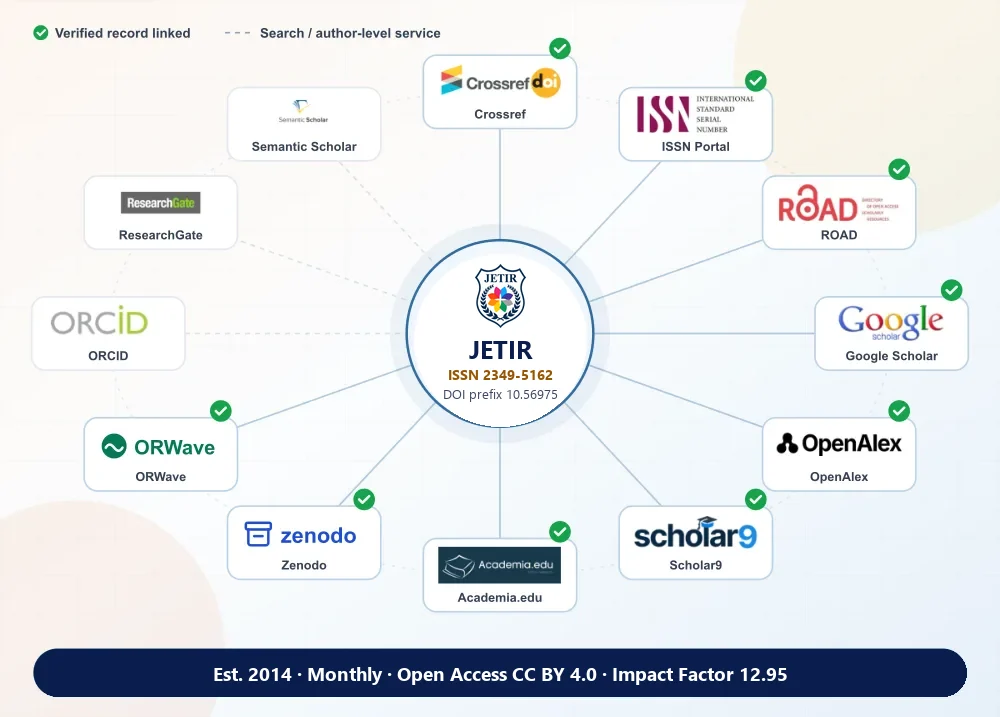
This page replaces that wall with a table that states coverage status in plain words and tells you how to check each line for yourself. Where the answer is "not currently indexed", the page says so. That is more useful to a researcher choosing a venue than any badge, and it is the standard this journal holds itself to.
Checked at the source
Live Figures You Can Verify
Each number links to the service that publishes it. Figures read on 27 Nov 2026; they change as the services update.
Coverage Status Table
| Service | Type | Status | How to verify | Last checked |
|---|---|---|---|---|
| Crossref | DOI registration | Verified 2,249 DOIs | Crossref journal record or resolve any DOI at doi.org | 27 Nov 2026 |
| ISSN Portal / ROAD | Serial registration | Verified | ISSN Portal record | 27 Nov 2026 |
| Google Scholar | Scholarly discovery | Verified citation profile | Journal profile | 27 Nov 2026 |
| OpenAlex | Scholarly discovery | Verified 25,747 works | Source record | 27 Nov 2026 |
| Zenodo | Open repository | Search records searchable | Zenodo search | 27 Nov 2026 |
| Scholar9 | Transparent review registry | Verified | Journal page | 27 Nov 2026 |
| ORWave | Discovery platform | Verified | Journal listing | 27 Nov 2026 |
| Semantic Scholar | Scholarly discovery | Search | Search the journal name | 27 Nov 2026 |
| BASE | Scholarly discovery | Not yet confirmed | Search ISSN 2349-5162 at base-search.net | — |
| WorldCat | Library catalogue | Not yet confirmed | Search ISSN 2349-5162 at worldcat.org | — |
| Scopus | Selective citation index | Not currently indexed | Check the official Scopus source list | 27 Nov 2026 |
| Web of Science | Selective citation index | Not currently indexed | Check the official Master Journal List | 27 Nov 2026 |
| DOAJ | Open access directory | Not currently indexed | Search ISSN 2349-5162 at doaj.org | 27 Nov 2026 |
| PubMed / MEDLINE | Subject index (biomedical) | Not currently indexed | Search the NLM catalogue | — |
One click each
Verify JETIR Yourself
Verified links open the journal’s own record or a search result for it at the service. Search links open a general search on a sharing platform.

Crossref Search Verified
Every deposited JETIR article with its DOI and metadata.

Google Scholar Verified
The journal’s citation profile — citations, h-index and i10-index.



OpenAlex Verified
Open catalogue of scholarly works — the journal’s source record and its works.
Google Search Verified
Pages indexed from jetir.org, and results for the journal’s full name.

ROAD / ISSN Verified
The ISSN record for 2349-5162 in the ISSN International Centre’s directory.

ResearchGate Search
Research network where authors share JETIR papers — search it for the journal name.
Indexing & discovery
Indexing
Where the journal or its articles are formally listed or registered.
Crossref Verified
DOI registration agency — metadata for every DOI-registered paper is deposited here.
DOI prefix 10.56975 Verified
A permanent Digital Object Identifier on request, so a paper stays citable.

ISSN Portal Verified
The journal’s serial registration — ISSN 2349-5162, held with the ISSN International Centre.

ORCID Registry
Author identifier registry — links each author’s record to their published work.

Publons / ResearcherID Registry
Reviewer and researcher registry (now Web of Science reviewer recognition), used for peer-review activity.
Scholar9 Verified
Transparent peer-review registry — where the journal’s review certificate is recorded.
Discovery
Where researchers can discover, search, read, save or share published articles.
Google Scholar Verified
Search and citation tracking — JETIR’s profile with its citations, h-index and i10-index.
OpenAlex Verified
Open index of works, authors and citations — the successor to Microsoft Academic’s data.
ORWave Verified
Open Research Wave — open-access journal and research discovery platform.
Academia.edu Verified
Academic sharing platform with reader analytics for each uploaded paper.

Semantic Scholar Search
AI-powered search that surfaces papers by meaning, citation and influence.
ResearchGate Search
Research network where authors share papers and readers follow their work.



SSRN Search
Elsevier’s preprint and working-paper network (a repository, not a journal index).
Microsoft Academic, listed on older pages, was retired by Microsoft at the end of 2021; its data lives on in OpenAlex, shown above.
Four Kinds of Listing — and Where JETIR Stands
“Indexed in” is used for four very different things. Knowing which kind a listing is tells you how much it proves.
Selective citation indexes
Curated by an editorial board; a journal must apply and be accepted.
Registration & identifiers
Proves the journal and each article exist, permanently and checkably.
Discovery engines
Harvest open metadata so work can be found and cited.
Sharing platforms
Places researchers upload their own copies. Not indexing at all.
Scholarly Discovery
These services crawl or harvest article metadata and make published work findable and citable. They are the category most people mean by "indexing":
- Google Scholar — crawls well-structured journal pages and builds a citation graph. Coverage is automatic rather than granted, and can change.
- Semantic Scholar — an academic search corpus built largely from publisher metadata and Crossref records.
- OpenAlex — an open catalogue of scholarly works, largely derived from Crossref and other open sources.
- BASE — harvests repository and journal metadata over open protocols.
- WorldCat — a library catalogue, useful for confirming a title's bibliographic existence.
Appearing in these does not amount to selective editorial evaluation. It means the metadata is clean, open and reachable — which is a genuine engineering achievement, but a different claim from being accepted into a curated index.
Persistent Identifiers
- Crossref — registers a DOI for an article on request and distributes its metadata across the scholarly ecosystem. See CrossRef DOI for what is deposited and how to check a DOI resolves.
- ORCID — identifies authors unambiguously across their career. Authors are encouraged to supply an ORCID at submission so their record attaches to the right person.
A resolving DOI is the single strongest piece of independently checkable evidence that an article exists as published. It is verifiable by anyone in seconds, which is exactly why it matters more than a badge.
Research-Sharing Platforms
ResearchGate, Academia.edu and Mendeley are not indexing services. They are places where researchers upload and share copies of their own work. Listing them under an "Indexed In" heading, as many journal sites do, is misleading, and this site does not do it.
They are still useful to authors for visibility, and you are welcome to share your published article on them in line with the Copyright & Licence terms. Share the DOI link rather than a PDF, so views and citations attach to the article record.
Not Currently Indexed
JETIR is not currently indexed in Scopus, Web of Science or DOAJ. Any page, email or advertisement suggesting otherwise is wrong, and should be reported to the editorial office.
This matters practically. If your institution, funder or degree requirement specifically demands publication in a Scopus- or Web of Science-indexed journal, this journal does not satisfy that requirement, and you should choose a venue that does. Saying so plainly is more useful to you than a hedge.
Originality
Plagiarism Detection: Turnitin & iThenticate
Every submission is screened for similarity before peer review, and the similarity report is available to the author on request. The accepted similarity threshold is below 15%.

Turnitin
Similarity check against published literature, web content and submitted work.

iThenticate
Turnitin’s service for publishers and researchers, with AI-writing detection available.
Licences & standards
Licences, Access and Recognition



ISSN Registered • Open Access • Transparent Peer Review • Creative Commons CC BY 4.0 • Ethics policies follow COPE guidance
JETIR is a Transparent, Peer-Reviewed, Open Access Journal (Refereed Journal). Following the discontinuation of UGC and UGC-CARE journal listing, JETIR is aligned with UGC's Suggested Parameters for Choosing Peer-Reviewed Journals. UGC public notice (PDF)
Citations
Impact Factor and Citation Metrics
JETIR’s Impact Factor of 12.95 is calculated from the journal’s Google Scholar citation data (h-index based). The figures below come from JETIR’s Google Scholar profile and its OpenAlex record, which anyone can open. It is not a Clarivate Journal Impact Factor.
Google Scholar profile: 74,343 citations, h-index 101, i10-index 1,230 (all years). OpenAlex record: 14,300 citations, h-index 28, 25,747 works. Read on 27 Nov 2026.
Open the Google Scholar profile ↗ · OpenAlex record ↗ · Impact Factor Details →
| Google Scholar | All years | Since 2021 |
|---|---|---|
| Citations | 74,343 | 35,701 |
| h-index | 101 | 72 |
| i10-index | 1,230 | 845 |
Citations per year on JETIR’s Google Scholar profile, read on 27 Nov 2026. *2026 is a partial year.
Digital preservation
How JETIR Preserves Every Published Paper
JETIR currently preserves its archive through its own preservation network. It has now started the process of applying to join a LOCKSS-based preservation network, so copies will also be held independently by libraries.
- Now
Own preservation network
- Every article at a permanent URL that is never restructured or reused
- Crossref DOIs (prefix 10.56975) that resolve independently of the website
- Archived copies in Zenodo (CERN) and records in OpenAlex and Google Scholar
- Withdrawn and retracted papers kept online and marked, never deleted
- A written succession plan if the journal ever stops publishing
- In progress
Applying to join LOCKSS
JETIR has started the process of applying to join a LOCKSS-based network, in which participating libraries each keep a copy and check it against the others. The application is under way; this page will be updated when participation is confirmed.
About LOCKSS ↗ - Options
Further services
CLOCKSS, Portico and the PKP Preservation Network are also assessed below, with what each requires.
Compare the services ↓
CLOCKSS vs Portico vs LOCKSS vs PKP PN
These are different approaches to preserving digital scholarly content.
| Feature | CLOCKSS | Portico | LOCKSS | PKP PN |
|---|---|---|---|---|
| Primary purpose | Long-term preservation | Long-term preservation | Distributed preservation | Preservation of journals published on OJS |
| Technology | LOCKSS-based | Independent preservation infrastructure | Open-source LOCKSS software | LOCKSS-based network run by PKP |
| Dark archive | Yes | Yes, for its preservation service | Depends on network configuration | Yes |
| Public access after trigger | Yes, under its policies | Yes, under defined conditions | Access depends on network and preservation arrangements | Yes, if the journal stops publishing or content is no longer available |
| Publisher participation | Paid service | Paid service | Some participation options are free | Free for eligible journals |
| Community model | Publishers and libraries | Preservation service supported by libraries and publishers | Library-centered preservation networks | PKP with participating libraries |
| Main requirement | Participation agreement and fee | Participation agreement and fee | Joining or forming a network | The journal must run on Open Journal Systems (OJS) and enable the PN plugin |
| Fit for JETIR | Possible later (paid) | Possible later (paid) | Application process started | Only if the journal moves to OJS — JETIR runs its own platform |
Today’s standard
How JETIR Meets Today’s Peer-Review Standards
Peer review is judged on process and evidence. These are the practices institutions and indexing services look for, each with its policy page.
Double-blind review Verified
Subject experts evaluate each paper without seeing author identities.
Transparent review records Verified
Reviewer reports and certificates recorded on Scholar9.
Similarity screening Verified
Every submission checked with Turnitin / iThenticate before review; report available to the author on request.
AI-use disclosure Verified
Authors must disclose AI tools; AI-writing detection is available.
Ethics following COPE guidance Verified
Authorship, misconduct, corrections and retractions policies.
UGC & UGC-CARE
UGC’s New Recommendations: Where JETIR Stands
JETIR is a Transparent, Peer-Reviewed, Open Access Journal (Refereed Journal). Following the discontinuation of UGC and UGC-CARE journal listing, JETIR is aligned with UGC's Suggested Parameters for Choosing Peer-Reviewed Journals.
35 suggestive parameters in 8 groups
Annexure-I of UGC’s notice. JETIR reports 28 met, 2 partly met, 3 not published and 2 not applicable — with the reason for each.
UGC circulars and notices
- Public Notice — CARE Journals (discontinuation) (PDF) ↗
- Final list of UGC-CARE journals (1,474, archived) (PDF) ↗
- Public Notice — CARE (PDF) ↗
- Public Notice — CARE, 14 January 2019 (PDF) ↗
Parameter-by-parameter evidence
About the journal
Journal of Emerging Technologies and Innovative Research (JETIR) at a Glance
- Journal
- Journal of Emerging Technologies and Innovative Research About
- ISSN (online)
- 2349-5162 Verify
- Established
- 2014
- Frequency
- Monthly Current issue
- Publisher
- JETIR Publication
- Impact Factor
- 12.95 Details
- DOI
- Crossref, prefix 10.56975 DOI
- Review
- Double-blind, transparent records Policy
- Access & licence
- Open access, CC BY 4.0 Policy
- Subjects
- Multidisciplinary Research areas
- Editorial board
- Named editors View board
- Reviewers
- Public list Reviewer list Join
- editor@jetir.org Contact
- Phone / WhatsApp
- +91 94260 33211 Support
| Charge | Indian authors | Foreign authors |
|---|---|---|
| Publication fee (after acceptance) Details | ₹1501 | $59 |
| Crossref DOI (optional, on request) Add | ₹300 | $20 |
| Hard copy of certificate (optional) | ₹500 | $100 |
| Bundle: journal hard copy + certificate + DOI | ₹1100 | $170 |
| Transparent peer-review report (on request) | ₹700 | $20 |
Pay online: publication charges · pay fees online · payment options · payment terms
How to Verify Any Entry
- Go directOpen the service’s own website by typing its address — never by clicking a logo on a journal page.
- Search the ISSNSearch ISSN 2349-5162 as well as the title. Titles are imitated; the ISSN is the reliable key.
- Look for articlesConfirm actual article records appear, not merely a title entry with nothing behind it.
- Match the publisherCheck that the publisher name and website in the record match the site you are on.
- Keep proofNote the date of your check, and keep a screenshot if it matters to an institutional submission.
Apply these steps to every journal you are considering, this one included. A journal that objects to being checked is telling you something.
Language We Avoid
| Phrase | Why it is avoided |
|---|---|
| "international publishing practice" | Implies Scopus coverage without claiming it. Either a journal is indexed or it is not. |
| "Under evaluation by Scopus" | Not stated unless an application is genuinely open, with a date. |
| "Indexed in ResearchGate" | ResearchGate is a sharing platform, not an index. |
| "Approved by UGC" | See UGC CARE / UGC Approved Status for the accurate position and how to check it. |
| "World's leading journal" | Unverifiable marketing. Replaced with facts a reader can check. |
Report an Inaccuracy
If any statement on this site overstates coverage, recognition or metrics, report it to editor@jetir.org with the page address and what you believe is wrong. Corrections are made to the page and the "last checked" date updated.
Accuracy here is not a courtesy to readers — it is the basis on which a journal earns the right to be taken seriously.
Indexing & Discovery FAQs
Is JETIR UGC CARE approved?
UGC discontinued CARE listing, so no journal is on a current CARE list. JETIR is a Transparent, Peer-Reviewed, Open Access Journal (Refereed Journal) aligned with UGC’s Suggested Parameters for Choosing Peer-Reviewed Journals, with its status published parameter by parameter.
Is JETIR indexed in Scopus, Web of Science or DOAJ?
No, and the journal says so openly. Its records are in Crossref, the ISSN Portal/ROAD, Google Scholar, OpenAlex, Scholar9, Zenodo, ORWave and Academia.edu, each linked on this page.
What is JETIR’s DOI prefix?
Crossref DOI prefix 10.56975. A DOI is registered for an article on request, at publication.
How is the Impact Factor of 12.95 calculated?
From the journal’s Google Scholar citation data (h-index based). It is not a Clarivate Journal Impact Factor.
How can I verify these listings myself?
Open each “Verified” link on this page: it goes straight to the record or search result at the service itself, not to a badge.
What does the “Search” tag mean?
The service is a general search or sharing platform; the link opens a search for the journal rather than a journal record.
Certificates · ORWave
Verify the certificates yourself
Like the listings above, these ORWave documents are shown as issued: certificate numbers, dates and the full PDF. Each certificate also carries its own verification QR code.
JETIR holds four documents issued by ORWave – Open Access Repository (JETIR is journal no. 3 on ORWave): an impact factor certificate, a recognition letter, a peer-review certificate and a letter of appreciation. Each opens on ORWave.
Certificate of Impact Factor (OR-F)
ORWave’s impact factor evaluation of JETIR
View on ORWave ↗Recognition Letter
ORWave’s recognition of JETIR as a journal on its platform
View on ORWave ↗Certificate of Peer-Reviewed Journal
Recognition of JETIR’s documented peer-review process
View on ORWave ↗Letter of Appreciation
Includes ORWave’s checklist against UGC’s suggestive parameters
View on ORWave ↗How to read these. An ORWave evaluation score is ORWave’s own assessment. It is separate from JETIR’s 12.95 impact factor and is not a Clarivate Journal Impact Factor. The UGC checklist inside the letter is ORWave’s assessment against UGC’s suggestive parameters for peer-reviewed journals, not a listing by UGC. ORWave (orwave.org) is one of the platforms of the Journey & Wisdom Publications network.
Ready to publish?
Publish With a Journal You Can Verify
Transparent, double-blind peer review, similarity screening, Crossref DOIs on request under 10.56975, open access under CC BY 4.0 and alignment with UGC’s Suggested Parameters — with a fee of ₹1501 (Indian authors) or $59 (foreign authors), charged only after acceptance.