
Indexing and Abstracting Explained
Indexing and abstracting services are the databases and search systems through which readers find published research. An indexing service records an article's metadata so it can be searched and cited; an abstracting service additionally stores its summary. Neither hosts the article itself — they point to it.
Coverage matters because it determines whether a paper is discoverable beyond the journal's own website. It is not a quality award, and it is not the same as UGC CARE listing or an impact factor, though these are often conflated.
What indexing is
- A searchable record of an article’s metadata
- A route by which readers outside the journal find the paper
- A link from that record back to the article and its DOI
- Something anyone can check at the service itself
What indexing is not
- A quality award or a ranking of the journal
- The same as UGC CARE listing or an impact factor
- A logo on a journal page — that is a picture, not a record
- Permanent: coverage can start and stop
JETIR Coverage
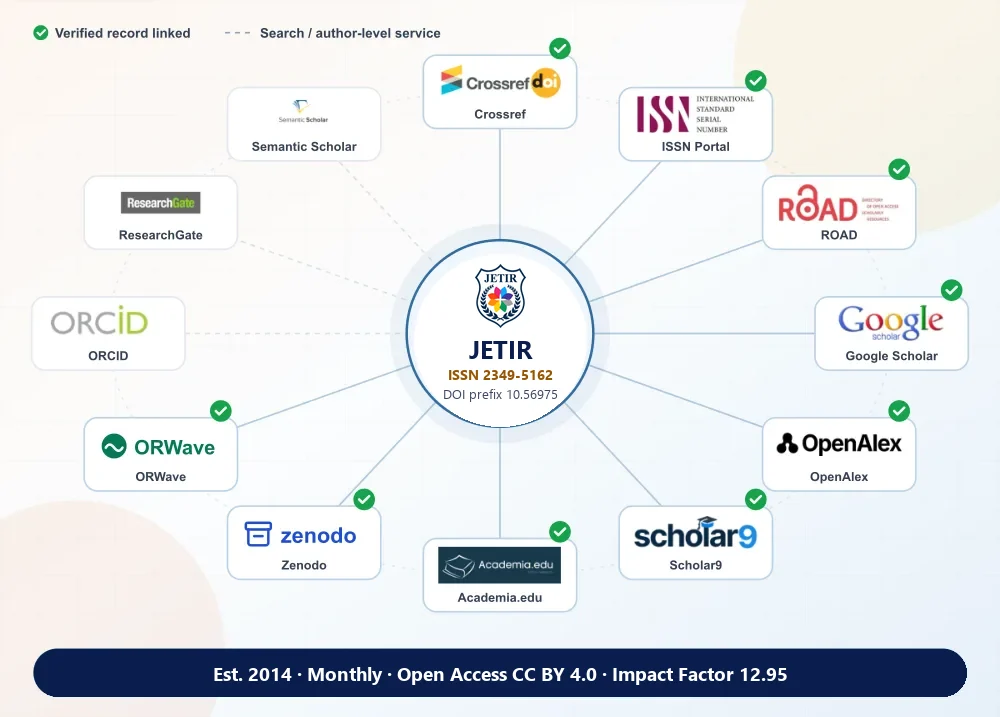
| Service | What it provides | Status / last verified |
|---|---|---|
| Crossref | DOI registration and citation linking | Verified 2,249 DOIs · 27 Nov 2026 |
| Google Scholar | Academic search visibility and citation counts | Verified journal profile · 27 Nov 2026 |
| OpenAlex | Open catalogue of works and citations | Verified 25,747 works · 27 Nov 2026 |
| ISSN Portal / ROAD | Serial registration and open access directory | Verified · 27 Nov 2026 |
| Zenodo | Open repository (CERN) for archived records | Search records searchable · 27 Nov 2026 |
| Scholar9 | Transparent peer-review registry | Verified · 27 Nov 2026 |
| ORWave | Open-access discovery platform | Verified · 27 Nov 2026 |
| Scopus, Web of Science, DOAJ | Selective indexes and directory | Not currently indexed — stated openly |
Kinds of Services
“Indexed” covers five quite different kinds of service. Each works differently and is joined in a different way — and the line at the foot of each card shows where JETIR stands.
How Content Reaches Them
No service “receives” an article by itself. Records reach them through a chain that starts with peer review and ends with a reader’s search — each link in it can be checked at its own website.
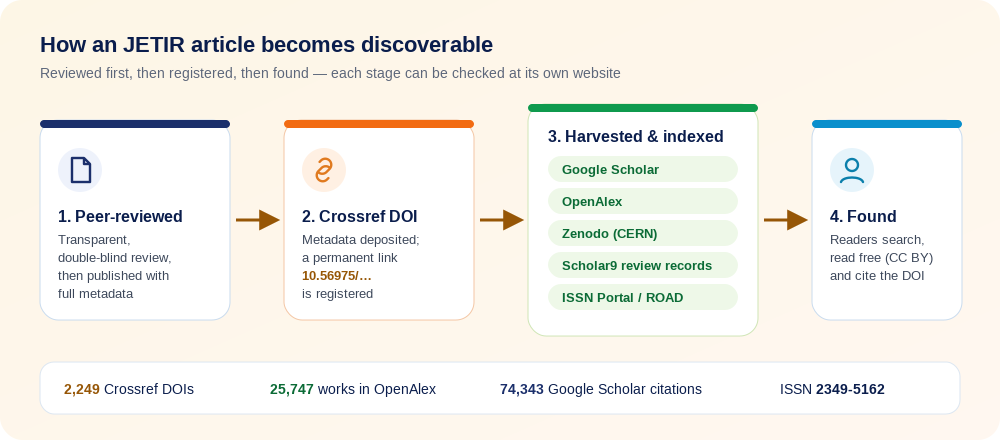
- PublishedAccepted, copy edited and placed in an issue with a stable URL
- Metadata preparedTitle, authors, affiliations, abstract, keywords, ISSN, volume, issue, pages, date
- DOI depositedThe record goes to the registration agency, which mints the DOI
- Crawled & harvestedSearch engines crawl the page; harvesters collect records over standard protocols
- ListedEach service adds the record on its own schedule — often weeks later
Reviewed Before It Is Indexed
Indexing services list what a journal publishes; they do not review it. That is why the review has to happen first. Every JETIR research article goes through transparent, double-blind peer review before it is published, registered or harvested.
Double-blind
Reviewers do not see who wrote the paper, and authors do not see who reviewed it.
- Similarity checked first (below 15%)
- Reviewed by subject experts
- Decision sent by email & SMS
Transparent
The review is recorded, so anyone can check that it really took place.
- Review record on Scholar9
- Public reviewer list
- Formal report on request
The review record on Scholar9 is itself one of the services listed above — so the evidence that an indexed JETIR article was reviewed sits in a public registry, not only on the journal’s own site. The full workflow is on the Peer Review Process page.
Metadata That Makes It Work
Discoverability depends almost entirely on the accuracy of what is deposited:
Errors in author names or affiliations are the most common reason an article fails to attach to the right researcher profile. Check these carefully at the camera-ready stage.
Verifying a Coverage Claim
Four steps, a few minutes each, settle any coverage claim — for JETIR or any other journal:
- Go to the sourceThe service’s own website — not a logo or badge on a journal page
- Search two waysBy ISSN 2349-5162 as well as by the journal title
- Look for articlesActual article records, not merely a journal title entry
- Note the dateCoverage can start and stop, so record when you checked
The dated, service-by-service results of these checks for JETIR — including the services it is not in — are on Indexing Verification.
Improving Your Own Discoverability
Indexing services can only work with what you give them. Five habits make the biggest difference:
Frequently Asked Questions
How soon after publication will my article appear in a database?
It varies by service. DOI registration is quick; search engines and aggregators pick records up on their own crawl schedules, which can take several weeks.
Does indexing mean the journal is UGC CARE listed?
No. They are separate assessments with separate criteria. See UGC CARE / UGC Approved Status.
My article is not showing up in a search. What should I do?
Confirm the article page and DOI resolve correctly, then write to editor@jetir.org with your paper ID so the deposited metadata can be checked for errors.
Where is JETIR indexed?
Records for JETIR (ISSN 2349-5162) are verified at Crossref, Google Scholar, OpenAlex, the ISSN Portal / ROAD, Zenodo, Scholar9 and ORWave, each linked from the coverage table above and dated on Indexing Verification.
Is JETIR indexed in Scopus, Web of Science or DOAJ?
No, and the journal says so openly. These are selective services joined only by application and evaluation; JETIR does not claim coverage in them.
Are JETIR articles peer reviewed before they are indexed?
Yes. Every research article goes through transparent, double-blind peer review before publication. Indexing services then list the published article; they do not review it themselves. The review is recorded on Scholar9, and the formal Transparent Peer Review Report is available on request.
Certificates · ORWave
ORWave evaluation: impact factor certificate and peer-review recognition
JETIR holds four documents issued by ORWave – Open Access Repository (JETIR is journal no. 3 on ORWave): an impact factor certificate, a recognition letter, a peer-review certificate and a letter of appreciation. Each opens on ORWave.
Certificate of Impact Factor (OR-F)
ORWave’s impact factor evaluation of JETIR
View on ORWave ↗Recognition Letter
ORWave’s recognition of JETIR as a journal on its platform
View on ORWave ↗Certificate of Peer-Reviewed Journal
Recognition of JETIR’s documented peer-review process
View on ORWave ↗Letter of Appreciation
Includes ORWave’s checklist against UGC’s suggestive parameters
View on ORWave ↗How to read these. An ORWave evaluation score is ORWave’s own assessment. It is separate from JETIR’s 12.95 impact factor and is not a Clarivate Journal Impact Factor. The UGC checklist inside the letter is ORWave’s assessment against UGC’s suggestive parameters for peer-reviewed journals, not a listing by UGC. ORWave (orwave.org) is one of the platforms of the Journey & Wisdom Publications network.
Checked at the source
Live Figures You Can Verify
Each number links to the service that publishes it. Figures read on 27 Nov 2026; they change as the services update.
One click each
Verify JETIR Yourself
Verified links open the journal’s own record or a search result for it at the service. Search links open a general search on a sharing platform.

Crossref Search Verified
Every deposited JETIR article with its DOI and metadata.
Google Scholar Verified
The journal’s citation profile — citations, h-index and i10-index.



OpenAlex Verified
Open catalogue of scholarly works — the journal’s source record and its works.
Google Search Verified
Pages indexed from jetir.org, and results for the journal’s full name.
ROAD / ISSN Verified
The ISSN record for 2349-5162 in the ISSN International Centre’s directory.

ResearchGate Search
Research network where authors share JETIR papers — search it for the journal name.
Indexing & discovery
Indexing
Where the journal or its articles are formally listed or registered.
Crossref Verified
DOI registration agency — metadata for every DOI-registered paper is deposited here.
DOI prefix 10.56975 Verified
A permanent Digital Object Identifier on request, so a paper stays citable.
ISSN Portal Verified
The journal’s serial registration — ISSN 2349-5162, held with the ISSN International Centre.

ORCID Registry
Author identifier registry — links each author’s record to their published work.

Publons / ResearcherID Registry
Reviewer and researcher registry (now Web of Science reviewer recognition), used for peer-review activity.
Scholar9 Verified
Transparent peer-review registry — where the journal’s review certificate is recorded.
Discovery
Where researchers can discover, search, read, save or share published articles.
Google Scholar Verified
Search and citation tracking — JETIR’s profile with its citations, h-index and i10-index.
OpenAlex Verified
Open index of works, authors and citations — the successor to Microsoft Academic’s data.
ORWave Verified
Open Research Wave — open-access journal and research discovery platform.
Academia.edu Verified
Academic sharing platform with reader analytics for each uploaded paper.

Semantic Scholar Search
AI-powered search that surfaces papers by meaning, citation and influence.
ResearchGate Search
Research network where authors share papers and readers follow their work.


SSRN Search
Elsevier’s preprint and working-paper network (a repository, not a journal index).
Microsoft Academic, listed on older pages, was retired by Microsoft at the end of 2021; its data lives on in OpenAlex, shown above.
Ready to publish?
Publish With a Journal You Can Verify
Transparent, double-blind peer review, similarity screening, Crossref DOIs on request under 10.56975, open access under CC BY 4.0 and alignment with UGC’s Suggested Parameters — with a fee of ₹1501 (Indian authors) or $59 (foreign authors), charged only after acceptance.