Is JETIR UGC CARE approved in 2026?
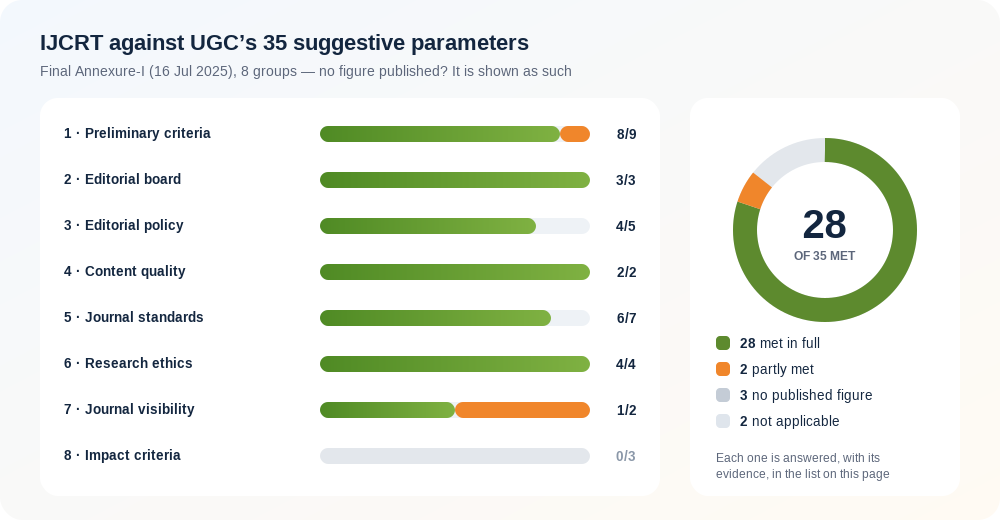
No journal is on a UGC-CARE list in 2026, because UGC discontinued CARE listing — decided at the 584th Commission meeting on 3 October 2024, published on 11 February 2025 and confirmed on 16 July 2025. JETIR is a Transparent, Peer-Reviewed, Open Access Journal (Refereed Journal) aligned with UGC’s Suggested Parameters for Choosing Peer-Reviewed Journals, and this page answers all 35 of them.
What is JETIR’s UGC Approved Journal Number?
JETIR is UGC Approved Journal No. 63975 (2019): entry 63975 on the 2019 UGC Approved List of Journals, against ISSN 2349-5162. The UGC Approved list is no longer in use. In the May 2018 Standing Committee re-evaluation, 4,305 entries were removed from the approved list; UGC-CARE replaced the list in 2019 and was itself discontinued in 2025. JETIR is a Transparent, Peer-Reviewed, Open Access Journal (Refereed Journal) and is aligned with UGC’s Suggested Parameters for Choosing Peer-Reviewed Journals.
Which UGC parameters does JETIR not fully meet?
Three of the 35 carry no published figure: acceptance rate (3.5), self-citation score (8.1) and total citation rate (8.2). Two do not apply: print continuum (5.5 — the journal is online-first) and CiteScore (8.3, a Scopus metric). Two are partial: repository integration (1.8) and indexation in reputed databases (7.2). The other 28 are met.
Can I use a JETIR paper for promotion, API score or a PhD requirement?
That is your institution’s decision, and under the current framework it is meant to be. UGC asks higher education institutions to apply the suggestive parameters, if useful through internal committees. This page is laid out so a committee can check JETIR against each parameter directly.
How much does it cost to publish in JETIR?
The publication charge is ₹1501 for Indian authors and $59 USD for foreign authors. It is disclosed upfront and invoiced only after your paper has been accepted through peer review — never at submission.
Is JETIR indexed in Scopus or Web of Science?
No. JETIR is indexed in Google Scholar, registered with Crossref and ROAD (ISSN) and archived in Zenodo. It is not indexed in Scopus, Web of Science or DOAJ. If your institution requires Scopus or Web of Science, choose from the official lists — and always verify by ISSN.
How do I get my transparent peer review report?
Review runs through Scholar9.com. The transparent peer review report is available on request. You can see a sample report.
How do I submit my paper to JETIR?
Submit online at jetir.org/submitpaper.php, or email your manuscript to editor@jetir.org. For help, call or WhatsApp +91 94260 33211.
What evidence can I show my institution about JETIR?
The evidence pack on this page links to records held outside the journal: the ISSN Portal record, the UGC public notice, the Google Scholar profile (74,343 citations), the Crossref record (2,249 DOIs), the Scholar9 review record, the editorial board, the plagiarism policy and the published charges, alongside JETIR’s answer to each of the 35 parameters.
Can I publish my paper in Hindi or another Indian language?
Yes. JETIR accepts papers in English, in all Indian (local) languages and in foreign languages. Before submission, confirm with the editorial office that a language editor and reviewers are available for your language, and send the font details and font file.