
What an Impact Factor Is
An impact factor is a citation-based average: it estimates how often a typical article in a journal is cited over a defined window. It describes a journal, not any individual paper, and it is only meaningful when the source of the citation data and the years counted are stated alongside it.
The measure was originally devised to help librarians decide which journals to subscribe to, not to evaluate individual researchers. It has since been pressed into service for hiring, promotion and funding decisions, which is why understanding its construction matters: a number quoted without its source and window cannot be checked, and a number that cannot be checked should not carry weight in a career decision.
What it tells you
- How often a typical article in the journal is cited
- Whether the journal’s work is being read and used
- How that use changes from year to year
- Something you can recompute from the stated source
What it does not tell you
- How good, or how often cited, any single paper is
- Whether a journal is indexed or UGC CARE listed
- Anything at all, if its source and window are missing
- How journals in different fields compare
JETIR Impact Factor
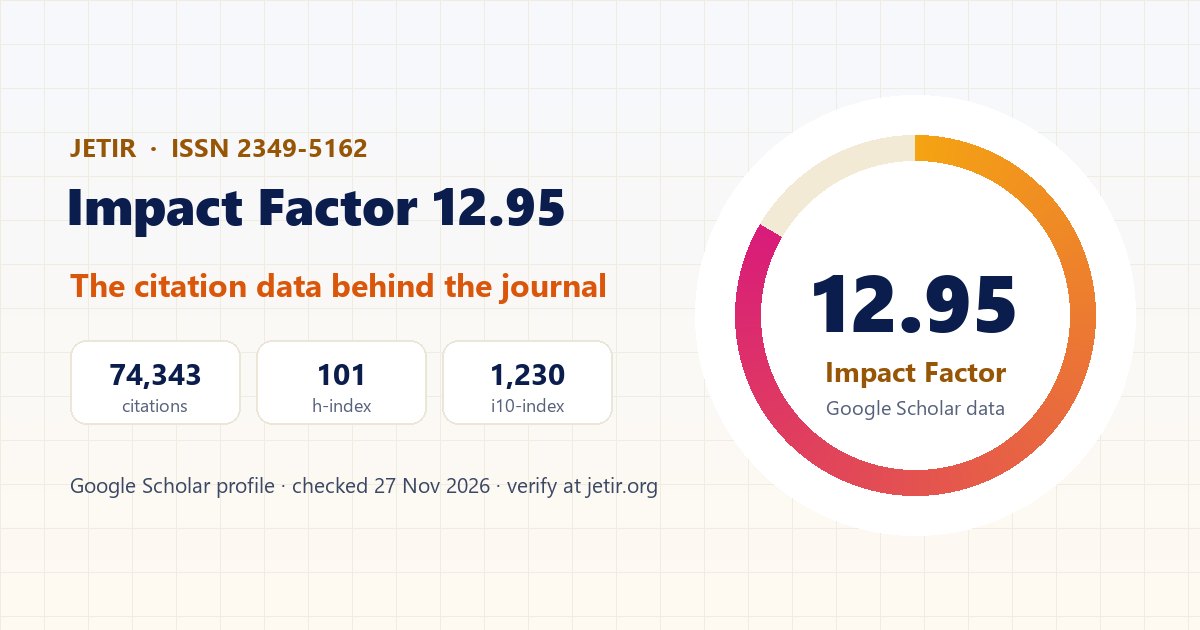
| Journal | Journal of Emerging Technologies and Innovative Research (JETIR) |
|---|---|
| ISSN | 2349-5162 |
| Impact factor | 12.95 |
| Citation data source | The journal’s Google Scholar profile, with Semantic Scholar used alongside |
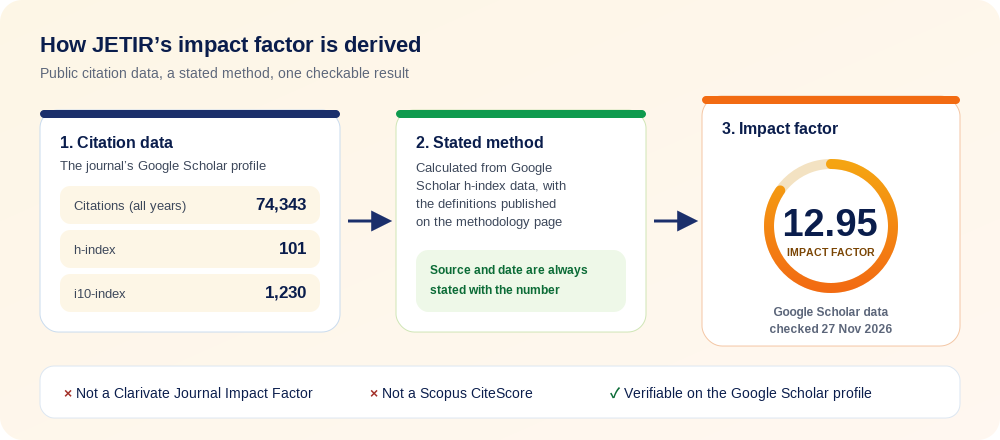
| Method | Calculated from Google Scholar h-index data — definitions on the Impact Factor methodology page |
| Supporting figures | 74,343 citations · h-index 101 · i10-index 1,230 (all years); 35,701 citations since 2021 |
| What it is not | Not a Clarivate Journal Impact Factor and not a Scopus CiteScore — JETIR is not in Web of Science or Scopus |
| Last reviewed | 27 Nov 2026 |
How the 12.95 is derived
The figure is built in three visible steps: public citation data, a published method, and one result that anyone can check against the source. Nothing in the chain depends on a database the reader cannot open.
A decade of citation growth
The yearly totals on the Google Scholar profile (chart below) show how use of JETIR articles has grown:
Citations
Impact Factor and Citation Metrics
JETIR’s Impact Factor of 12.95 is calculated from the journal’s Google Scholar citation data (h-index based). The figures below come from JETIR’s Google Scholar profile and its OpenAlex record, which anyone can open. It is not a Clarivate Journal Impact Factor.
Google Scholar profile: 74,343 citations, h-index 101, i10-index 1,230 (all years). OpenAlex record: 14,300 citations, h-index 28, 25,747 works. Read on 27 Nov 2026.
Open the Google Scholar profile ↗ · OpenAlex record ↗ · Impact Factor Details →
| Google Scholar | All years | Since 2021 |
|---|---|---|
| Citations | 74,343 | 35,701 |
| h-index | 101 | 72 |
| i10-index | 1,230 | 845 |
Citations per year on JETIR’s Google Scholar profile, read on 27 Nov 2026. *2026 is a partial year.
How It Is Calculated
The standard two-year calculation is:
Because both terms depend on the window chosen and on which database supplies the citations, two correctly calculated figures for the same journal can differ. That is why the source and window must always be published with the number.
A worked example
Suppose a journal published 200 citable articles across the two years before the calculation year, and those articles attracted 460 citations during the calculation year. The impact factor is 460 ÷ 200 = 2.30. Changing the window to three years, or counting citations from a different database, would produce a different — and equally "correct" — number for the same journal.
What counts as a citable article
Research papers, review articles and short communications are normally counted in the denominator. Editorials, notices and correspondence usually are not, though citations to them may still be counted in the numerator by some databases. This asymmetry is one reason figures drift between sources, and a further reason to state the method alongside the result.
Citation Data Sources
Different services count citations differently, and a journal may appear with different values in each:
How to Verify It Yourself
- Open the sourceSearch the journal name or ISSN 2349-5162 in the citation source named above
- Count articlesPublished by the journal in the two years before the calculation year
- Count citationsReceived by those articles during the calculation year
- Divide & compareCitations ÷ articles, against the published figure
If you cannot reproduce a published figure from the stated source, write to editor@jetir.org and ask for the underlying counts.
Other Metrics That Matter
Citing the Figure Correctly
When quoting the journal's impact factor in a CV, funding application or institutional report, give the value, the year and the source together, for example: "Impact factor [value] ([year]), calculated from [source] citation data." Never present a journal-level metric as a measure of an individual article's quality.
Published in Journal of Emerging Technologies and Innovative Research (ISSN 2349-5162); journal impact factor 12.95, calculated from Google Scholar citation data (checked 27 Nov 2026).
Do
- Give the value, the source and the date together
- Link the Google Scholar profile so readers can check it
- Quote your own article’s citations alongside it
Avoid
- Calling it a Clarivate, Web of Science or “Thomson Reuters” impact factor
- Quoting the number with no source or year
- Using it as a score for your individual paper
Limitations and Honest Use
Impact factors are averages over skewed distributions: a small number of heavily cited papers can lift a journal's figure well above what a typical article receives. They also vary systematically by discipline, since citation habits differ between fields, and they say nothing about the rigour of any particular paper.
Frequently Asked Questions
Does a higher impact factor mean my paper will be cited more?
No. The figure is an average across a journal. Citations to your article depend on its subject, quality, visibility and the citing habits of your field.
Why do different websites list different impact factors for the same journal?
Because they use different citation databases and different year windows. A figure is only interpretable when its source and window are stated.
Is an impact factor the same as being indexed or UGC CARE listed?
No, these are separate things. See Indexing & Abstracting and UGC CARE / UGC Approved Status.
What is the impact factor of JETIR?
12.95, calculated from the journal’s Google Scholar citation data (74,343 citations, h-index 101, i10-index 1,230), last checked on 27 Nov 2026.
Is JETIR’s 12.95 a Clarivate Journal Impact Factor?
No. JETIR is not in Web of Science, so it has no Clarivate Journal Impact Factor, and it is not in Scopus, so it has no CiteScore. The 12.95 is calculated from Google Scholar data, and the page says so wherever the number appears.
How can I verify JETIR’s citation figures?
Open the journal’s Google Scholar profile: citations, h-index and i10-index are shown there for all years and since 2021. The method is set out on the Impact Factor methodology page.
Know which number is quoted
The Metrics, and What Each One Measures
“Impact factor” is used loosely for several different numbers. Knowing which one is quoted matters more than the figure itself.
| Metric | What it measures | Published by | JETIR |
|---|---|---|---|
| Impact Factor (this page) | Citation-based journal metric calculated from Google Scholar data | JETIR, from Google Scholar data | 12.95 |
| h-index | The number h where h papers are each cited at least h times | Google Scholar profile | 96 |
| i10-index | Papers with at least 10 citations | Google Scholar profile | 1,230 |
| Journal Impact Factor (JIF) | Two-year citation average for Web of Science journals | Clarivate (Journal Citation Reports) | None not in Web of Science |
| CiteScore | Four-year citation average | Scopus | None not Scopus-indexed |
| SJR | Citations weighted by the standing of the citing journal | SCImago (Scopus data) | None not Scopus-indexed |
| Citation count | How often one specific paper is cited — the only one describing your work | Google Scholar, Crossref, OpenAlex | Per article |
Checked at the source
Live Figures You Can Verify
Each number links to the service that publishes it. Figures read on 27 Nov 2026; they change as the services update.
Ready to publish?
Publish With a Journal You Can Verify
Transparent, double-blind peer review, similarity screening, Crossref DOIs on request under 10.56975, open access under CC BY 4.0 and alignment with UGC’s Suggested Parameters — with a fee of ₹1501 (Indian authors) or $59 (foreign authors), charged only after acceptance.