
Current Status — Answered Directly
UGC and UGC-CARE approval, along with alignment with the latest UGC-CARE recommendations and guidelines. JETIR is aligned with UGC's Suggested Parameters for Choosing Peer-Reviewed Journals.
JETIR is a Transparent, Peer-Reviewed, Open Access Journal (Refereed Journal). Following the discontinuation of UGC and UGC-CARE journal listing, JETIR is aligned with UGC's Suggested Parameters for Choosing Peer-Reviewed Journals.
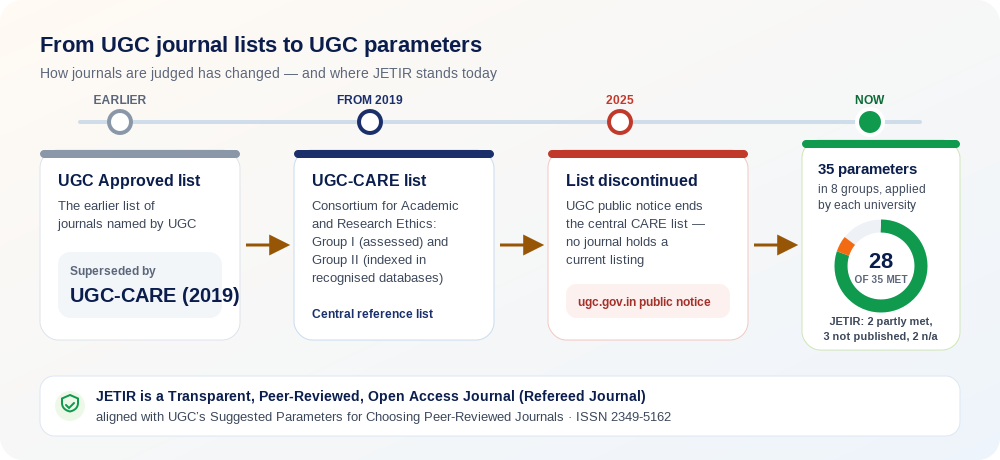
The UGC CARE list was discontinued in 2025, so universities now assess journals against UGC’s suggestive parameters — JETIR’s status against each one is set out below. Submit your paperSee the 35 parametersRead the primary source, not our summary
UGC Public Notice on CARE Journals
This is the official University Grants Commission notice confirming the position. We link it rather than paraphrase it, so you can verify it yourself — which is exactly what you should do with any journal's claims, including ours.
How the position changed — at a glance
Journals in India were first judged against a central UGC list, then against the UGC-CARE list. That list has now been discontinued, and each university applies UGC’s suggestive parameters itself. The timeline below shows each stage and where JETIR stands today.
Why this makes the claim stronger, not weaker
A journal advertising a listing that no longer exists is telling you it has not checked. A journal that states the position accurately, names the source and shows its working gives you something you can actually verify. That is the difference between a badge and evidence — and it is why this page states the position plainly before it tells you what JETIR does claim.
Everything below sets each UGC CARE / UGC Approved recommendation against what JETIR actually does, with a link to where you can confirm it. Nothing here asks you to take the journal's word for anything.
| Journal | Journal of Emerging Technologies and Innovative Research (JETIR) |
|---|---|
| ISSN | 2349-5162 |
| Established | 2014 — continuous monthly publication since |
| Publisher | JETIR Publication, Ahmedabad, Gujarat, India |
| UGC Approved Journal No. | 63975 (2019) — the journal’s number on the earlier UGC Approved list |
| Journal type | Transparent Peer-Reviewed Open Access Journal (Refereed Journal) |
| UGC CARE / UGC Approved list | Discontinued in 2025 — no journal holds a current listing |
| What applies now | UGC suggestive parameters, applied by each university |
| JETIR position | Aligns with UGC and UGC CARE recommendations; follows the UGC CARE guidelines |
| Official source | UGC Public Notice on CARE Journals (PDF) |
| Selective index coverage | Not currently indexed in Scopus, Web of Science or DOAJ — stated openly |
What UGC CARE Is
UGC CARE (Consortium for Academic and Research Ethics) was an initiative of the University Grants Commission in India to maintain a reference list of journals considered acceptable for academic assessment purposes, and to discourage publication in journals with weak or absent editorial standards.
The older phrase "peer-reviewed journal" refers to an earlier list that was discontinued and replaced by the CARE approach. Listings are reviewed periodically, and a journal's presence on any list can change over time — which is why a date-stamped verification matters more than a badge.
How the List Was Organised (Historical)
Membership of either group was determined by the Commission rather than by the journal. Since the list was discontinued in 2025, no journal holds a current listing in either group, and universities now apply the UGC suggestive parameters instead.
Assessment Criteria
Assessments of this kind typically examine eight things. Each card below is one question an assessor asks of a journal:
How JETIR Aligns
Independently of any listing decision, the journal maintains the practices such criteria look for:
Following the UGC CARE Guidelines
JETIR is a Transparent Peer-Reviewed Open Access Journal (Refereed Journal), operated in alignment with UGC and UGC CARE recommendations for peer-reviewed journals.
The University Grants Commission has published its position on CARE journals as a public notice. Rather than paraphrasing it, the primary document is linked here so you can read the source directly:
Read the official UGC public notice (PDF)
How the journal aligns with each recommendation
| UGC CARE recommendation | How JETIR applies it | Where to verify |
|---|---|---|
| Registered ISSN | ISSN 2349-5162, in continuous use since 2014 | Official ISSN register |
| Transparent peer review | Transparent, double-blind review by subject experts, with the full workflow published and the review recorded on Scholar9 | Peer Review Process |
| Refereed journal status | Every research submission is refereed before any decision to publish | Peer Review Process |
| Identifiable editorial board | Board members handle submissions within their expertise and declare conflicts | Journal Transparency |
| Published ethics policies | Ethics, plagiarism, authorship, corrections and retractions all documented | Journal Policies |
| Plagiarism screening | Every manuscript screened for similarity before review | Plagiarism Policy |
| Transparent charges | ₹1501 INR / $59 USD, published before submission, payable only after acceptance | Publication Charges |
| Open access | Free to read, CC BY 4.0, no paywall and no embargo | Open Access Policy |
| Regular publication | Monthly schedule maintained since 2014 | Journal archive |
| Accurate metadata and identifiers | Crossref DOI registered for published articles, with complete metadata | Crossref DOI |
| No misleading claims | Indexing stated honestly, including databases the journal is not in | Indexing Verification |
UGC & UGC-CARE
UGC’s New Recommendations: Where JETIR Stands
JETIR is a Transparent, Peer-Reviewed, Open Access Journal (Refereed Journal). Following the discontinuation of UGC and UGC-CARE journal listing, JETIR is aligned with UGC's Suggested Parameters for Choosing Peer-Reviewed Journals.
35 suggestive parameters in 8 groups
Annexure-I of UGC’s notice. JETIR reports 28 met, 2 partly met, 3 not published and 2 not applicable — with the reason for each.
UGC circulars and notices
- Public Notice — CARE Journals (discontinuation) (PDF) ↗
- Final list of UGC-CARE journals (1,474, archived) (PDF) ↗
- Public Notice — CARE (PDF) ↗
- Public Notice — CARE, 14 January 2019 (PDF) ↗
Parameter-by-parameter evidence
Checked at the source
Live Figures You Can Verify
Each number links to the service that publishes it. Figures read on 27 Nov 2026; they change as the services update.
One click each
Verify JETIR Yourself
Verified links open the journal’s own record or a search result for it at the service. Search links open a general search on a sharing platform.

Crossref Search Verified
Every deposited JETIR article with its DOI and metadata.

Google Scholar Verified
The journal’s citation profile — citations, h-index and i10-index.



OpenAlex Verified
Open catalogue of scholarly works — the journal’s source record and its works.
Google Search Verified
Pages indexed from jetir.org, and results for the journal’s full name.

ROAD / ISSN Verified
The ISSN record for 2349-5162 in the ISSN International Centre’s directory.

ResearchGate Search
Research network where authors share JETIR papers — search it for the journal name.
Indexing & discovery
Indexing
Where the journal or its articles are formally listed or registered.
Crossref Verified
DOI registration agency — metadata for every DOI-registered paper is deposited here.
DOI prefix 10.56975 Verified
A permanent Digital Object Identifier on request, so a paper stays citable.

ISSN Portal Verified
The journal’s serial registration — ISSN 2349-5162, held with the ISSN International Centre.

ORCID Registry
Author identifier registry — links each author’s record to their published work.

Publons / ResearcherID Registry
Reviewer and researcher registry (now Web of Science reviewer recognition), used for peer-review activity.
Scholar9 Verified
Transparent peer-review registry — where the journal’s review certificate is recorded.
Discovery
Where researchers can discover, search, read, save or share published articles.
Google Scholar Verified
Search and citation tracking — JETIR’s profile with its citations, h-index and i10-index.
OpenAlex Verified
Open index of works, authors and citations — the successor to Microsoft Academic’s data.
ORWave Verified
Open Research Wave — open-access journal and research discovery platform.
Academia.edu Verified
Academic sharing platform with reader analytics for each uploaded paper.

Semantic Scholar Search
AI-powered search that surfaces papers by meaning, citation and influence.
ResearchGate Search
Research network where authors share papers and readers follow their work.



SSRN Search
Elsevier’s preprint and working-paper network (a repository, not a journal index).
Microsoft Academic, listed on older pages, was retired by Microsoft at the end of 2021; its data lives on in OpenAlex, shown above.
Originality
Plagiarism Detection: Turnitin & iThenticate
Every submission is screened for similarity before peer review, and the similarity report is available to the author on request. The accepted similarity threshold is below 15%.

Turnitin
Similarity check against published literature, web content and submitted work.

iThenticate
Turnitin’s service for publishers and researchers, with AI-writing detection available.
Licences & standards
Licences, Access and Recognition



ISSN Registered • Open Access • Transparent Peer Review • Creative Commons CC BY 4.0 • Ethics policies follow COPE guidance
JETIR is a Transparent, Peer-Reviewed, Open Access Journal (Refereed Journal). Following the discontinuation of UGC and UGC-CARE journal listing, JETIR is aligned with UGC's Suggested Parameters for Choosing Peer-Reviewed Journals. UGC public notice (PDF)
Citations
Impact Factor and Citation Metrics
JETIR’s Impact Factor of 12.95 is calculated from the journal’s Google Scholar citation data (h-index based). The figures below come from JETIR’s Google Scholar profile and its OpenAlex record, which anyone can open. It is not a Clarivate Journal Impact Factor.
Google Scholar profile: 74,343 citations, h-index 101, i10-index 1,230 (all years). OpenAlex record: 14,300 citations, h-index 28, 25,747 works. Read on 27 Nov 2026.
Open the Google Scholar profile ↗ · OpenAlex record ↗ · Impact Factor Details →
| Google Scholar | All years | Since 2021 |
|---|---|---|
| Citations | 74,343 | 35,701 |
| h-index | 101 | 72 |
| i10-index | 1,230 | 845 |
Citations per year on JETIR’s Google Scholar profile, read on 27 Nov 2026. *2026 is a partial year.
About the journal
Journal of Emerging Technologies and Innovative Research (JETIR) at a Glance
- Journal
- Journal of Emerging Technologies and Innovative Research About
- ISSN (online)
- 2349-5162 Verify
- Established
- 2014
- Frequency
- Monthly Current issue
- Publisher
- JETIR Publication
- Impact Factor
- 12.95 Details
- DOI
- Crossref, prefix 10.56975 DOI
- Review
- Double-blind, transparent records Policy
- Access & licence
- Open access, CC BY 4.0 Policy
- Subjects
- Multidisciplinary Research areas
- Editorial board
- Named editors View board
- Reviewers
- Public list Reviewer list Join
- editor@jetir.org Contact
- Phone / WhatsApp
- +91 94260 33211 Support
| Charge | Indian authors | Foreign authors |
|---|---|---|
| Publication fee (after acceptance) Details | ₹1501 | $59 |
| Crossref DOI (optional, on request) Add | ₹300 | $20 |
| Hard copy of certificate (optional) | ₹500 | $100 |
| Bundle: journal hard copy + certificate + DOI | ₹1100 | $170 |
| Transparent peer-review report (on request) | ₹700 | $20 |
Pay online: publication charges · pay fees online · payment options · payment terms
How to Verify a Journal Now
Five checks, in this order, give a dated answer you can rely on — for JETIR or any other journal:
- Read the UGC noticeThe official source linked at the top of this page — not mirrors, circulated PDFs or badges
- Search title and ISSNTitles are often imitated; the ISSN is the reliable key
- Match the publisherThe publisher and website in the ISSN record should match the site you are on
- Check the parametersPeer review, ethics, charges, identifiers, indexing — and note the date
- Ask your institutionIts own approved list, if any, governs how your paper is credited
What This Means for Authors
If your promotion, API score or thesis requirement depends on publishing in a listed journal, verify the status yourself at the official source before you submit, and keep a dated record of what you saw. Ask your institution which list it recognises, since institutional requirements vary and are the ones that will be applied to you.
Cloned and Predatory Journals
Cloned journals copy a legitimate title, ISSN and even site design to collect fees from authors. Protect yourself:
Safe habits
- Reach the journal by typing the official domain, jetir.org, rather than following a link in an unsolicited email
- Confirm that the ISSN on the site (2349-5162) matches the official record for that title
- Pay only after acceptance, through the channels on the journal’s own site
Warning signs
- Guaranteed acceptance or same-day publication promises
- Fees demanded before any review
- Metric badges that cannot be verified — treat them as decoration, not evidence
Certificates · ORWave
ORWave’s UGC parameters checklist and peer-review certificates
ORWave’s letter of appreciation includes an annexure checking JETIR against the 35 UGC suggestive parameters for peer-reviewed journals (15 fulfilled, 0 not fulfilled, 20 not verified). It is shown here with the peer-review and impact factor certificates.
JETIR holds four documents issued by ORWave – Open Access Repository (JETIR is journal no. 3 on ORWave): an impact factor certificate, a recognition letter, a peer-review certificate and a letter of appreciation. Each opens on ORWave.
Certificate of Impact Factor (OR-F)
ORWave’s impact factor evaluation of JETIR
View on ORWave ↗Recognition Letter
ORWave’s recognition of JETIR as a journal on its platform
View on ORWave ↗Certificate of Peer-Reviewed Journal
Recognition of JETIR’s documented peer-review process
View on ORWave ↗Letter of Appreciation
Includes ORWave’s checklist against UGC’s suggestive parameters
View on ORWave ↗How to read these. An ORWave evaluation score is ORWave’s own assessment. It is separate from JETIR’s 12.95 impact factor and is not a Clarivate Journal Impact Factor. The UGC checklist inside the letter is ORWave’s assessment against UGC’s suggestive parameters for peer-reviewed journals, not a listing by UGC. ORWave (orwave.org) is one of the platforms of the Journey & Wisdom Publications network.
Frequently Asked Questions
Is JETIR UGC approved?
UGC and UGC-CARE approval, along with alignment with the latest UGC-CARE recommendations and guidelines. JETIR is aligned with UGC's Suggested Parameters for Choosing Peer-Reviewed Journals. Its number on the earlier UGC Approved list is 63975 (2019).
Is "UGC CARE / UGC Approved" still a valid term?
The phrase is still widely used, but the central UGC-CARE list itself was discontinued in 2025. Universities now assess journals against UGC’s suggestive parameters, so a journal’s position should be checked against those parameters and the official UGC notice.
What are the UGC suggestive parameters, and how does JETIR meet them?
They are 35 parameters in 8 groups, published as Annexure-I of UGC’s notice, covering preliminary journal criteria, editorial board, editorial policy, content quality, journal standards, research ethics, visibility and impact. JETIR reports 28 met, 2 partly met, 3 not published and 2 not applicable, with the reason for each — see UGC’s New Recommendations.
Will my university accept a paper published in JETIR?
That is decided by your university under its own rules, applying the UGC suggestive parameters. Ask your research office in writing before you submit, and keep the reply.
Can a journal's status change after my paper is published?
Yes. Lists are reviewed periodically. Your published article remains published, but how an institution credits it depends on that institution's rules, so keep dated evidence of the status at the time of publication.
Does indexing automatically mean UGC CARE listing?
No. Indexing and CARE listing are separate processes with separate criteria. See Indexing & Abstracting.
Ready to publish?
Publish With a Journal You Can Verify
Transparent, double-blind peer review, similarity screening, Crossref DOIs on request under 10.56975, open access under CC BY 4.0 and alignment with UGC’s Suggested Parameters — with a fee of ₹1501 (Indian authors) or $59 (foreign authors), charged only after acceptance.