
Impact factor
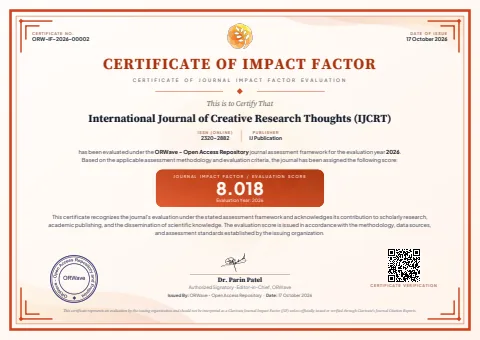
Certificate of Impact Factor
8.018ORWave evaluation score · 2026
Peer Review, Refereed, Indexed, Multidisciplinary, Multilanguage, UGC CARE Approved, Open Access Journal ★ ISSN 2349-5162 ESTD 2014 Call for Paper All Policy Track Journal List WhatsApp Email
Journals increasingly show certificates for impact factors, peer review and indexing. Some are informative; some are decoration. This guide gives you a seven-step method to read any of them properly, and works through it using the three documents ORWave – Open Access Repository issued to IJCRT in October 2026.
A certificate is a claim made by an issuer about a journal at a point in time. Its value depends entirely on who issued it, what it says it measured and when. A certificate that is seen but not read can mislead in both directions: an impressive-looking document can say very little, and a plain one can say exactly what you need.
The method below takes a couple of minutes per certificate and needs nothing more than the document and the journal’s website.
Ask for, or download, the PDF rather than relying on a cropped image on a home page.
Title, abbreviation, ISSN and publisher must match the journal’s website and the ISSN portal exactly.
Who issued it, who signed it, and can you find the issuer’s own website?
A score or status belongs to a year. A certificate with no year cannot tell you anything current.
“Evaluation score”, “peer-review status” and “indexed” are different claims. Note the exact words.
A certificate number, QR code or verification page lets you confirm the document is genuine.
A responsible issuer states the limits of its certificate. Its absence is itself information.
| Step | Impact factor certificate | Peer-review certificate | Letter of appreciation |
|---|---|---|---|
| 1. Original | All three published as PDFs on jetir.org | ||
| 2. Identity | International Journal of Creative Research Thoughts (JETIR) · ISSN 2349-5162 · IJ Publication | ||
| 3. Issuer | ORWave – Open Access Repository · signed by Dr. Parin Patel, Editor-in-Chief, ORWave | ||
| 4. Date | 17 Oct 2026 · year 2026 | 21 Oct 2026 · period 2026 | 21 Oct 2026 · period 2026 |
| 5. Claim | Evaluation score 8.018 | Peer-reviewed scholarly journal; double-blind | Peer-review status recognised; UGC parameters checklist |
| 6. Verification | ORW-IF-2026-00002 · QR | ORW-PR-2026-00002 · QR | ORW-LA-2026-00002 · QR |
| 7. Limits | Not a Clarivate JIF | Does not establish indexing, citation impact or accreditation | No accreditation by a regulatory or indexing authority; checklist is not a UGC listing |
Certificates · ORWave · 2026
Open each document in the viewer and check it against the table above: identity, issuer, date, claim, certificate number and small print.
8.018ORWave evaluation score · 2026
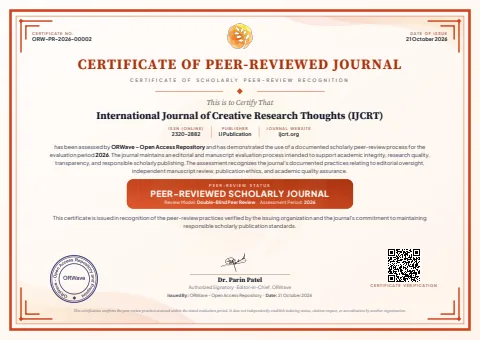
Peer-reviewedDouble-blind review · assessment period 2026
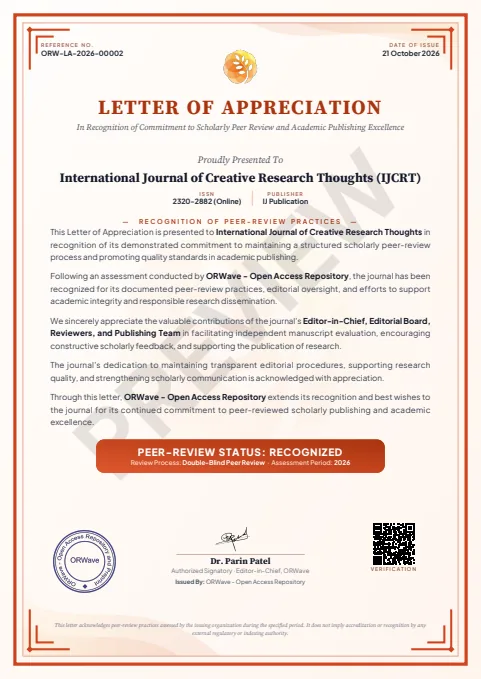
RecognizedPeer-review status · with a 35-point UGC parameters checklist
How to read these. 8.018 is ORWave’s own evaluation score for 2026. It is separate from the 9.17 impact factor IJCRT calculates from Google Scholar data, and, as the certificate itself says, it is not a Clarivate Journal Impact Factor. The peer-review certificate and the letter cover the 2026 assessment period. The UGC checklist inside the letter is ORWave’s assessment against UGC’s suggestive parameters for peer-reviewed journals, not a listing by UGC. ORWave (orwave.org) is one of the platforms of the Journey & Wisdom Publications network.
| Red flag | What it suggests |
|---|---|
| ISSN on the certificate differs from the journal’s | A cloned journal or a certificate borrowed from another title |
| No issuer website, or an issuer that only exists on the certificate | Nothing stands behind the claim |
| No year, or a score with no year | The figure cannot be current or comparable |
| Claims approval by a body that does not issue certificates | A misleading use of a regulator’s name |
| Impact factor with no statement of who calculated it | A number with no meaning attached |
| Only a low-resolution image, never the document | The details cannot be checked |
Submit to a journal that publishes its certificates as originals you can check.
₹1501 Indian authors · $59 foreign authors · payable only after acceptanceCertificates are one input. Before submitting anywhere, also check:
Read certificates like any other evidence: get the original, match the identity, know the issuer and year, note the exact claim, find the verification route and read the limits. JETIR’s three ORWave documents are published in full so you can do exactly that — and the same seven steps will serve you for every journal you consider.
These answers are also published as FAQ structured data for search engines.
That the journal identity matches exactly: full title, abbreviation and ISSN. An ISSN that differs from the one on the journal’s website is the clearest sign of a cloned or misused certificate.
Prefer the original PDF. IJCRT publishes its ORWave documents as downloadable PDFs with certificate numbers, so they can be checked line by line.
Only if it is issued through Clarivate’s Journal Citation Reports. ORWave’s certificate for IJCRT says explicitly that its score is not a Clarivate JIF.
No issuer you can find, no date or year, no certificate number, wording that claims approval by a body that does not issue certificates, or a score with no statement of what it measures.
No. Use them together with the journal’s policies, published papers, editorial board and the databases it claims.
₹1501 for Indian authors or $59 for foreign authors, only after acceptance. Submission is free.
Still deciding? Read the author guidelines and the publication charges, then submit when your manuscript is ready.
₹1501 Indian authors · $59 foreign authors · payable only after acceptancePeer-reviewed, open access, ISSN 2349-5162. Free to submit; the fee of ₹1501 (Indian authors) or $59 (foreign authors) applies only after acceptance.
Questions? editor@jetir.org · WhatsApp +91 94260 33211



















