
Impact factor
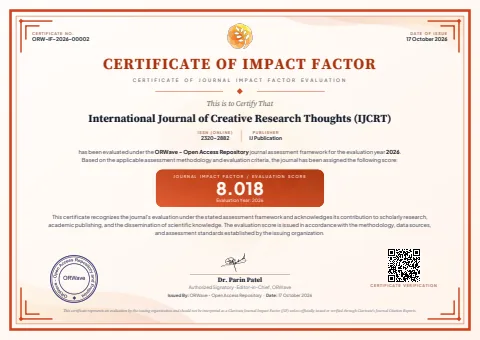
Certificate of Impact Factor
8.018ORWave evaluation score · 2026
Peer Review, Refereed, Indexed, Multidisciplinary, Multilanguage, UGC CARE Approved, Open Access Journal ★ ISSN 2349-5162 ESTD 2014 Call for Paper All Policy Track Journal List WhatsApp Email
Which approval answers which question, and which document to attach — so the committee reading your file can confirm each one in a click. Journal of Emerging Technologies and Innovative Research, ISSN 2349-5162.
For years, Indian committees asked one question: is the journal on the UGC list? JETIR was listed as UGC Approved Journal No. 63975 (2019). UGC then moved to the CARE reference list, and on 3 October 2024 decided to discontinue that list too. In its place UGC issued suggestive parameters — 36 of them in 8 groups — that institutions and researchers use to judge a peer-reviewed journal themselves.
So the question your file must now answer is different: does the journal show the evidence? The sections below map each question a panel is likely to ask to the credential that answers it and the document that proves it.
JETIR is a Transparent, Peer-Reviewed, Open Access Journal (Refereed Journal). Following the discontinuation of UGC and UGC-CARE journal listing alignment with the latest UGC-CARE recommendations and guidelines, JETIR is aligned with UGC's Suggested Parameters for Choosing Peer-Reviewed Journals. — The journal’s statement on UGC and UGC-CARE
Seven questions a review panel commonly asks, the credential that answers each, and what to attach.
| The panel asks | Credential | What to attach |
|---|---|---|
| Is the journal properly registered? | ISSN 2349-5162 | The ISSN Portal record (opens in a new tab) — title and ISSN must match. |
| Was it on UGC’s approved journal list? | UGC Approved Journal No. 63975 (2019) | The UGC 2019 approved journal list (entry 63975, p. 215) (opens in a new tab) with the UGC Regulations 2018 (opens in a new tab). |
| Does it meet UGC’s current guidance? | Aligned with UGC’s Suggested Parameters | The UGC public notice (opens in a new tab) and the journal’s parameter-by-parameter status. |
| Was the paper peer reviewed? | Transparent, double-blind peer review | The journal’s review certificate (opens in a new tab); for your own paper, the optional reviewer report. |
| Where can the paper be found permanently? | Crossref DOI (on request) | Your article’s DOI link (https://doi.org/10.56975/…), which opens the article page. |
| Was the paper actually published? | Certificate of publication | The e-certificate and confirmation letter, plus the article link in the journal archive. |
| What is the journal’s citation impact? | Impact Factor 12.95 (Google Scholar data) | The calculation method and the Google Scholar profile (opens in a new tab). |
The same order works for a PhD pre-submission check, a promotion dossier or a funding report.
Universities, research committees and funders each set their own publication requirements, and many have revised them since UGC ended the CARE list. Start from the exact wording your institution uses.
ISSN record, UGC 2019 approved-list entry No. 63975 (2019), the UGC public notice, the journal’s statement on UGC’s Suggested Parameters and its peer-review certificate. All are linked on this page.
The published article link, your e-certificate and confirmation letter, and the DOI if you requested one. Every author named on the paper receives a certificate.
A Crossref DOI, printed copies, or a reviewer report for your paper — each requested separately after acceptance.
Give links that open at the source — the ISSN Portal, doi.org, the UGC website — rather than screenshots or logos. A reviewer of your file can confirm each one in a click.
The publication fee is charged only after acceptance, never at submission.
Stating a credential precisely protects your file. These are the common overstatements to avoid.
UGC Approved No. 63975 (2019) • ISSN 2349-5162 • Crossref DOI • CC BY 4.0 • ₹1501 / $59 after acceptance
Certificates · ORWave · 2026
View the impact factor certificate, the peer-reviewed journal certificate and the letter of appreciation that ORWave – Open Access Repository issued to IJCRT, or download the PDFs.
8.018ORWave evaluation score · 2026
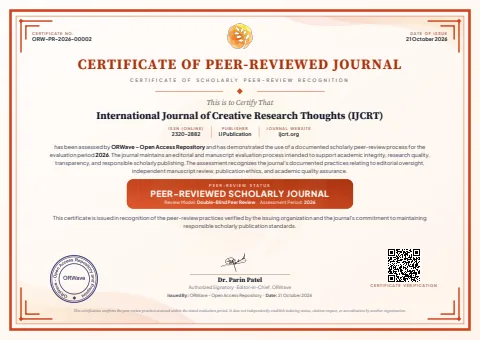
Peer-reviewedDouble-blind review · assessment period 2026
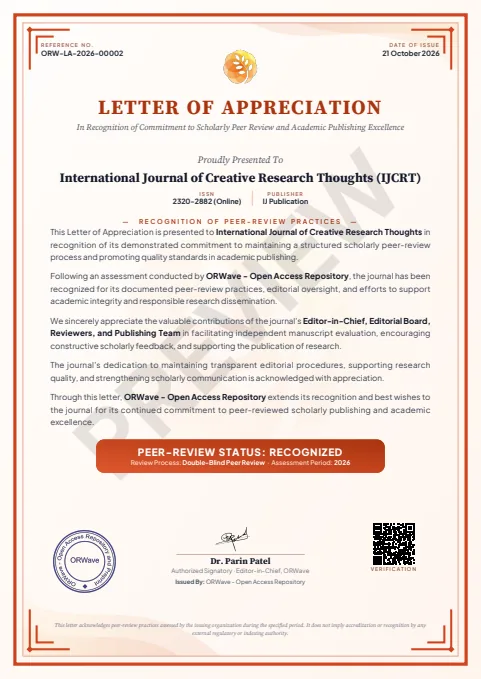
RecognizedPeer-review status · with a 35-point UGC parameters checklist
How to read these. 8.018 is ORWave’s own evaluation score for 2026. It is separate from the 9.17 impact factor IJCRT calculates from Google Scholar data, and, as the certificate itself says, it is not a Clarivate Journal Impact Factor. The peer-review certificate and the letter cover the 2026 assessment period. The UGC checklist inside the letter is ORWave’s assessment against UGC’s suggestive parameters for peer-reviewed journals, not a listing by UGC. ORWave (orwave.org) is one of the platforms of the Journey & Wisdom Publications network.



















