
Impact factor
Certificate of Impact Factor
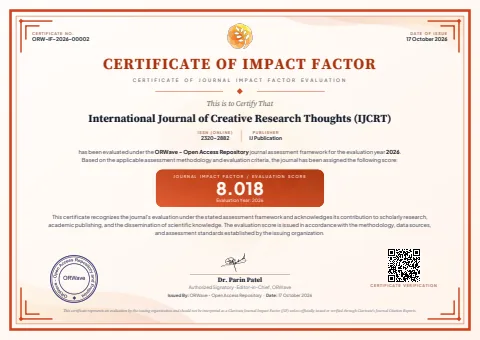
8.018ORWave evaluation score · 2026
Peer Review, Refereed, Indexed, Multidisciplinary, Multilanguage, UGC CARE Approved, Open Access Journal ★ ISSN 2349-5162 ESTD 2014 Call for Paper All Policy Track Journal List WhatsApp Email
The phrase “impact factor” is used for several different numbers, calculated by different organisations from different data. IJCRT shows two of them — 9.17, calculated from Google Scholar citation data, and 8.018, ORWave’s evaluation score for 2026. This guide explains what each kind of figure is, why they differ, and how to quote them accurately.
Ask three people for a journal’s impact factor and you may get three different numbers — all of them correct. The term began as the name of one specific metric, but it is now widely used for any citation-based or evaluation-based score of a journal. The only safe rule is: a figure without its source and year is not information.
| Figure | Who produces it | Based on |
|---|---|---|
| Journal Impact Factor (JIF) | Clarivate, in Journal Citation Reports | Citations in the Web of Science Core Collection |
| CiteScore | Elsevier, for Scopus-indexed titles | Citations in Scopus over four years |
| SJR | SCImago, from Scopus data | Citations weighted by the citing journal’s prestige |
| Google Scholar-based figures | Google Scholar (h5-index) or a journal calculating from Scholar data | Citations found by Google Scholar |
| Evaluation scores | Assessment bodies, under their own frameworks | The issuer’s stated criteria and data |
For a fuller treatment of the first three, see how to read impact factor, CiteScore and SJR.
| 9.17 | 8.018 | |
|---|---|---|
| Kind of figure | Impact factor | Journal impact factor / evaluation score |
| Calculated by | JETIR | ORWave – Open Access Repository |
| Data / basis | Google Scholar citation data | ORWave’s assessment framework and criteria |
| Year | As stated on the impact factor page | 2026 (certificate dated 17 October 2026) |
| Document | Impact factor page | Certificate ORW-IF-2026-00002 |
| Clarivate JIF? | No | No — stated on the certificate |
Certificates · ORWave · 2026
The impact factor certificate is the first card. Its footnote states, in ORWave’s words, that the score is not a Clarivate Journal Impact Factor.
8.018ORWave evaluation score · 2026
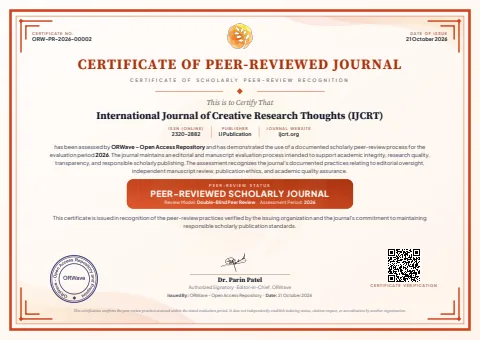
Peer-reviewedDouble-blind review · assessment period 2026
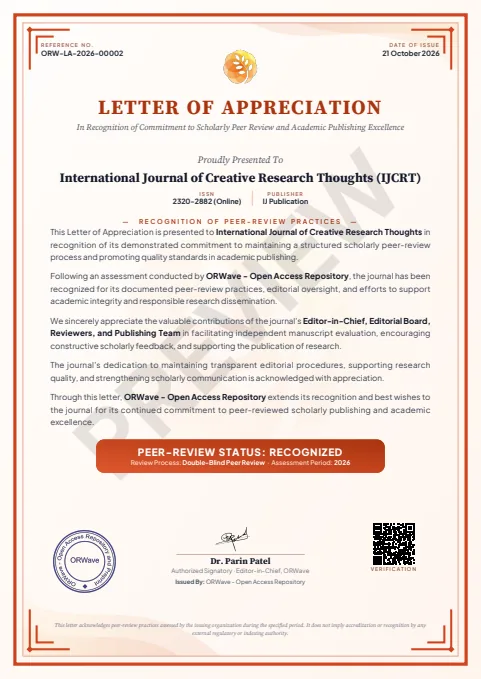
RecognizedPeer-review status · with a 35-point UGC parameters checklist
How to read these. 8.018 is ORWave’s own evaluation score for 2026. It is separate from the 9.17 impact factor IJCRT calculates from Google Scholar data, and, as the certificate itself says, it is not a Clarivate Journal Impact Factor. The peer-review certificate and the letter cover the 2026 assessment period. The UGC checklist inside the letter is ORWave’s assessment against UGC’s suggestive parameters for peer-reviewed journals, not a listing by UGC. ORWave (orwave.org) is one of the platforms of the Journey & Wisdom Publications network.
Google Scholar finds citations across a very wide range of sources. Curated databases count only citations from the journals they index.
A two-year citation window gives a different result from a four- or five-year one for the same journal.
A pure citation ratio and an evaluation score that weighs several criteria are not designed to agree.
Every figure is a snapshot. A score for 2026 says nothing about 2024 or 2027.
Publish where every metric is shown with its source.
₹1501 Indian authors · $59 foreign authors · payable only after acceptanceMetrics summarise; they do not replace the evidence behind them. When deciding where to publish, weigh:
“Impact factor” is a family of numbers, not one number. JETIR’s 9.17 and ORWave’s 8.018 measure different things, are produced by different bodies and are both shown with their sources. Quote either one with its source and year, never call either a JIF, and judge a journal on the evidence behind its numbers.
These answers are also published as FAQ structured data for search engines.
Because they are two different measurements: 9.17 is calculated by IJCRT from Google Scholar citation data, and 8.018 is ORWave’s evaluation score for 2026. Showing both, with their sources, is more transparent than choosing one.
Each is real for what it measures. The important thing is to quote a figure with its source and year, never on its own.
The JIF published in Clarivate’s Journal Citation Reports for journals in the Web of Science Core Collection. Neither of IJCRT’s figures is a JIF.
No. Figures from different methods and data sources are not comparable. Compare like with like, or compare the underlying evidence: citations, review practice and indexing.
With its source and year, for example: “IJCRT, ORWave evaluation score 8.018 (2026)” or “IJCRT, impact factor 9.17 (calculated from Google Scholar data)”.
No. Metrics do not change the review process. IJCRT’s review is double-blind, and the fee of ₹1501 / $59 applies only after acceptance.
Still deciding? Read the author guidelines and the publication charges, then submit when your manuscript is ready.
₹1501 Indian authors · $59 foreign authors · payable only after acceptancePeer-reviewed, open access, ISSN 2349-5162. Free to submit; the fee of ₹1501 (Indian authors) or $59 (foreign authors) applies only after acceptance.
Questions? editor@jetir.org · WhatsApp +91 94260 33211



















