
Impact factor
Certificate of Impact Factor
12.950ORWave evaluation score · 2026
Peer Review, Refereed, Indexed, Multidisciplinary, Multilanguage, UGC CARE Approved, Open Access Journal ★ ISSN 2349-5162 ESTD 2014 Call for Paper All Policy Track Journal List WhatsApp Email
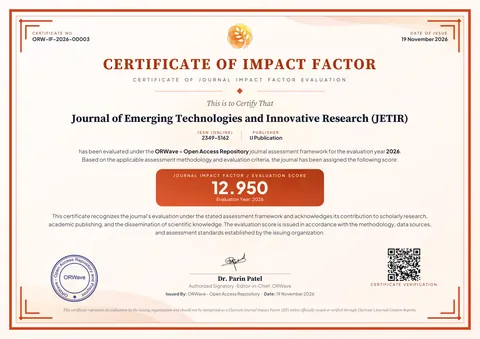
On 19 November 2026 ORWave – Open Access Repository issued JETIR (ISSN 2349-5162) a Certificate of Impact Factor carrying a journal evaluation score of 12.950 for the evaluation year 2026, together with a Letter of Recognition that records the same figure. This guide walks through the certificate line by line, shows the original, and explains how the score sits beside the 12.95 impact factor JETIR calculates from its Google Scholar citation data.
ORWave – Open Access Repository assessed JETIR under its own journal assessment framework for the evaluation year 2026. The outcome is a single figure, a journal impact factor / evaluation score of 12.950, recorded on Certificate of Impact Factor ORW-IF-2026-00003, which ORWave dated 19 November 2026. Everything printed on the document is set out below, so you can compare it with the original PDF further down the page.
| Journal named | Journal of Emerging Technologies and Innovative Research (JETIR) |
|---|---|
| ISSN (online) | 2349-5162 |
| Publisher, as printed | IJ Publication |
| Issuing body | ORWave – Open Access Repository |
| Figure awarded | 12.950, labelled “Journal Impact Factor / Evaluation Score” |
| Evaluation year | 2026 |
| Certificate number | ORW-IF-2026-00003 |
| Date of issue | 19 November 2026 |
| Signatory | Dr. Parin Patel, Authorized Signatory · Editor-in-Chief, ORWave |
| Verification | QR code marked “Certificate Verification”, plus the ORWave seal |
The same day, ORWave issued three more documents to JETIR: a Certificate of Peer-Reviewed Journal, a Letter of Appreciation with a UGC parameters checklist, and a Letter of Recognition that repeats the 12.950 figure. All four are numbered in the same series, ending in 00003, which is JETIR’s journal number with ORWave.
A certificate is worth only what its parts can be checked against. Each element below answers one question a careful reader, supervisor or committee member will ask, and together they show how to read this certificate and any other a journal puts in front of you.
ORW-IF-2026-00003 on the left, 19 November 2026 on the right. The number lets you refer to this exact document; the date tells you which year’s assessment you are holding.
The full title with its abbreviation, the online ISSN 2349-5162 and the publisher. Compare all three with the journal’s own website and the ISSN Portal: a different ISSN is the quickest way to spot a certificate lifted from another title.
The text says the journal “has been evaluated under the ORWave – Open Access Repository journal assessment framework for the evaluation year 2026”. One issuer, one framework, one year: that is the context the score belongs to.
12.950 in the central panel, captioned “Journal Impact Factor / Evaluation Score” with “Evaluation Year: 2026” beneath. The label tells you it is ORWave’s evaluation, not a number taken from a citation database.
Dr. Parin Patel signs as Authorized Signatory and Editor-in-Chief of ORWave, beside the round ORWave seal. This is the person and body that stand behind the figure.
A QR code for certificate verification at the bottom right, and a one-line footnote that rules out reading the score as a Clarivate Journal Impact Factor.
Certificates · ORWave · 2026
The Certificate of Impact Factor is the first card; open it in the viewer to follow the elements described above, or download the PDF. The peer-review certificate, the Letter of Appreciation and the Letter of Recognition, all dated 19 November 2026, sit alongside it.
12.950ORWave evaluation score · 2026
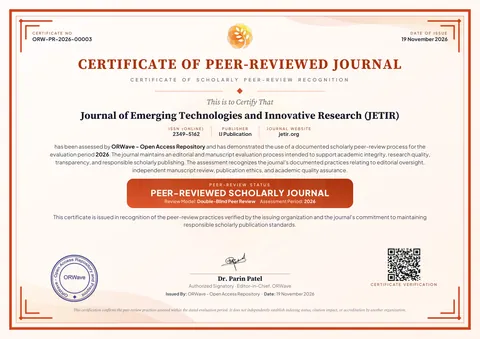
Peer-reviewedDouble-blind review · assessment period 2026
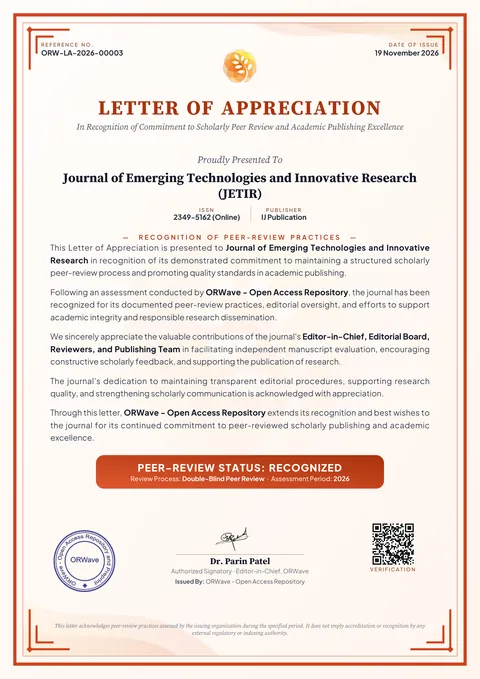
RecognizedPeer-review status · with a 35-point UGC parameters checklist
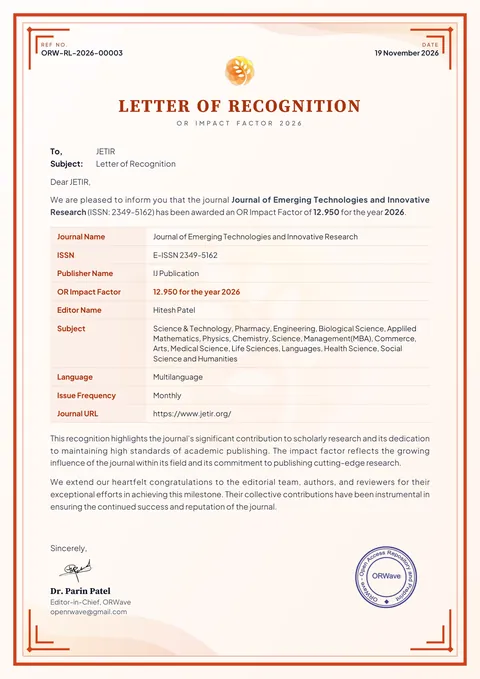
12.950OR Impact Factor for the year 2026
How to read these. 12.950 is ORWave’s own evaluation score (OR Impact Factor) for 2026. It is separate from the 12.95 impact factor JETIR calculates from Google Scholar data, and, as the certificate itself says, it is not a Clarivate Journal Impact Factor. The peer-review certificate and the letters cover the 2026 assessment period. The UGC checklist inside the letter is ORWave’s assessment against UGC’s suggestive parameters for peer-reviewed journals, not a listing by UGC. ORWave (orwave.org) is one of the platforms of the Journey & Wisdom Publications network.
The fourth card above is a one-page Letter of Recognition, reference ORW-RL-2026-00003, also dated 19 November 2026. It tells the journal that it “has been awarded an OR Impact Factor of 12.950 for the year 2026” and lists the journal record that ORWave holds:
| Journal name | Journal of Emerging Technologies and Innovative Research |
|---|---|
| ISSN | E-ISSN 2349-5162 |
| Publisher name | IJ Publication |
| OR Impact Factor | 12.950 for the year 2026 |
| Subjects listed | Science & Technology, Pharmacy, Engineering, Biological Science, Applied Mathematics, Physics, Chemistry, Science, Management (MBA), Commerce, Arts, Medical Science, Life Sciences, Languages, Health Science, Social Science and Humanities |
| Language | Multilanguage |
| Issue frequency | Monthly |
| Journal URL | https://www.jetir.org/ |
The letter adds no new score; it confirms the one on the certificate and states the journal details ORWave used. That makes it a useful cross-check: if the ISSN, frequency and web address in the letter match what you see on this site, the certificate refers to the journal you are dealing with. The letter is signed by Dr. Parin Patel as Editor-in-Chief of ORWave and gives ORWave’s contact address, openrwave@gmail.com.
ORWave says it assigned the score “based on the applicable assessment methodology and evaluation criteria”, and that the score is issued “in accordance with the methodology, data sources, and assessment standards established by the issuing organization”. Put simply, 12.950 is ORWave’s measured view of JETIR for 2026, reached by ORWave’s own rules. It is not a count you can reproduce from a public database, and it is not meant to be.
The certificate also names what the evaluation acknowledges: the journal’s contribution to scholarly research, to academic publishing and to the spread of scientific knowledge. ORWave’s assessment checklist, issued as the second page of its Letter of Appreciation, files the figure under “Journal Visibility” (parameter 7.1, remark “OR Impact Factor 12.95 (2026)”) and records Google Scholar as the reputed database in which the journal is indexed (parameter 7.2).
A certificate you can rely on says what it does not cover. This one does so in its footnote, in ORWave’s words:
“This certificate represents an evaluation by the issuing organization and should not be interpreted as a Clarivate Journal Impact Factor (JIF) unless officially issued or verified through Clarivate’s Journal Citation Reports.”
JETIR carries the same limit wherever the certificate is shown on this site. The aim is simple: no reader should take 12.950 for something it was never meant to be. It is also worth knowing who ORWave is. The note under the certificate cards explains that ORWave is one of the platforms of the Journey & Wisdom Publications network; read the score as that platform’s evaluation and weigh it alongside records kept by outside services such as Crossref, OpenAlex and Google Scholar.
Readers of this site will meet two figures that look almost identical. They are shown side by side on purpose, because they come from different places:
| Figure | Produced by | Basis | Where it is documented |
|---|---|---|---|
| 12.95 | JETIR | Impact factor calculated from the journal’s Google Scholar citation data (h-index based) | Impact factor page |
| 12.950 | ORWave – Open Access Repository | Evaluation score under ORWave’s assessment framework, evaluation year 2026 | Certificate ORW-IF-2026-00003 and letter ORW-RL-2026-00003 |
The two agree to two decimal places, which can make them look like one figure quoted twice. Treat them as two records all the same. One is the journal’s own calculation from citation data anyone can open; the other is an outside platform’s evaluation under its own framework. Neither is a Clarivate JIF, and agreement between them does not change what either one is. Our guide to impact factor, evaluation score or JIF explains how to quote figures like these without blurring them together.
Publish in a peer-reviewed, open access journal that shows its certificates in full, small print included.
₹1501 Indian authors · $59 foreign authors · payable only after acceptanceORWave’s Certificate of Impact Factor ORW-IF-2026-00003 records an evaluation score of 12.950 for JETIR for 2026, issued on 19 November 2026 and confirmed by the Letter of Recognition ORW-RL-2026-00003. Read it for exactly what it claims to be — ORWave’s evaluation, not a Clarivate JIF — and set it beside the journal’s open records: the Google Scholar profile, Crossref’s 2,249 DOIs under prefix 10.56975, and the OpenAlex source record. The peer-review certificate and the Letter of Appreciation with its UGC parameters checklist complete the set.
These answers are also published as FAQ structured data for search engines.
A journal impact factor / evaluation score of 12.950 for the evaluation year 2026. It is printed on Certificate of Impact Factor ORW-IF-2026-00003, dated 19 November 2026, and repeated in ORWave’s Letter of Recognition ORW-RL-2026-00003 as an “OR Impact Factor of 12.950 for the year 2026”.
No. The certificate’s own footnote says it represents an evaluation by the issuing organisation and should not be read as a Clarivate Journal Impact Factor unless it is issued or verified through Clarivate’s Journal Citation Reports. JETIR has no Clarivate JIF.
They are two separate records. 12.95 is the impact factor JETIR calculates from its Google Scholar citation data (h-index based); 12.950 is ORWave’s evaluation score for 2026 under ORWave’s framework. The two figures agree to two decimal places, but each should still be quoted with its own source.
In the certificate viewer on this page, which also offers the PDF for download. The same four ORWave documents are shown on the journal information, indexing and peer review pages of this site.
Dr. Parin Patel, Authorized Signatory and Editor-in-Chief of ORWave, on behalf of ORWave – Open Access Repository. The certificate also carries the ORWave seal and a QR code headed “Certificate Verification”.
No. Review stays double-blind, and the publication charge stays ₹1501 for Indian authors or $59 for foreign authors, payable only after acceptance.
IJ Publication, the name under which ORWave records the journal. On this site the publisher is written as JETIR Publication (IJ Publication).
Still deciding? Read the author guidelines and the publication charges, then submit when your manuscript is ready.
₹1501 Indian authors · $59 foreign authors · payable only after acceptancePeer-reviewed, open access, ISSN 2349-5162. Free to submit; the fee of ₹1501 (Indian authors) or $59 (foreign authors) applies only after acceptance.
Questions? editor@jetir.org · WhatsApp +91 94260 33211



















