
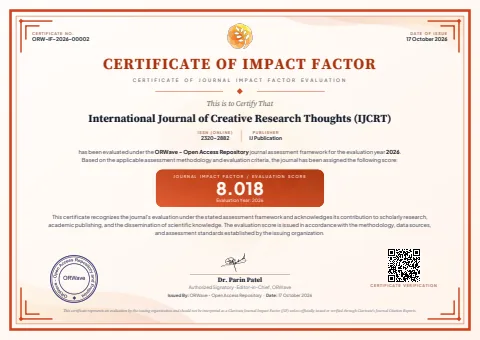
Impact factor
Certificate of Impact Factor
8.018ORWave evaluation score · 2026
Peer Review, Refereed, Indexed, Multidisciplinary, Multilanguage, UGC CARE Approved, Open Access Journal ★ ISSN 2349-5162 ESTD 2014 Call for Paper All Policy Track Journal List WhatsApp Email
With its peer-review certificate, ORWave – Open Access Repository sent IJCRT a Letter of Appreciation recognising its double-blind peer-review practice, and an annexure that checks the journal against the 35 suggestive parameters UGC published for peer-reviewed journals. Fifteen are marked fulfilled, none not fulfilled, and twenty were not verified in this assessment. Here is the letter, the full checklist and how to read it.
The letter is titled “In Recognition of Commitment to Scholarly Peer Review and Academic Publishing Excellence” and is presented to International Journal of Creative Research Thoughts (JETIR), ISSN 2349-5162 (Online), publisher IJ Publication. Its reference number is ORW-LA-2026-00002 and it is dated 21 October 2026.
It recognises JETIR’s “demonstrated commitment to maintaining a structured scholarly peer-review process and promoting quality standards in academic publishing”, and states that, following ORWave’s assessment, the journal “has been recognized for its documented peer-review practices, editorial oversight, and efforts to support academic integrity and responsible research dissemination”.
Like the two certificates, it is signed by Dr. Parin Patel, Authorized Signatory and Editor-in-Chief of ORWave, and carries a verification QR code. Its footnote says it acknowledges peer-review practices assessed during the period and “does not imply accreditation or recognition by any external regulatory or indexing authority”.
Certificates · ORWave · 2026
The Letter of Appreciation is the third card; the UGC parameters checklist is its second page. Open it in the viewer and scroll down to reach the checklist.
8.018ORWave evaluation score · 2026
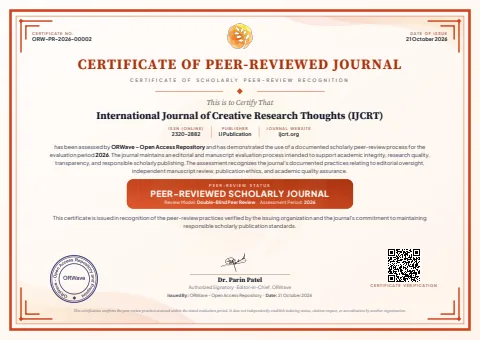
Peer-reviewedDouble-blind review · assessment period 2026
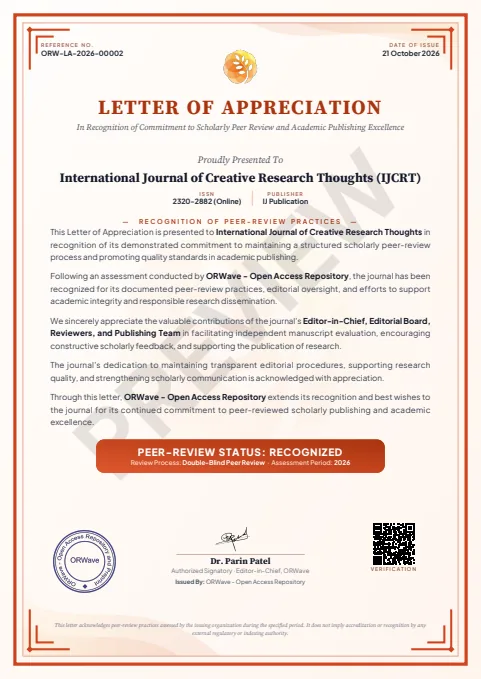
RecognizedPeer-review status · with a 35-point UGC parameters checklist
How to read these. 8.018 is ORWave’s own evaluation score for 2026. It is separate from the 9.17 impact factor IJCRT calculates from Google Scholar data, and, as the certificate itself says, it is not a Clarivate Journal Impact Factor. The peer-review certificate and the letter cover the 2026 assessment period. The UGC checklist inside the letter is ORWave’s assessment against UGC’s suggestive parameters for peer-reviewed journals, not a listing by UGC. ORWave (orwave.org) is one of the platforms of the Journey & Wisdom Publications network.
The second page of the letter is an assessment checklist: “Assessment of International Journal of Creative Research Thoughts (JETIR) against the Suggestive Parameters for Peer-Reviewed Journals issued by the University Grants Commission (F. No. 1-1/2018 (CARE/JOURNAL), dated 16 July 2025), for the assessment period 2026.”
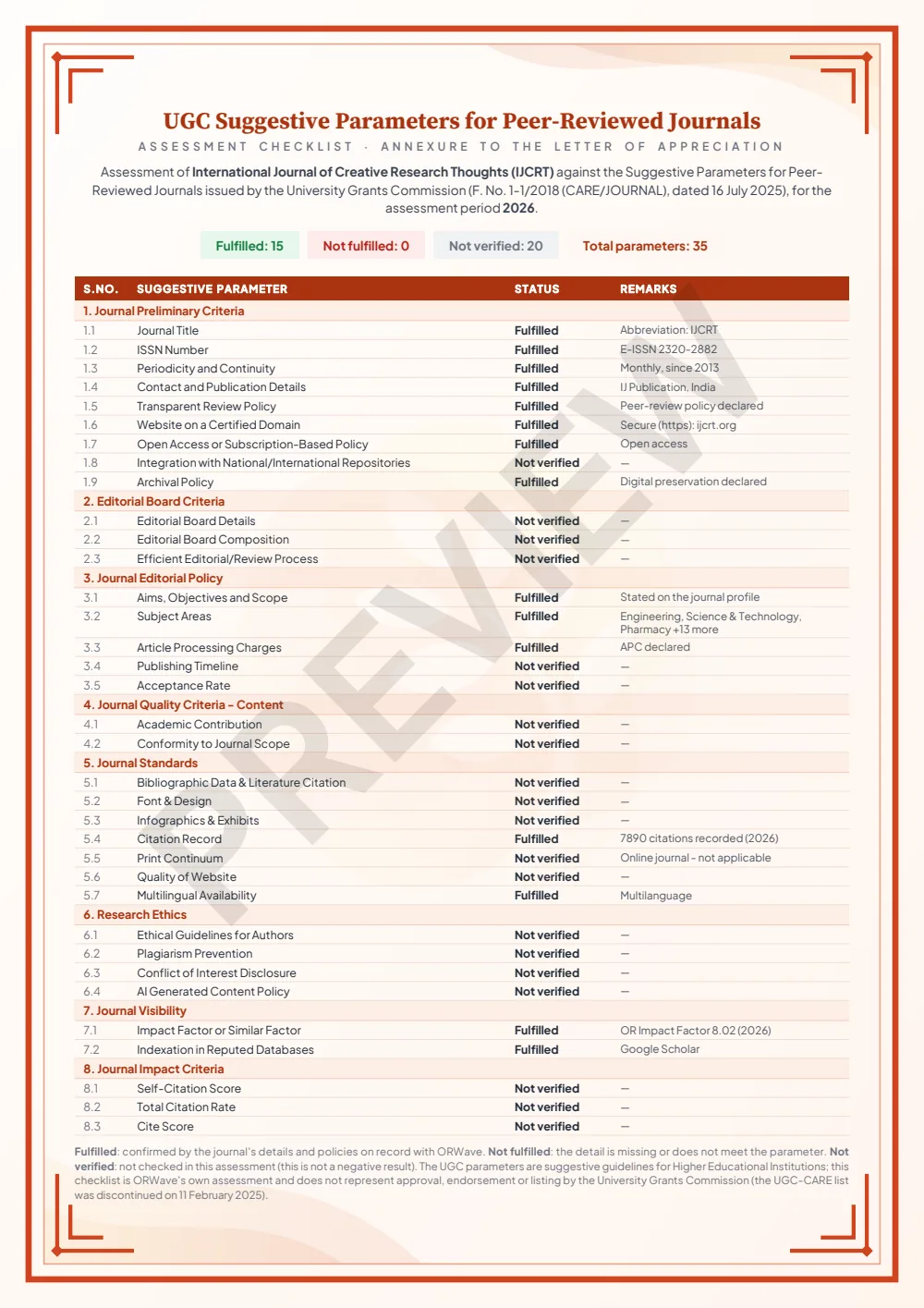
| Result | Count | Meaning given in the annexure |
|---|---|---|
| Fulfilled | 15 | Confirmed by the journal’s details and policies on record with ORWave |
| Not fulfilled | 0 | The detail is missing or does not meet the parameter |
| Not verified | 20 | Not checked in this assessment (not a negative result) |
| Total | 35 | All UGC suggestive parameters, in eight groups |
| No. | Parameter | ORWave’s remark |
|---|---|---|
| 1.1 | Journal title | Abbreviation: JETIR |
| 1.2 | ISSN number | E-ISSN 2349-5162 |
| 1.3 | Periodicity and continuity | Monthly, since 2013 |
| 1.4 | Contact and publication details | IJ Publication, India |
| 1.5 | Transparent review policy | Peer-review policy declared |
| 1.6 | Website on a certified domain | Secure (https): jetir.org |
| 1.7 | Open access or subscription-based policy | Open access |
| 1.9 | Archival policy | Digital preservation declared |
| 3.1 | Aims, objectives and scope | Stated on the journal profile |
| 3.2 | Subject areas | Engineering, Science & Technology, Pharmacy and 13 more |
| 3.3 | Article processing charges | APC declared |
| 5.4 | Citation record | 7,890 citations recorded (2026) |
| 5.7 | Multilingual availability | Multilanguage |
| 7.1 | Impact factor or similar factor | OR Impact Factor 8.02 (2026) |
| 7.2 | Indexation in reputed databases | Google Scholar |
Each parameter is explained, with the public page that documents it, in our companion guide: the UGC suggestive parameters checklist for JETIR.
Publish in a journal that documents its policies openly and is assessed against UGC’s suggestive parameters.
₹1501 Indian authors · $59 foreign authors · payable only after acceptanceTwenty parameters carry the status “not verified”. The annexure defines this as “not checked in this assessment (this is not a negative result)”. They are:
| Group | Parameters |
|---|---|
| 1. Preliminary | 1.8 Integration with national/international repositories |
| 2. Editorial board | 2.1 Board details · 2.2 Board composition · 2.3 Efficient editorial/review process |
| 3. Editorial policy | 3.4 Publishing timeline · 3.5 Acceptance rate |
| 4. Content quality | 4.1 Academic contribution · 4.2 Conformity to journal scope |
| 5. Standards | 5.1 Bibliographic data · 5.2 Font & design · 5.3 Infographics · 5.5 Print continuum (online journal — not applicable) · 5.6 Quality of website |
| 6. Research ethics | 6.1 Ethical guidelines · 6.2 Plagiarism prevention · 6.3 Conflict of interest · 6.4 AI-generated content policy |
| 8. Impact | 8.1 Self-citation score · 8.2 Total citation rate · 8.3 CiteScore |
Several of these are documented publicly on this site even though they were outside this assessment — for example the peer review process, the similarity limit of 15% and the journal’s ethics and editorial policies. Anyone checking JETIR for their institution can verify those pages directly.
The annexure says so in its own words: the UGC parameters are “suggestive guidelines for Higher Educational Institutions; this checklist is ORWave’s own assessment and does not represent approval, endorsement or listing by the University Grants Commission”. For JETIR’s full UGC history, see JETIR UGC & CARE journal details and UGC recognition.
The Letter of Appreciation recognises JETIR’s double-blind peer review for 2026, and its annexure records fifteen UGC suggestive parameters as fulfilled and none as not fulfilled. Read it for what it is — a clear, itemised third-party assessment — and use the journal’s own pages to check anything it did not cover.
These answers are also published as FAQ structured data for search engines.
A letter dated 21 October 2026, reference ORW-LA-2026-00002, recognising IJCRT’s structured double-blind peer-review process and thanking its Editor-in-Chief, Editorial Board, Reviewers and Publishing Team. Its status line reads “Peer-Review Status: Recognized”.
Fifteen of 35 are marked fulfilled and none not fulfilled. The other twenty are marked not verified, which the annexure explains is not a negative result.
The Suggestive Parameters for Peer-Reviewed Journals issued by the University Grants Commission under F. No. 1-1/2018 (CARE/JOURNAL), dated 16 July 2025.
No. The annexure says it is ORWave’s own assessment and does not represent approval, endorsement or listing by UGC. The parameters are suggestive guidelines for higher educational institutions.
The copy published here carries ORWave’s PREVIEW watermark, exactly as received. The content is the same as described on this page.
No. The annexure defines not verified as “not checked in this assessment” and says it is not a negative result. IJCRT’s own pages document several of them, such as its editorial board and ethics policies.
Still deciding? Read the author guidelines and the publication charges, then submit when your manuscript is ready.
₹1501 Indian authors · $59 foreign authors · payable only after acceptancePeer-reviewed, open access, ISSN 2349-5162. Free to submit; the fee of ₹1501 (Indian authors) or $59 (foreign authors) applies only after acceptance.
Questions? editor@jetir.org · WhatsApp +91 94260 33211



















