
Impact factor
Certificate of Impact Factor
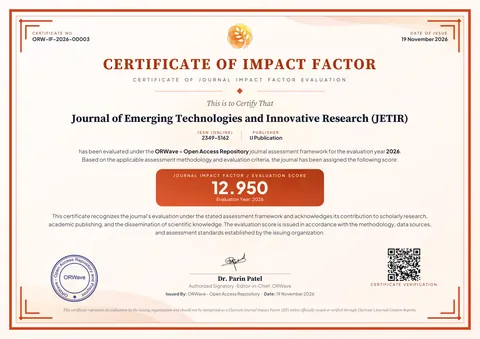
12.950ORWave evaluation score · 2026
Peer Review, Refereed, Indexed, Multidisciplinary, Multilanguage, UGC CARE Approved, Open Access Journal ★ ISSN 2349-5162 ESTD 2014 Call for Paper All Policy Track Journal List WhatsApp Email
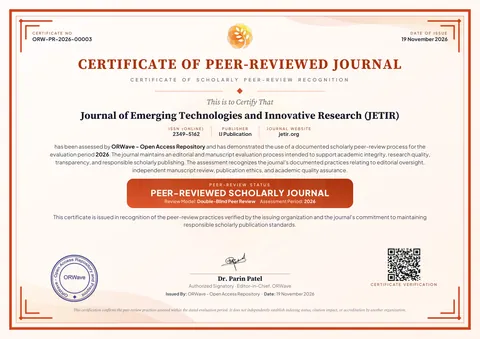
On 19 November 2026 ORWave – Open Access Repository issued JETIR a Certificate of Peer-Reviewed Journal recording the status “Peer-Reviewed Scholarly Journal”, with double-blind peer review as the review model, for the 2026 assessment period. This guide sets out what the certificate records, the four practices it names, the limits it states, and how each stage of the certified process looks from an author’s side.
The core sentence of the certificate is short: JETIR “has been assessed by ORWave – Open Access Repository and has demonstrated the use of a documented scholarly peer-review process for the evaluation period 2026”. Everything else on the page either identifies the journal, qualifies that finding or tells you who stands behind it. The result is printed in a panel headed “Peer-Review Status”:
| Peer-review status | Peer-Reviewed Scholarly Journal |
|---|---|
| Review model | Double-Blind Peer Review |
| Assessment period | 2026 |
| Journal | Journal of Emerging Technologies and Innovative Research (JETIR) · ISSN 2349-5162 (online) |
| Publisher and website, as printed | IJ Publication · jetir.org |
| Certificate number and date | ORW-PR-2026-00003 · 19 November 2026 |
| Signatory | Dr. Parin Patel, Authorized Signatory · Editor-in-Chief, ORWave |
The certificate is one of four documents ORWave issued to JETIR on the same day. The others are the Certificate of Impact Factor, the Letter of Appreciation with its UGC parameters checklist and a Letter of Recognition. Only this one deals with peer review on its own.
ORWave writes that its assessment “recognizes the journal’s documented practices relating to editorial oversight, independent manuscript review, publication ethics, and academic quality assurance”. Each of those phrases corresponds to a concrete step that a manuscript goes through at JETIR:
The editorial office reads every submission first, checking that it fits the journal’s scope, that the files are complete and that the formatting follows the author guidelines.
A research paper that passes screening goes to reviewers working in its subject. They are not told who the authors are, and the authors are not told who the reviewers are.
A similarity check with a limit below 15%, declared conflicts of interest, and corrections or retractions handled in the open under the journal’s ethics policy.
Written decisions that carry the reviewers’ comments, revision rounds when needed, and a charge that falls due only after acceptance, so payment can never influence a decision.
The certificate sums up the purpose of these practices as supporting “academic integrity, research quality, transparency, and responsible scholarly publishing”, and closes by saying it is issued “in recognition of the peer-review practices verified by the issuing organization”.
Certificates · ORWave · 2026
The Certificate of Peer-Reviewed Journal is the second card. The Letter of Appreciation, which recognises the same double-blind practice, the impact factor certificate and the Letter of Recognition are beside it, all dated 19 November 2026.
12.950ORWave evaluation score · 2026
Peer-reviewedDouble-blind review · assessment period 2026
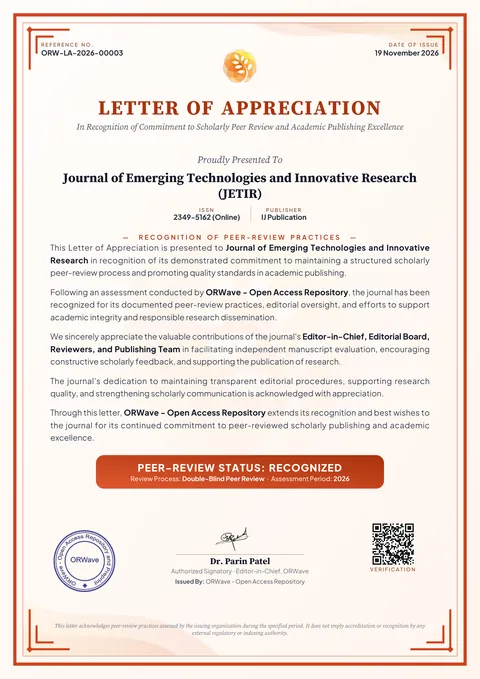
RecognizedPeer-review status · with a 35-point UGC parameters checklist
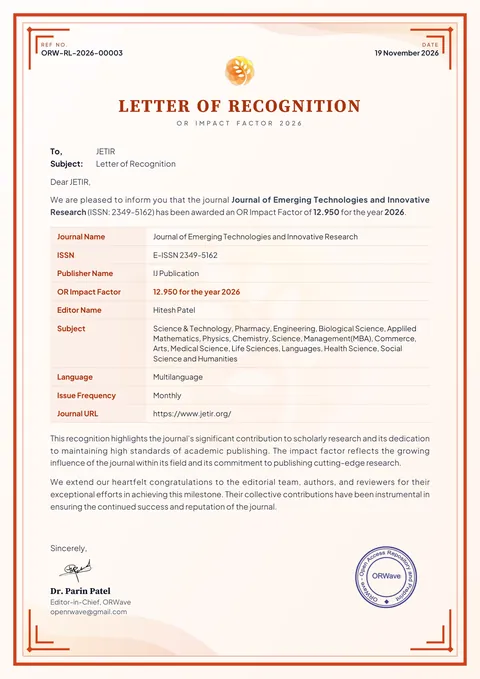
12.950OR Impact Factor for the year 2026
How to read these. 12.950 is ORWave’s own evaluation score (OR Impact Factor) for 2026. It is separate from the 12.95 impact factor JETIR calculates from Google Scholar data, and, as the certificate itself says, it is not a Clarivate Journal Impact Factor. The peer-review certificate and the letters cover the 2026 assessment period. The UGC checklist inside the letter is ORWave’s assessment against UGC’s suggestive parameters for peer-reviewed journals, not a listing by UGC. ORWave (orwave.org) is one of the platforms of the Journey & Wisdom Publications network.
Under double-blind review neither side knows the other. Reviewers receive an anonymised manuscript, and authors receive comments without names attached. The point is to take reputation, institution and personal acquaintance out of the judgement, so that the reviewers respond to the argument and the evidence in front of them.
| Model | Reviewer knows the author? | Author knows the reviewer? |
|---|---|---|
| Single-blind | Yes | No |
| Double-blind (the model at JETIR) | No | No |
| Open review | Yes | Yes |
Anonymity does not mean secrecy about the process. JETIR shares the reviewers’ comments and the reasons for each decision with the authors, so you can see how your paper was judged even though you do not see who judged it. For a deeper look at the model, read double-blind review, certified; the journal’s own transparent peer review record describes how comments are shared.
ORWave is not the only body to have looked at the process. Scholar9 issued JETIR a Certificate of Peer-Reviewed Journal, ID PRC00000015, dated 21 December 2023, recording that the journal adheres to the principles and standards of the peer-review process as verified during its onboarding on Scholar9. That certificate is published as a PDF on this site, and the journal’s page is on Scholar9.
A certificate describes a process in general terms. Here is the same process as an author meets it, from upload to publication.
You upload the manuscript with its declarations through the submission form and receive a Paper ID by email.
The office checks scope, completeness and originality; overall similarity must be below 15%, with quoted sources properly referenced.
The anonymised paper goes to reviewers in the subject, who assess it without knowing who wrote it.
You hear by email and SMS whether the paper is accepted, needs revision or is declined, with the reviewers’ comments.
After acceptance and payment of ₹1501 / $59, the article appears open access under CC BY 4.0; a Crossref DOI under prefix 10.56975 is available on request.
Submit to a journal whose double-blind peer review is documented and certified, with the certificate on the page.
₹1501 Indian authors · $59 foreign authors · payable only after acceptanceThe footnote at the bottom of the certificate sets its boundaries: “This certification confirms the peer-review practices assessed within the stated evaluation period. It does not independently establish indexing status, citation impact, or accreditation by another organization.”
It is worth reading the certificate with one more piece of context. As the note under the certificate cards explains, ORWave is one of the platforms of the Journey & Wisdom Publications network. Its certificate records how JETIR’s documented process was assessed; your own reading of the journal’s policies and recent papers remains the best test of whether the process suits your work.
Our guide to showing journal certificates to a university describes what different committees usually ask for and how to present it.
ORWave’s Certificate of Peer-Reviewed Journal ORW-PR-2026-00003 records JETIR as a peer-reviewed scholarly journal using double-blind review for 2026, on the strength of its documented editorial oversight, independent review, publication ethics and quality assurance. It claims no more than that, and its footnote says so — which is exactly what makes it usable as evidence. Read it alongside the journal’s peer review process page, the transparent peer review record and, for a second issuer’s view, the Scholar9 certificate PRC00000015.
These answers are also published as FAQ structured data for search engines.
That JETIR “has demonstrated the use of a documented scholarly peer-review process for the evaluation period 2026”. Its status panel reads “Peer-Reviewed Scholarly Journal”, with the review model given as double-blind peer review and the assessment period as 2026.
The certificate names four: editorial oversight, independent manuscript review, publication ethics and academic quality assurance. It describes them as the journal’s documented practices.
No. Its footnote says it does not independently establish indexing status, citation impact or accreditation by another organisation. It covers peer review only; indexing records are listed on the indexing and discovery pages.
Yes. Every research submission is screened by the editorial office and, if it is within scope and complete, sent for double-blind review before any decision to publish. Decisions are sent by email and SMS.
Yes. Scholar9 issued JETIR a Certificate of Peer-Reviewed Journal, ID PRC00000015, dated 21 December 2023, which is published on this site as a PDF. It is a separate document from a different issuer.
No. The certificate describes how papers are assessed, not how quickly. Acceptance still depends on what the reviewers and the editor conclude about your manuscript.
Only after acceptance: ₹1501 for Indian authors or $59 for foreign authors. Submission and review are free.
Still deciding? Read the author guidelines and the publication charges, then submit when your manuscript is ready.
₹1501 Indian authors · $59 foreign authors · payable only after acceptancePeer-reviewed, open access, ISSN 2349-5162. Free to submit; the fee of ₹1501 (Indian authors) or $59 (foreign authors) applies only after acceptance.
Questions? editor@jetir.org · WhatsApp +91 94260 33211



















