
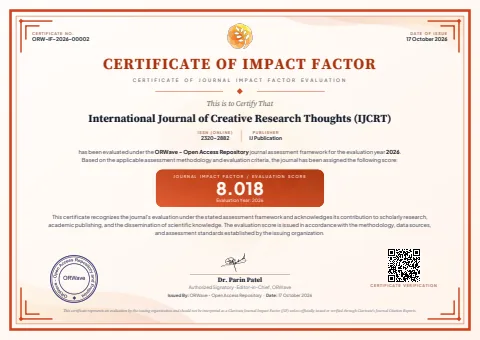
Impact factor
Certificate of Impact Factor
8.018ORWave evaluation score · 2026
Peer Review, Refereed, Indexed, Multidisciplinary, Multilanguage, UGC CARE Approved, Open Access Journal ★ ISSN 2349-5162 ESTD 2014 Call for Paper All Policy Track Journal List WhatsApp Email
Journal of Emerging Technologies and Innovative Research, ISSN 2349-5162: a monthly, open access, transparent peer-reviewed journal for every discipline — with its indexing records and UGC position linked to the source.
The short version, before the detail below.
Journal of Emerging Technologies and Innovative Research (JETIR) is an open access, peer-reviewed journal for multidisciplinary research across science, engineering, technology, management, medicine, the social sciences and the humanities. It exists to give serious work an affordable route to publication that is open about how it works.
A researcher should be able to see how a decision was reached. That is why reviewers’ written comments come back with every decision, why the fee and each optional extra are published before payment, and why the indexing claims on this page link to records you can open yourself.
One transparent fee. Everything below is included unless marked as an option.
Listed as UGC Approved Journal No. 63975 (2019), and aligned with UGC’s Suggested Parameters since the CARE list ended. The UGC position.
Double-blind review by subject specialists, with written comments returned alongside the decision and review records on Scholar9.
Every submission is checked with Turnitin / iThenticate before review; the accepted threshold is below 15% (with sources properly quoted and referenced).
A permanent, resolvable identifier under prefix 10.56975, keeping the paper citable whatever happens to web addresses.
Free to read, download and cite, with no paywall for readers and no transfer of copyright away from you.
Records in Crossref, the ISSN Portal, Google Scholar, OpenAlex, Scholar9 and more — each linked below. Check the records.
Six stages, the same for every subject.
Submit through the online portal. A Registration ID and Private Key are issued straight away; together they open the paper on the Track Paper page.
The editorial office checks scope, formatting and similarity (Turnitin / iThenticate, threshold below 15%, with sources properly quoted and referenced) before review. Papers outside scope or above the threshold are returned at this point.
Subject reviewers assess originality, method, results and clarity without seeing author identities. Their written comments come back with the decision.
Accept, revise or reject. Your paper is evaluated by expert reviewers, and acceptance or rejection notifications are sent via email and SMS.
Signed undertaking and licence form (authors keep copyright; papers are published under CC BY 4.0) and the publication charge. A Crossref DOI, hard copy and peer-review report are optional and chosen at this stage.
The paper is published open access in the monthly issue, the e-certificate becomes available, and Crossref metadata is deposited where a DOI was requested.
Each tile opens the record or search at the service itself. Verified opens the journal’s own record; Search opens a general search; Registry is a service authors use alongside the journal.
Where the journal or its articles are formally listed or registered.
 Crossref
Verified
(opens in a new tab)
 ISSN Portal
Verified
(opens in a new tab)
 ROAD
Verified
(opens in a new tab)
 ORCID
Registry
(opens in a new tab)
 Publons / ResearcherID
Registry
(opens in a new tab)
 Scholar9
Verified
(opens in a new tab)
Where researchers find, read, save or share published articles.
 Google Scholar
Verified
(opens in a new tab)
 OpenAlex
Verified
(opens in a new tab)
 Academia.edu
Verified
(opens in a new tab)
 Semantic Scholar
Search
(opens in a new tab)
 ResearchGate
Search
(opens in a new tab)
 Mendeley
Search
(opens in a new tab)
 CiteSeerX
Search
(opens in a new tab)
 SSRN
Search
(opens in a new tab)
Not indexed in Scopus, Web of Science or DOAJ — and not claimed. Microsoft Academic, named on older pages, was retired in 2021; OpenAlex carries its data. Full indexing & discovery details, with live figures.
In the journal’s own words, with the record behind each step.
UGC and UGC-CARE approval, along with alignment with the latest UGC-CARE recommendations and guidelines. JETIR is aligned with UGC's Suggested Parameters for Choosing Peer-Reviewed Journals.
JETIR is a Transparent, Peer-Reviewed, Open Access Journal (Refereed Journal). Following the discontinuation of UGC and UGC-CARE journal listing alignment with the latest UGC-CARE recommendations and guidelines, JETIR is aligned with UGC's Suggested Parameters for Choosing Peer-Reviewed Journals. UGC public notice (PDF) (opens in a new tab)
23 guides: the journal’s own status first, then the archived list, choosing a journal after CARE, and UGC compared with international indexes.
JETIR is multidisciplinary and considers research from every subject, including interdisciplinary work.
No submission fee and no review fee. You pay only after acceptance.
| Item | Detail |
|---|---|
| Journal name | Journal of Emerging Technologies and Innovative Research (JETIR) |
| ISSN (online) | 2349-5162 — ISSN Portal record (opens in a new tab) |
| UGC | UGC Approved Journal No. 63975 (2019); aligned with UGC’s Suggested Parameters |
| Impact Factor | 12.95 — from Google Scholar citation data (method) |
| DOI | Crossref, prefix 10.56975, on request |
| Established | 2014 |
| Frequency | Monthly — 12 issues per year |
| Current issue | Volume 13, Issue 11 — November 2026 |
| Review | Double-blind, transparent records; reviewer panel 3,000+ |
| Similarity | Turnitin / iThenticate, accepted below 15% |
| Licence | Creative Commons Attribution 4.0 International (CC BY 4.0) |
| Ethics | Policies follow COPE guidance (ethics policy) |
| Publisher | JETIR Publication |
| Website | jetir.org |
| editor@jetir.org |
Certificates · ORWave · 2026
Three documents issued by ORWave – Open Access Repository in October 2026, each viewable in full: the impact factor certificate, the peer-reviewed journal certificate and the letter of appreciation.
8.018ORWave evaluation score · 2026
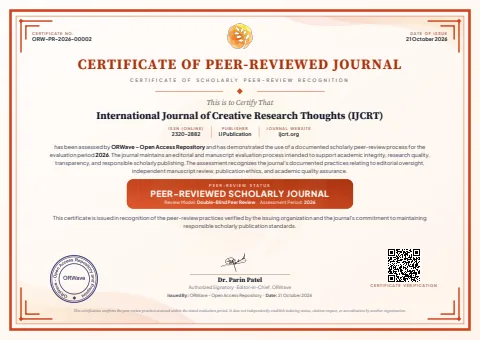
Peer-reviewedDouble-blind review · assessment period 2026
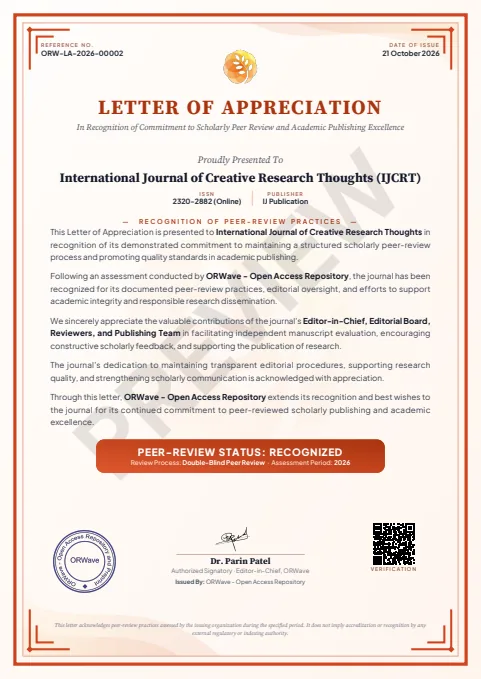
RecognizedPeer-review status · with a 35-point UGC parameters checklist
How to read these. 8.018 is ORWave’s own evaluation score for 2026. It is separate from the 9.17 impact factor IJCRT calculates from Google Scholar data, and, as the certificate itself says, it is not a Clarivate Journal Impact Factor. The peer-review certificate and the letter cover the 2026 assessment period. The UGC checklist inside the letter is ORWave’s assessment against UGC’s suggestive parameters for peer-reviewed journals, not a listing by UGC. ORWave (orwave.org) is one of the platforms of the Journey & Wisdom Publications network.
Volume 13, Issue 11 (November 2026) is open until 30 Nov 2026. UGC CARE Approved • ISSN 2349-5162 • Crossref DOI on request • ₹1501 after acceptance



















