
Impact factor
Certificate of Impact Factor
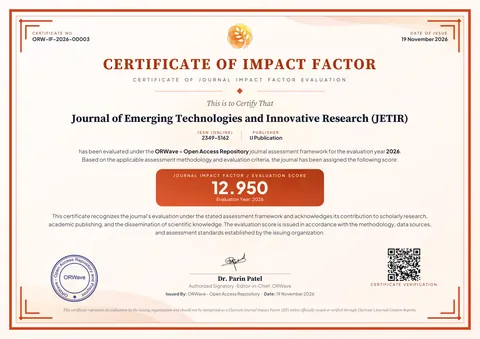
12.950ORWave evaluation score · 2026
Peer Review, Refereed, Indexed, Multidisciplinary, Multilanguage, UGC CARE Approved, Open Access Journal ★ ISSN 2349-5162 ESTD 2014 Call for Paper All Policy Track Journal List WhatsApp Email
When an editorial desk sends a paper back, the reason is usually something its authors could have spotted themselves in a few hours of careful reading. This workbook turns the JETIR author guidelines into tick-box worksheets — five for the parts of the manuscript, one for files, one for declarations and two for the weeks after acceptance and publication — and places JETIR’s own records, numbers and policies beside each step.
A guide to the publication process explains what happens to a manuscript once it leaves your hands. A workbook covers the parts that stay in your hands: the days before submission and the weeks after the paper goes live. The companion guide walks through JETIR’s publication stages in order; this page is its practical counterpart. It holds each part of the manuscript up against JETIR’s published requirements, gets the files and declarations ready, and then lists the small after-publication jobs that decide whether readers, indexes and appraisal committees ever find the work.
Every worksheet is a short run of checks. Paste them into a document of your own and give each line one of three marks: Done, Fix or Not applicable. The rule is simple — the submission form stays closed until no line is marked Fix.
JETIR has published monthly since 2014 and accepts work from many disciplines, so the three practice manuscripts below come from different fields. They were invented for teaching and do not describe real papers:
A questionnaire study of how faculty in engineering colleges use a learning management system for online quizzes and assignments, prepared by an assistant professor with two colleagues.
A low-cost soil-moisture sensor for drip irrigation, built and then tested against a reference meter on field plots by an M.Tech. student and a supervisor.
A structured review of published work on machine-learning models that detect plant leaf diseases from photographs, written by a single computer-science researcher.
If none of the three resembles your field, translate each check into your discipline’s terms instead of dropping it.
Before turning to the detailed worksheets, spend ten minutes scoring the draft, awarding 0, 1 or 2 points in each of ten areas. The scale is ours rather than an official JETIR reviewer form, but it tracks the qualities peer reviewers generally weigh: originality, significance, clarity, correctness and presentation.
| Area | 0 points | 1 point | 2 points |
|---|---|---|---|
| Title | Vague, or longer than 15 words | Lacks the setting or the method | Precise and within 15 words |
| Abstract | Absent, or above 250 words | Mostly background | All four parts: background, methods, results, conclusion |
| Keywords | None given | Under 4, or copies of title words | 4–6 terms a searcher would actually type |
| Introduction | No stated problem | Objectives hard to find | Problem, gap and numbered objectives |
| Literature review | Summary after summary | Occasional comparison | Critical, and ending on the gap |
| Methods | Impossible to repeat | Only the main steps | Design, sample, instruments, analysis and ethics |
| Results | Unordered | Prose repeats the tables | One objective answered after another |
| Discussion and conclusion | Repeats the results | Partial comparison | Set against earlier studies, with limitations named |
| References | Several styles mixed | IEEE with missing details | Consistent IEEE, with DOIs wherever they exist |
| Format and declarations | Neither started | Format nearly right | JETIR sample format used; declarations drafted |
Sixteen points or more, with no row at zero, means the draft can move on to the worksheets. A lower score, or even one zero, tells you where revision has to begin. On its first pass Example A scored 12: its abstract described the questionnaire but never said what the faculty reported, and its keywords simply repeated the title. Example C scored 13 and lost most of its points in the literature review, which read as one summary after another. Example B reached 15 and dropped marks only on references. None of the three needed more data; all three needed rewriting.
More people read a paper’s title, abstract and keywords than any other part of it: the JETIR editor at screening, the reviewers deciding whether to accept an invitation and, once the paper is online, Google Scholar, OpenAlex and every reader scanning a page of search results. JETIR’s guidelines fix three limits here — no more than 15 words in the title, no more than 250 words in an abstract that covers background, methods, results and conclusion, and between 4 and 6 keywords.
| Example | First draft | Revised |
|---|---|---|
| A — title | A Study on the Role of Technology in Assessment Among Faculty in the Present Scenario | Engineering Faculty Use of a Learning Management System for Online Assessment: A Survey |
| A — keywords | technology; assessment; faculty | learning management system; online assessment; engineering education; faculty technology adoption; questionnaire survey |
| B — title | Smart Irrigation Sensor | Design and Field Testing of a Low-Cost Capacitive Soil-Moisture Sensor for Drip Irrigation |
| C — title | Machine Learning in Agriculture | Machine-Learning Models for Detecting Plant Leaf Diseases From Images: A Structured Review |
Each revised title tells a reader what the paper contains and stays inside the limit. To test an abstract, hand it on its own to a colleague outside the project; if they cannot tell you afterwards what was done and what was found, write it again. For Example A the repair was a single added sentence reporting how many respondents used the system for weekly quizzes — the figure the survey had been designed to find in the first place.
Within the first page a reviewer forms a view on whether the authors know which question they are answering. The introduction has three jobs: name the problem, show why it matters, and close with objectives or hypotheses. The review of literature that follows is not a roll-call of earlier authors — JETIR’s guidelines ask for a critical treatment of the relevant work that arrives at the research gap.
Example C needed the classic repair. Its draft walked through some forty studies in sequence, every paragraph starting with an author’s name and a year. The rewrite sorted the same studies into four themes — the image datasets used, the model families compared, the distance between laboratory and field accuracy, and running models on inexpensive phones — and ended each theme with a sentence on where the findings conflicted. No extra reading was done, yet the review became an argument pointing to a clear gap: few of the studies tested their models on photographs taken in working fields. Example A’s fix was smaller. Its introduction promised five objectives while the questionnaire measured only three, so the other two were cut.
The methods section is where reviewers decide whether the results deserve their trust. JETIR’s guidelines expect it to describe the research methods, how the data were collected, which analysis techniques were applied and how ethical questions were handled. A useful benchmark: could a capable researcher in your field, given nothing but your paper, run the study again and obtain comparable data?
| Element | Example A (survey) | Example B (prototype) | Example C (review) |
|---|---|---|---|
| Design | Cross-sectional questionnaire survey | Prototype built, calibrated and compared with a reference meter | Structured literature review |
| Sample or material | How colleges and faculty members were selected, and how many replied | Sensor components and their sources, the calibration soil, the number of field plots | Databases consulted, search strings, years searched |
| Instrument or procedure | Questionnaire sections, rating scale, pilot round | Calibration steps, reading interval, test duration, how error was measured | Inclusion and exclusion rules; screening steps and who carried them out |
| Ethics | Informed consent, anonymity, permission from each college | No human participants; the landowner’s permission for the field plots | Usually no approval required — say so in one line |
Example B’s first draft said only that the sensor “was calibrated and tested in the field”. The revision named the soil used for calibration and the reference meter the sensor was checked against, said how often readings were logged and for how many days the test ran, and explained how the error between the two instruments was calculated. Five sentences turned a bare claim into a procedure another engineer could follow.
The results report what was found, the discussion explains what it means, and the conclusion draws it together and points forward. Early drafts most often go wrong by blending the three. JETIR’s guidelines combine results and discussion into one section — findings presented with tables and figures, then interpreted against the existing literature — and follow it with a conclusion covering key findings, implications, limitations and directions for further research. Inside a combined section, give reporting and interpretation separate paragraphs so that a reader can always tell them apart.
Example B first set out sensor readings and reference readings in a table and then retyped every pair of values across two dense paragraphs. The revised version kept the table and let the text say three things only: how far, on average, the sensor drifted from the reference meter, at which moisture levels the gap was widest, and how that compared with the commercial sensors described in the literature. The section shrank by half and became far easier for a reviewer to verify.
Presentation faults seldom sink a paper by themselves, yet they slow the screening desk and colour how a reviewer reads everything else. JETIR uses IEEE citation style: sources receive numbers in square brackets in the order the text first cites them, and a source cited again keeps the number it was first given.
| Item | JETIR requirement | Quick test |
|---|---|---|
| In-text citations | Bracketed numbers, for example [3] | Search the file for a bracket followed by a year; author–date leftovers from another style will show up |
| Reference order | Numbered by first appearance | The first source cited is [1], the next new one [2], and the sequence never jumps |
| DOIs | Given wherever one exists | Read down the list and confirm that every journal article shows its DOI |
| Figures | 300 dpi or more; TIFF, PNG or JPEG; numbered, with the caption underneath | View at 200% zoom; fuzzy axis labels usually mean the resolution is too low |
| Tables | Made with Word’s table tool; numbered, with the title above and notes below | Click into the table; if no single cell can be selected, it is a pasted picture |
Zotero, Mendeley and other reference managers can switch a list into IEEE in one click, but read the result yourself for missing issue numbers, page ranges and DOIs. Keep every figure’s original file in a folder of its own: figures travel inside the Word manuscript, and the JETIR editorial team may ask for the high-resolution sources during production.
The online form accepts the manuscript itself. Everything else in the bundle is either built into that file, prepared now for use after acceptance, or kept for your own records. Getting the file right at the first attempt removes one of the commonest reasons a paper goes back to its authors before any reviewer has seen it.
| Item | Format or content | Needed |
|---|---|---|
| Manuscript | A Word document (.doc or .docx) in JETIR’s sample paper format; a PDF cannot be submitted | With the submission |
| Page set-up | A4 pages, double line spacing, 12-point Times New Roman, bold 12-point headings, page numbers in the footer | With the submission |
| Figures | Placed inside the Word file, with originals of 300 dpi or more kept to hand | With the submission; originals if asked |
| Cover letter | A brief note on what the paper does and why it matters | With the submission |
| Author information | Every author and affiliation, the corresponding author’s email, and each author’s ORCID iD | With the submission |
| Undertaking form | Signed in ink, then scanned | After acceptance |
| Formatted paper | The Word file renamed with the Paper ID/Reg ID | After acceptance |
| Identity proof | A scan of the corresponding author’s ID | After acceptance |
| Payment proof | A record showing the transaction ID, the amount and the date | After acceptance |
The sample paper format and the undertaking form are both linked from the author guidelines. Download them before writing another paragraph: drafting straight into the template is far less work than reformatting a finished paper. While the paper is still a draft, put the date and a version number into every file name, for example lms-assessment_2026-11-28_v4.docx. Once JETIR has allotted the Paper ID/Reg ID, the formatted file you send after acceptance is renamed with that ID instead.
Declarations take only a few lines, yet a missing one can halt a paper at the screening desk. Four areas need attention.
JETIR runs a similarity check on every submission before it goes to review. The author guide names Turnitin or iThenticate as the tools and puts the accepted level below 15%, provided that sources are properly quoted and referenced. Read the match report rather than just the headline figure. Quoted and cited material often matches without harm, whereas paragraphs copied from your own dissertation without a citation count as reuse even though the words are yours.
Declare every AI tool that played a part in writing, analysis or images; JETIR treats undisclosed AI-generated text as a breach of its policy. A brief, truthful statement does the job:
If no AI tool was involved, one sentence saying so is enough. If a tool helped write code, run statistics or prepare an image, name the tool and the step it was used for. Whatever software played a part, the authors answer for every sentence and every number in the paper.
Name everyone who contributed substantially, in the order the group agreed. State funding and any conflict of interest; if there is none, write “The authors declare that they have no conflict of interest.” Where people or animals were involved, give the ethics approval or the consent procedure. JETIR’s ethics policy explains what the journal expects of its authors.
Last of all, the paper must be original work that is not under review at any other journal. If a preprint has already been posted, check JETIR’s preprint policy and mention the preprint in your cover letter.
Once every worksheet line reads Done, sending the paper to JETIR takes only a few minutes.
₹1501 Indian authors · $59 foreign authors · payable only after acceptanceThe worked examples in this workbook are aimed at JETIR. The same publisher network also runs four sister journals whose main policies match. Copy the facts below word for word whenever you record a JETIR paper in a CV, a thesis or an appraisal file.
| Detail | JETIR |
|---|---|
| Full name | Journal of Emerging Technologies and Innovative Research |
| Online ISSN | 2349-5162 (ISSN Portal record) |
| Publishing since | 2014 |
| Frequency and scope | Monthly, online, multidisciplinary |
| Publisher | JETIR Publication, Ahmedabad, Gujarat, India |
| Access and licence | Open access under CC BY 4.0 |
| Peer review | Double-blind, made transparent after publication |
| DOI | Crossref, prefix 10.56975, as an optional service after acceptance; Crossref lists 2,249 DOIs for ISSN 2349-5162 |
| Impact factor | 12.95, calculated from JETIR’s Google Scholar citation data (h-index based) — not a Clarivate Journal Impact Factor |
| Evaluation | ORWave Certificate of Impact Factor ORW-IF-2026-00003 (OR Impact Factor 12.950 for 2026) and Certificate of Peer-Reviewed Journal ORW-PR-2026-00003, both issued 19 November 2026 |
| UGC | UGC Approved Journal No. 63975 (2019) |
| Charges | Submission and review free; ₹1501 (Indian authors) or $59 (foreign authors) after acceptance, covering up to 5 authors |
| Contact | editor@jetir.org · mobile/WhatsApp +91 94260 33211 |
| Sister journal | ISSN | Since | Charge after acceptance |
|---|---|---|---|
| IJCRT — International Journal of Creative Research Thoughts | 2320-2882 | 2013 | ₹1501 / $59 |
| IJRAR — International Journal of Research and Analytical Reviews | 2348-1269 | 2014 | ₹1570 / $59 |
| IJNRD — International Journal of Novel Research and Development | 2456-4184 | 2016 | ₹1570 / $59 |
| IJSDR — International Journal of Scientific Development and Research | 2455-2631 | 2016 | ₹1570 / $59 |
All five journals are monthly, multidisciplinary and open access under CC BY 4.0; all use double-blind review, can register Crossref DOIs and charge nothing at submission. IJCRT has its own website, ijcrt.org, while IJRAR, IJNRD and IJSDR take papers through ER Society. JETIR’s journal network page sets the five side by side, and the journal information page holds JETIR’s full profile.
With the worksheets complete, submission comes down to careful data entry:
The JETIR editorial desk first checks each paper for scope, format, completeness and similarity. Papers that clear the desk go to double-blind review, and the decision reaches the corresponding author by email together with the reviewers’ comments. How long review takes depends on when reviewers are free and whether revision is needed, so JETIR does not promise a fixed turnaround; the peer review page describes each stage, including how the review is made transparent once the paper is published. If reviewers ask for changes, reply to every comment in turn — the guide to answering peer review comments has ready-made templates.
Acceptance opens the one stage whose pace depends wholly on the authors. Payment falls due now, and not a day earlier, through JETIR’s publication charge page; for a paper with more than five authors, the fee calculator works out the total.
| Scenario | JETIR charge after acceptance |
|---|---|
| Example C: a single Indian author | ₹1501 |
| Example A: three Indian authors | ₹1501, because one charge covers up to 5 authors |
| A team of seven Indian authors | ₹1501 plus ₹500 for the sixth author and ₹500 for the seventh (GST included) |
| Six foreign authors | $59; papers by foreign authors carry no additional-author charge |
Crossref DOI registration and printed copies are optional extras. Indian authors will find them on the DOI and hard copy page and foreign authors on the matching page for foreign authors; the current charge for each service is shown there.
That final check deserves more care than it seems to need. JETIR’s author guide counts names, or an author order, that differ between the paper and the form among the reasons papers are returned. The other frequent delay is splitting the documents across several emails: the paper then waits until the last piece arrives.
An author’s work does not stop on publication day. The paper still has to be tied to you, to your research profiles and to the records that evaluators look up. Go through this list within the first month.
| Task | Where | Why it matters |
|---|---|---|
| Download certificates | Track Paper, using the Paper ID/Reg ID | Every author receives a certificate of publication |
| Check the article page | The paper’s own page on jetir.org | Names, affiliations, title and abstract must be correct; send any correction quickly to editor@jetir.org |
| Confirm the DOI, if taken | Type https://doi.org/ followed by the DOI; a JETIR DOI takes the form 10.56975/jetir.v13i3.577290 | The link must open your paper |
| Add the paper to ORCID | The Works section of your ORCID record | Import it from Crossref with the DOI, or enter it by hand |
| Add the paper to Google Scholar | Add articles on your Scholar profile | Scholar crawls on its own timetable, so adding the paper yourself is routine |
| Build an evidence folder | Your own storage | PDF, certificates, issue details, URL and DOI kept together for appraisals |
Google Scholar, OpenAlex and similar services find new papers on their own schedules, and nobody can hurry them. Keep two profiles apart in your mind: JETIR’s journal profile on Google Scholar counts citations to the journal as a whole, while your personal profile is yours to keep in order. If a preprint and the published version appear there as two entries, merge them so citations gather on one record. Under the CC BY 4.0 licence the paper may be shared anywhere with attribution; the copyright policy sets out the terms.
For the longer task of making the work visible — plain-language summaries, conference presentations, a shared dataset — see the guide to raising citations ethically.
When an appraisal committee asks where a journal is recorded, the strongest answer is a link the committee can open for itself. Some links below are records of JETIR as a journal; others are search links, which help with discovery but do not on their own prove indexing. The figures were read on 27 November 2026 and keep growing, so open each link for the current number.
| Service | What it shows for JETIR | Type of link |
|---|---|---|
| ISSN Portal | The registration of ISSN 2349-5162 | Journal record |
| Google Scholar profile | 74,343 citations (35,701 since 2021), h-index 101, i10-index 1,230 | Journal profile |
| OpenAlex | Source S2764944466: 25,747 works, 14,300 citations, h-index 28, i10-index 191 | Journal record |
| Crossref search | Search results; Crossref holds 2,249 DOIs for ISSN 2349-5162 under prefix 10.56975 | Discovery link |
| ORWave | OR Impact Factor 12.950 (2026) and the peer-reviewed journal certificate | Journal record |
| Scholar9 | The journal listing with its review records; Transparent Peer Review Certificate PRC00000015 | Journal profile |
| Academia | The journal’s profile and uploaded papers | Journal profile |
| OpenAlex works search | Search results for the word JETIR | Discovery link |
| Semantic Scholar | Search results | Discovery link |
| Zenodo | Search results | Discovery link |
| Google search | Search results | Discovery link |
To state it plainly: JETIR is not indexed in Scopus, Web of Science, DOAJ or PubMed, and it has no Clarivate Journal Impact Factor. Its impact factor of 12.95 is calculated from its Google Scholar citation data on an h-index basis, and ORWave’s 12.950 is ORWave’s own evaluation score. To check any journal against the large databases, use the official Scopus source list and Clarivate’s Master Journal List. JETIR’s indexing verification page shows how to open and read each record, and the impact factor page explains how the 12.95 figure is derived.
A carefully checked submission is the first entry in your paper’s record, and the JETIR charge is due only after acceptance.
₹1501 Indian authors · $59 foreign authors · payable only after acceptanceCertificates · ORWave · 2026
ORWave assessed JETIR (ISSN 2349-5162) and issued these four documents on 19 November 2026: the Certificate of Impact Factor, the Certificate of Peer-Reviewed Journal, the Letter of Appreciation and the Letter of Recognition. Open any of them in the viewer, or download the PDF you need for an appraisal file.
12.950ORWave evaluation score · 2026
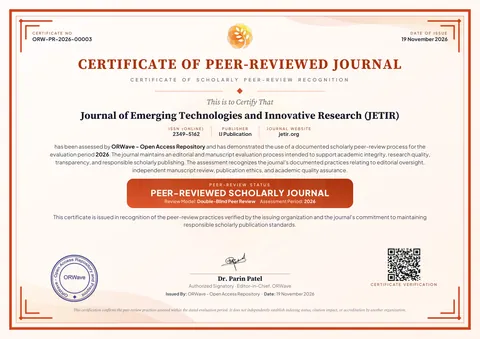
Peer-reviewedDouble-blind review · assessment period 2026
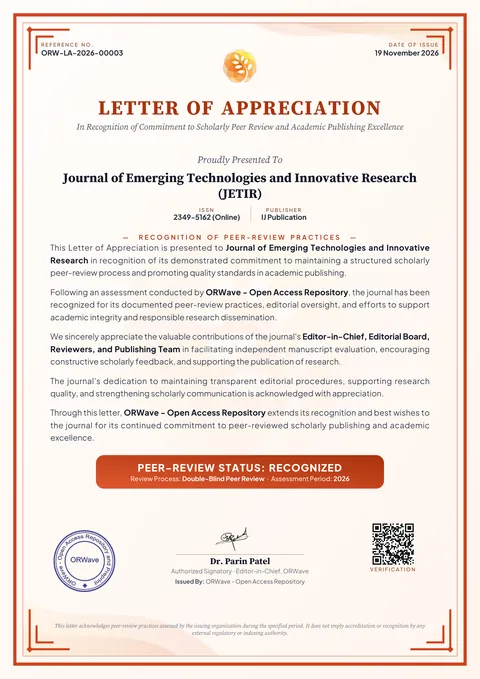
RecognizedPeer-review status · with a 35-point UGC parameters checklist
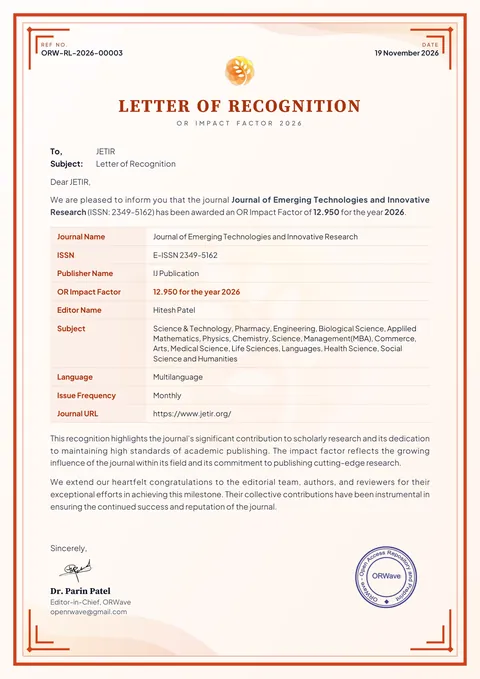
12.950OR Impact Factor for the year 2026
How to read these. 12.950 is ORWave’s own evaluation score (OR Impact Factor) for 2026. It is separate from the 12.95 impact factor JETIR calculates from Google Scholar data, and, as the certificate itself says, it is not a Clarivate Journal Impact Factor. The peer-review certificate and the letters cover the 2026 assessment period. The UGC checklist inside the letter is ORWave’s assessment against UGC’s suggestive parameters for peer-reviewed journals, not a listing by UGC. ORWave (orwave.org) is one of the platforms of the Journey & Wisdom Publications network.
Many Indian authors publish with an appraisal, a Ph.D. requirement or a promotion case in mind, and the way journals are judged has changed in the last two years. UGC created UGC-CARE on 28 November 2018 and kept its reference list of journals from 2019. At its 584th meeting, on 3 October 2024, the Commission resolved to discontinue that list, and a public notice followed on 11 February 2025. On 16 July 2025 UGC published the final archived list — 1,474 journals as they stood on 10 February 2025, kept for reference only — together with 35 suggestive parameters, grouped into eight categories, for choosing peer-reviewed journals.
JETIR’s own UGC record is older than the CARE list. It is UGC Approved Journal No. 63975 (2019): entry 63975 on UGC’s 2019 list of approved journals, with the publisher printed as IJPUBLICATION, and it is absent from the list of journals removed in May 2018.
Because institutions now weigh evidence about a journal rather than membership of one list, the evidence folder from Worksheet 9 earns its place: the ISSN record, the UGC entry, the peer review policy, the dated paper and your certificate. ORWave’s Letter of Appreciation ORW-LA-2026-00003 adds a 35-point check against UGC’s suggestive parameters (14 fulfilled, 0 not fulfilled, 21 not verified); it is ORWave’s assessment, not a UGC listing, and should be described that way in any file. Your own university’s current rules still apply, so confirm them with the appraisal office. JETIR’s UGC status page and UGC recognition page give the full position, and official notices appear on the UGC website.
After the worksheets have carried one paper through to JETIR, the routine for the next paper is short:
Research journal paper publication in 2026 rewards preparation far more than speed. None of the checks in this workbook is hard; each is simply easy to skip when a deadline is close. A title of 15 words or fewer, an abstract that reports a finding, methods a stranger could repeat, IEEE references that agree with the text, a Word file in JETIR’s sample format, and honest similarity and AI-use declarations — every one of them removes a reason for the paper to come back to you.
After publication the same discipline applies to the record: certificates downloaded, the DOI tested, ORCID and Google Scholar updated, and the evidence filed beside JETIR’s own records — its ISSN 2349-5162, its Google Scholar profile, its ORWave documents and UGC Approved Journal No. 63975 (2019). Keep the guidelines page open while you work, and submit once the last Fix mark has gone.
These answers are also published as FAQ structured data for search engines.
No. JETIR takes the manuscript only as a Microsoft Word document (.doc or .docx) written in its sample paper format, and a PDF upload is not accepted. Keep a PDF for your own files if you wish, but the file sent through the form must be the Word version.
An abstract may run to 250 words and should cover the background, the methods, the results and the conclusion. Each paper carries 4 to 6 keywords, and they help discovery most when several of them add terms that the title does not already contain.
IEEE. Sources are numbered in square brackets in the order in which the text first cites them, a source cited again reuses its first number, and each reference entry gives a DOI whenever one exists.
Every submission is screened with Turnitin or iThenticate before it reaches reviewers, and the accepted level is below 15%, with all sources quoted and referenced correctly. Passages lifted from your own thesis or an earlier paper without a citation still count as reuse, so cite them or write them afresh.
Yes. Declare any AI tool that helped with writing, analysis or images; AI-generated text that is not disclosed is treated as a breach of policy. The declaration names the tool, states the task it was used for and confirms that the authors checked the output and remain responsible for it.
There is no fixed page limit, so a paper of any length can be submitted together with its figures, tables and references. The limits that do apply concern the title (15 words at most), the abstract (250 words at most) and the keywords (between 4 and 6).
Only after acceptance; submission and review cost nothing. Indian authors pay ₹1501 and foreign authors pay $59, and one charge covers up to 5 authors. Each Indian author beyond the fifth adds ₹500 (GST included), while papers by foreign authors carry no additional-author charge.
Four items in a single email to editor@jetir.org, with the Paper ID/Reg ID in the subject line: the signed undertaking form, the formatted Word file named with that ID, the corresponding author’s identity proof and the proof of payment.
It is the registration number JETIR emails to the corresponding author once a paper is submitted, sent together with a private key. Keep both safe: they open the Track Paper page, label every document sent after acceptance and unlock the certificates after publication.
A Crossref DOI under JETIR’s prefix 10.56975 is an optional service chosen after acceptance. Indian authors find the current charge and the steps on the DOI and hard copy page; foreign authors have a separate page with the same information.
On ORCID, open Works and either import the record from Crossref with the DOI or type the details in yourself. On Google Scholar, use Add articles if the paper has not been found yet, and merge any duplicate versions so that every citation lands on a single record.
No. JETIR is not indexed in Scopus, Web of Science, DOAJ or PubMed and has no Clarivate Journal Impact Factor. Its impact factor of 12.95 is calculated from the journal’s Google Scholar citation data (h-index based), and its Google Scholar, OpenAlex, Crossref and ISSN Portal records can each be opened and checked directly.
Yes: UGC Approved Journal No. 63975 (2019). JETIR is entry 63975 on UGC’s 2019 list of approved journals and does not appear in the May 2018 removed list. Since the UGC-CARE list was discontinued, JETIR is aligned with UGC’s Suggested Parameters for Choosing Peer-Reviewed Journals; the UGC status page gives the details.
Still deciding? Read the author guidelines and the publication charges, then submit when your manuscript is ready.
₹1501 Indian authors · $59 foreign authors · payable only after acceptancePeer-reviewed, open access, ISSN 2349-5162. Free to submit; the fee of ₹1501 (Indian authors) or $59 (foreign authors) applies only after acceptance.
Questions? editor@jetir.org · WhatsApp +91 94260 33211



















