JETIR Home › JW Ecosystem › Engineering Research Society

Society & scholars · Engineering community · Journey & Wisdom Publications

Engineering Research Society: The Network’s Research Community — er-society.org

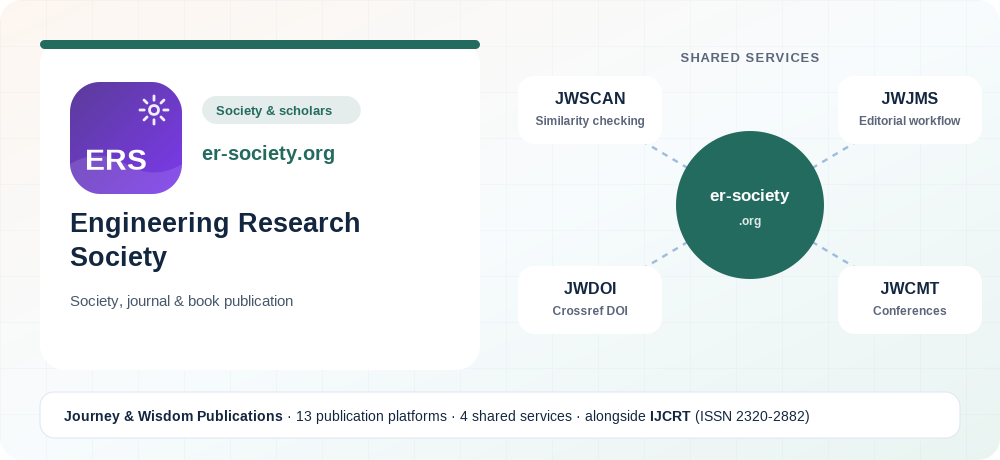
Engineering Research Society is the society platform of the Journey & Wisdom network. It publishes journal articles and books in engineering and applied technology, hosts proceedings from engineering events, and works as a knowledge hub for the community around them — authors, reviewers, organisers and students. Every JW service, from similarity checks to conference management and DOI support, can be requested through it.

  • Engineering and applied technology
  • Events and proceedings
  • A community of authors and reviewers
  • Sister-journal submissions
Engineering Research Society (er-society.org), the Journey & Wisdom society platform and knowledge hub for engineering research, events and proceedings
SocietySubject community first, titles second
3 outputsJournal articles, books and event proceedings
Knowledge hubGuides for engineering authors and organisers
4 sister journalsIJRAR, IJNRD, IJCRT and IJSDR submissions
Society & scholarsFamily shared with ScholarRPN
er-society.orgIts own scope, policies and charges

The platform

What Engineering Research Society Is

Engineering Research Society (er-society.org) sits in the “Society & scholars” family of the Journey & Wisdom network, next to Scholar Research Publication Network. It is the network’s engineering-focused society platform: it publishes journal articles and books in engineering and applied technology and hosts proceedings from engineering events. Like the six Wave hub sites, it is described by the owner as a journal platform and knowledge hub for the group’s journals, through which publication and all JW services are provided.

Two features make it different from the Wave platforms. First, it is society-shaped: the organising idea is a subject community rather than a journal title. A society platform puts the discipline’s people and standards first — the authors who publish, the reviewers who judge, the organisers who hold events, the students who are learning — and treats articles, books and proceedings as different ways of serving them. Second, according to its existing platform page, it also handles submissions for four multidisciplinary sister journals of JETIR: IJRAR, IJNRD, IJCRT and IJSDR, whose details are published on er-society.org and listed on the JETIR journals page.

This page explains the society side: what the platform provides, the kinds of engineering output it serves, how an engineering event turns into published proceedings, how a paper, a proceedings paper and a patent differ, and what a research community can and cannot do for its members. Engineering is the home field, but much of what follows — reviewer communities, events, proceedings, standards awareness — applies to any research society.

Point by point

What Engineering Research Society Provides

Thirteen things the society platform and the JW team offer its community of authors, reviewers and organisers.

  1. Journals in engineering and applied technology

    The group’s engineering journals on er-society.org publish research articles under their own scope, review policy and charges, which each journal states on its pages.

  2. An intake desk for four sister journals

    Submissions for IJRAR, IJNRD, IJCRT and IJSDR — multidisciplinary sister journals of JETIR — are handled through the platform, with each journal’s details on its own pages.

  3. Engineering books

    Monographs, edited volumes, textbooks and thesis-based books in engineering are produced with ISBNs through JW Book.

  4. Event proceedings

    Engineering conferences, symposia and workshops can publish accepted papers as proceedings volumes or route selected papers to a journal special issue that reviews them again.

  5. Conference management through JWCMT

    JWCMT runs the event workflow — call for papers, reviewer allocation by track, decisions, registration, certificates — and hands accepted papers to the publisher.

  6. A knowledge hub for engineering authors

    Guides cover engineering article types, units and notation, data and code availability, figures from instruments and simulations, and moving from conference paper to journal article.

  7. A reviewer community by speciality

    Engineering papers need reviewers who know the materials, methods and codes involved. A society platform is where those reviewers are found, invited and credited.

  8. Similarity screening through JWSCAN

    JWSCAN iThenticate reports help authors and editors handle reused methods text, standard descriptions and earlier conference versions properly.

  9. Recorded editorial work through JWJMS

    JWJMS keeps submissions, reviews and decisions on record for journals and special issues run through the platform.

  10. DOI support through JWDOI

    Where a journal or proceedings publisher registers DOIs, JWDOI prepares and deposits the metadata under that publisher’s own prefix.

  11. Open access and discovery

    Open Research Wave and Open Research Gate, both in the same Journey & Wisdom network, support open publication and repository deposit of engineering outputs.

  12. Member and author records

    ScholarRPN, the other Society & scholars platform, links an engineer’s papers, proceedings and profile into one record.

  13. Starting an engineering journal

    Departments planning their own title can read how to start an engineering journal and ask about the JW set-up, workflow and DOI services.

What engineers publish

Engineering Article Types and What Each Needs

Engineering research takes several forms. Reviewers judge each against different expectations, so choosing the right type is the first decision.

Experiment

Experimental study

Tests on materials, components, prototypes or systems. Needs specimen preparation, equipment with calibration, test standards followed, repeat counts, uncertainty and raw data availability.

Design

Design paper

A new design, method or system with its requirements, constraints, alternatives considered and evidence that it works — a prototype, a test or a validated model.

Simulation

Simulation and modelling

Numerical or analytical models. Needs governing equations, boundary conditions, mesh or step-size studies, validation against experiment or benchmarks, and software with versions.

Review

Review article

A structured survey of a technology or method, with a stated search strategy, comparison criteria and gaps. Systematic reviews follow a reporting checklist.

Case study

Case study

A real installation, failure, project or deployment analysed in depth, with data, context and lessons that apply beyond the single case.

Short form

Short communication

A brief, timely result or technical note. Same evidence standards, fewer words; often a first report that a full paper extends.

Event

Conference paper

A shorter paper presented at an event and published in proceedings; later extension into a journal article must add substantial new work.

Resource

Data or software paper

Describes a dataset, test rig, code library or model so others can reuse it, with a persistent identifier for the item itself.

Conventions engineering reviewers look for

Across these types, engineering readers expect the same habits: SI units used consistently, every symbol defined once, figures with labelled axes and units, uncertainty or error bars where measurements are reported, test standards cited by their full designation, and enough detail on materials, equipment and settings for someone else to repeat the work. Where results come from code or models, reviewers increasingly ask for the code or model to be available, or for a clear reason why it cannot be. Proprietary designs can be described at the level needed for evaluation without disclosing confidential detail — but say what was withheld and why. The discipline-by-discipline engineering guide covers field-specific expectations.

Society events

From an Engineering Event to Published Proceedings

Events are where engineering communities meet, and proceedings are how the work presented there enters the record. The flow shows the usual route through the network.

An engineering event from call for papers to proceedings1Event planTracks andpublisher2Call forpapersTemplate andrules3Review bytrackSpecialistreviewers4ScreeningOptional JWSCANcheck5EventPresentations,certificates6Final papersRevised after theevent7ProceedingsVolume or specialissueAn engineering event from call for papers to proceedings1Event planTracks and publisher2Call for papersTemplate and rules3Review by trackSpecialist reviewers4ScreeningOptional JWSCAN check5EventPresentations, certificates6Final papersRevised after the event7ProceedingsVolume or special issue
Figure 1 — The route from event to proceedings. The dashed stage is optional; the publication route should be fixed at stage 1, before the call for papers opens.

The most important decision is made first: where will accepted papers be published? A one-off proceedings volume is a book and is identified by an ISBN — free in India through isbn.gov.in. An annual proceedings series can carry an ISSN. A journal special issue is published under the journal’s ISSN after the journal’s own review, which may not accept every presented paper. Each route has its own template, length limit, licence and author agreement, and all of these belong in the call for papers so authors know before they submit.

For the organising committee, JWCMT handles the workflow, and JW Book handles a proceedings volume. For authors, the rule is simple: presentation and publication are separate decisions, and a proceedings paper later extended into a journal article must add substantial new material and cite the original. See proceedings versus a journal and publishing conference proceedings.

Compared

Journal Paper, Proceedings Paper and Patent Compared

Engineers often have three ways to record the same work. They do different jobs and come with different rules about timing and disclosure.

What you needJournal paperProceedings paperPatent
Main purposeShare verified findingsShare early work with peersProtect an invention commercially
Judged byPeer reviewers and editorsConference reviewersPatent examiners
Typical length and depthFull methods and resultsShorter, often preliminaryClaims plus enabling description
IdentifierJournal ISSN, DOI where registeredISBN for a volume, DOI optionalPatent number
Counts as public disclosureYes, once publishedYes, once presented or publishedYes, once the application is published
Order if a patent is plannedAfter the patent filingAfter the patent filingFile first, before any talk or paper
Open to anyone to read✓ if open access◐ depends on publisher✓ once published
Usual readerResearchersResearchers at the event and laterIndustry and examiners
Figure 2 — Three records of engineering work. Publishing a paper or proceedings before a patent filing can affect patentability; take advice from your institution’s IP office before disclosure.

Patent rules differ by country, and many systems treat any public disclosure — a talk, a poster, a preprint, a proceedings paper — as prior art. If your work could be patented, speak to your institution’s intellectual-property office before you submit or present it. Neither the society nor any journal can give legal advice on patents.

Community

What a Research Society Does for Its Community

A society platform is more than a set of journals. These are the roles a research society usually plays; the layers show who takes part in each.

AuthorsPublish and present
  • Journal articles
  • Books and chapters
  • Conference papers
  • Data and software
ReviewersJudge work in their speciality
  • Journal review
  • Track review at events
  • Reviewer credit
  • Declared conflicts
OrganisersBring the community together
  • Conferences
  • Workshops
  • Special issues
  • Proceedings volumes
Students and early-career membersLearn the process
  • Guides and templates
  • First submissions
  • Student sessions
  • Mentoring by seniors
Editors and boardsKeep standards
  • Scope and policies
  • Reviewer pools
  • Ethics cases
  • Corrections
Figure 3 — Roles within a research society. One person often holds several — an author this year, a reviewer next year, an organiser later.

Standards awareness is a society role that is easy to overlook. Engineering depends on published standards — for test methods, materials, safety, units and drawings — and on codes of practice that change. A society can help its members by expecting papers to cite the standard actually followed, with its full designation and year, and by explaining in its knowledge hub why that matters: a result tested to an outdated or unnamed method cannot be compared with anyone else’s.

Membership arrangements, if any, are set by the society itself and published on er-society.org; this page does not describe tiers, benefits or fees because they are not stated here. Ask the platform directly. What any genuine research society should offer, whatever its membership model, is visible: named office-holders, published policies, a record of events and outputs, and a clear statement of what members do and do not receive. Be cautious of any society, anywhere, that sells membership mainly as a route to guaranteed publication.

The guide to starting a society journal explains how societies and their journals usually relate, and the list of society-published journals shows the model across fields.

Who uses it

Who Engineering Research Society Is For

Engineering and applied-technology researchersAuthors of experimental, design, simulation, review and case-study papers who want a subject-focused community and venue.
Engineering event organisersDepartments, institutes and associations holding conferences or workshops that need a workflow and a proceedings route.
Reviewers by specialityEngineers willing to review in their field who want to be found by editors and credited for the work.
M.Tech, M.E. and doctoral studentsStudents publishing for the first time, presenting at events and learning conventions through the knowledge hub.
Sister-journal authorsResearchers submitting to IJRAR, IJNRD, IJCRT or IJSDR through the platform’s intake desk.
Departments planning a journalEngineering faculties that want their own title and need set-up, workflow, similarity and DOI support.

Step by step

Taking Part in the Community, Step by Step

Nine steps for authors, reviewers and organisers. The platform’s own pages state its current routes, policies and any charges.

The steps are written for the person taking part, not as a description of the society’s internal procedures, which er-society.org publishes for itself. Pick the steps that match your role; an organiser can skip the article steps and an author the event steps.

  1. Start on er-society.org — Open the site directly and read what it currently offers: journals, books, event proceedings, any membership or reviewer programme, and the contact route.
  2. Decide how you want to take part — As an author of an article or book, a reviewer in your speciality, an event organiser who needs proceedings, or a student learning the process — each has a different first step.
  3. For an article, match the journal and article type — Choose the journal whose scope fits and the article type that fits your work — experimental, design, simulation, review or case study — then follow its guidelines.
  4. Prepare engineering detail properly — Use SI units and defined symbols, give test conditions, materials and equipment, and state where data, code and models can be found.
  5. Check text and figures before submission — An optional JWSCAN report helps catch reused methods text; confirm you have rights to every figure and datasheet you reproduce.
  6. Offer to review in your speciality — Send a short profile with your field, methods you know well, ORCID iD and any conflicts, so editors can invite you when a paper fits.
  7. For an event, plan the proceedings route early — Contact the JW team before the call for papers opens to agree the event workflow on JWCMT and the publication route for accepted papers.
  8. Submit or apply through the stated route — Use the submission or contact route on er-society.org or the sister journal’s own site, and keep every acknowledgement and reference number.
  9. Stay part of the record — After publication or an event, link outputs to your ORCID record, share the landing pages and keep certificates and decisions for your institution.

No timelines, membership terms or charges are quoted on this page for the society platform or the sister journals. Each states its own on its website; ask in writing if a date or amount matters to you.

Honest limits

What a Society Platform Can and Cannot Do

What the society platform does

  • Publishes engineering articles, books and event proceedings
  • Brings authors, reviewers and organisers into one community
  • Explains engineering publishing conventions in its knowledge hub
  • Receives submissions for four sister journals of JETIR
  • Offers every JW service through one contact

What it cannot promise

  • Acceptance because someone is a member or presenter
  • Publication of every presented conference paper in a journal
  • Indexing in any database for any journal or proceedings
  • Patent or legal advice on disclosure
  • Recognition by a particular university or professional body

Contact

Contacting the Society and the JW Team

Charges for engineering journals, books, proceedings and the sister journals are set by each and published on their own pages. For JW services — conference management, proceedings production, similarity screening, DOI metadata, journal set-up — the team sends a written scope and quote after hearing what you need; JWSCAN publishes its rates on its own page.

Ask about Engineering Research Society and JW services

There is no fixed price list for this service: each journal, publisher or event starts from a different place, so the JW team replies with what it can do and a written quote. Describe your situation in a few lines.

Practical answers

How-To Questions About Engineering Research Society

How do I choose between a journal paper and a conference paper for my engineering work?

Choose a conference when the work is early, you want feedback and the field values the event; choose a journal when the work is complete and fully validated. Many engineers do both: present early results, then publish an extended journal version that adds substantial new work and cites the conference paper.

How do I report experimental uncertainty in an engineering paper?

State the uncertainty of each instrument, how many repeats you ran, how you combined uncertainties and what the error bars in figures represent. Report results with a sensible number of significant figures. Reviewers distrust precise-looking numbers without uncertainty.

How do I describe a simulation so reviewers can check it?

Give the governing equations, assumptions, boundary and initial conditions, the solver and software with versions, mesh or time-step independence results and validation against experiment or a benchmark. Share input files or code where possible, or say why not.

How do I cite an engineering standard correctly?

Use the issuing body, the full designation, the year or version and the title, exactly as it appears on the standard. Cite the version you actually followed, not the latest one, and say if you deviated from it and why.

How do I become a reviewer for engineering papers?

Send a short profile to the platform or journal: your specialities, the methods you know, recent publications, ORCID iD and any conflicts. Review promptly, stay within your expertise and decline papers where you have a conflict. This first-time reviewer guide helps with the report itself.

How do I organise an engineering conference with published proceedings?

Fix the dates, tracks and publication route first, then contact the JW team about running the event on JWCMT and producing proceedings through JW Book or a journal special issue. Put the template, licence and author agreement in the call for papers.

How do I extend a conference paper into a journal article?

Add substantial new material — more experiments, deeper analysis, a fuller comparison — rewrite rather than pad, cite the conference paper and tell the journal about it in the cover letter. This guide sets out what usually counts as a real extension.

How do I protect a possible invention before presenting it?

Talk to your institution’s intellectual-property office before any public disclosure — a talk, poster, preprint or paper. In many countries disclosure before filing can prevent a patent. Once a filing is made, you can usually present and publish as normal.

How do I submit to IJRAR, IJNRD, IJCRT or IJSDR?

Use the submission route shown on er-society.org or on the journal’s own website, listed on the JETIR journals page. Read the journal’s scope, guidelines and charges first, and keep the acknowledgement with its reference number.

How do I share data and code from an engineering study?

Deposit datasets, test records, CAD or model files and code in a repository that issues persistent identifiers, add a licence and a short readme, cite them in your paper and describe access in a data-availability statement. Withhold only what confidentiality or safety requires, and say so.

How do I present engineering figures that print and project well?

Label axes with quantities and units, keep text legible at final size, use markers as well as colours so lines remain distinguishable in greyscale, and avoid 3D effects that distort data. Export at the resolution the journal requests.

How do I ask the JW team for help with an engineering journal or event?

Email editor@jetir.org or message +91 94260 33211 on WhatsApp with the department or society, the event or journal, expected numbers and your timeline. The team replies with a written scope and quote; nothing starts before you agree it.

Ready to publish?

Submit your paper to JETIR

Peer-reviewed, open access, monthly · ISSN 2349-5162 · Crossref DOI · ₹1501 / $59 only after acceptance.

Questions

Engineering Research Society — Frequently Asked Questions

What is Engineering Research Society?
Engineering Research Society (er-society.org) is the society platform of the Journey & Wisdom network: it publishes engineering and applied-technology articles, books and event proceedings, serves as a knowledge hub for that community, and offers every JW service.
Is Engineering Research Society only for engineering?
Its own publishing focus is engineering and applied technology. Through its intake desk for four multidisciplinary sister journals of JETIR, it also receives work from other fields.
Which sister journals does er-society.org handle submissions for?
IJRAR, IJNRD, IJCRT and IJSDR, according to its platform page. Each journal’s scope, ISSN and charges are on its own pages and on the JETIR journals page.
Does membership of the society guarantee publication?
No. Publication decisions belong to each journal’s editors after peer review. Membership terms, if any, are published by the society on er-society.org.
Can my engineering conference publish proceedings through the network?
Yes. JWCMT can manage the event and JW Book can publish a proceedings volume with an ISBN; selected papers can go to a journal special issue that reviews them again. Charges are quoted in writing.
Is a conference paper the same as a journal article?
No. Proceedings papers are usually shorter and reviewed by the event; a journal article is reviewed by the journal and usually reports complete work. An extension must add substantial new material.
Will engineering proceedings be indexed in major databases?
Indexing is decided by each database on its own criteria, and no platform can promise it. Complete metadata and careful review make proceedings easier to evaluate.
Is Engineering Research Society part of JETIR?
They are separate members of the same network. JETIR (ISSN 2349-5162) is a multidisciplinary journal with its own editors and fees; er-society.org is the network’s society platform.
Can students take part?
Yes. Students can publish, present at events and use the knowledge hub’s guides; any student programmes are described on er-society.org.
Does the society give patent advice?
No. Questions about patents and disclosure should go to your institution’s intellectual-property office or a qualified patent professional.
How are reviewers chosen for engineering papers?
Editors invite reviewers by speciality, checking for conflicts of interest. Engineers can offer to review by sending a profile with their fields and ORCID iD.
Where do I ask about JW services for an engineering department?
Write to editor@jetir.org or WhatsApp +91 94260 33211 with your plans; the reply includes a written scope and quote.

Terms to know

Important Keywords

Terms that come up for engineering authors, reviewers and event organisers in a research society.

  • Engineering Research Society
  • er-society.org
  • research society platform
  • engineering research community
  • applied technology research
  • engineering article types
  • experimental study
  • design paper
  • simulation and modelling paper
  • engineering case study
  • SI units
  • measurement uncertainty
  • engineering standards citation
  • conference proceedings
  • proceedings with ISBN
  • journal special issue
  • conference paper extension
  • patent and prior disclosure
  • engineering peer reviewers
  • sister journals IJRAR IJNRD IJCRT IJSDR
  • knowledge hub
  • Society and scholars

Publish your own research

Engineering and Multidisciplinary Papers in JETIR

JETIR, the network’s multidisciplinary journal, accepts engineering research alongside other fields, reviewed double-blind by subject reviewers. Its guidelines and submission page are below.

JETIR at a glance

  • Journal of Emerging Technologies and Innovative Research · ISSN 2349-5162 · monthly · since 2014
  • Transparent, double-blind peer review by subject reviewers
  • Open access under CC BY 4.0 · multidisciplinary scope
  • ₹1501 (Indian authors) / US$59 (foreign authors), charged only after acceptance
  • Indian papers with more than 5 authors: ₹500 per extra author, incl. GST · no extra-author fee for foreign authors

Before you submit

JETIR is a Transparent, Peer-Reviewed, Open Access Journal (Refereed Journal). Following the discontinuation of UGC and UGC-CARE journal listing, JETIR is aligned with UGC's Suggested Parameters for Choosing Peer-Reviewed Journals.

Planning an engineering event, book or paper?

Ask the JW team about er-society.org, proceedings, conference management or any JW service. For a finished paper, JETIR accepts engineering work in its multidisciplinary scope and invoices only after acceptance (₹1501 India, US$59 elsewhere).

Just ₹1501
Publish in a UGC-aligned Peer-Reviewed JournalLow Cost ₹1501 Indian Author$59 USD InternationalPublish in a UGC-aligned Peer-Reviewed Journal₹1501 Indian Authors$59 USD InternationalUGC-aligned peer-reviewed journal · ₹1501 India · $59 Intl
Submit Paper →
Support