JETIR Home › JW Ecosystem › International Journal Wave

Wave family · International authors · Journey & Wisdom Publications

International Journal Wave: Publishing Across Borders — ijwave.org

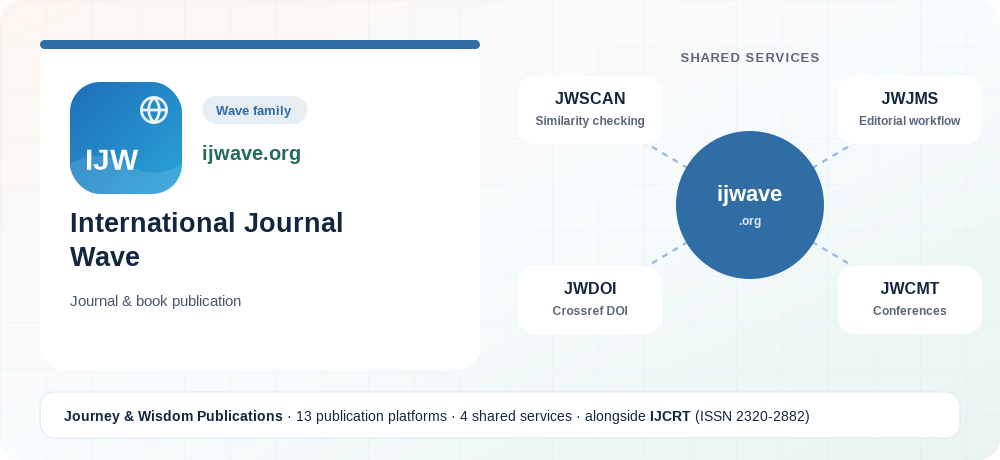
International Journal Wave is a journal platform and knowledge hub of the Journey & Wisdom network for research that crosses national borders. The group’s journals are published through it, its guides cover the practical side of international authorship, and authors can request any JW service from the same place — from similarity checks to DOI support and book publication.

  • International co-authorship
  • ORCID and affiliation metadata
  • Verifying a journal abroad
  • Every JW service on request
International Journal Wave (ijwave.org), a Journey & Wisdom journal platform and knowledge hub for authors publishing across borders
Cross-borderBuilt for authors and teams in more than one country
HubJournal platform with a knowledge base for international authors
Wave familyOne of six Wave platforms in the network
4 servicesSimilarity, workflow, DOI and conference support behind it
EnglishManuscripts written for an international readership
ijwave.orgJournals, scope and charges on its own site

The platform

International Journal Wave as a Platform and a Knowledge Hub

International Journal Wave (ijwave.org) is the international-facing site of the Wave family. The owner describes each of these sites in the same way: a journal platform and knowledge hub for the group’s journals, from which publication and all JW services are provided. On ijwave.org that means three things. Journals of the group are published there, with their scope, boards and policies. Guides explain how publishing works when authors, readers and institutions are in different countries. And the full range of JW services — journal and book publication, similarity checking, DOI support, conference and journal management, discovery help — can be requested through it.

The international angle is not decoration. A paper written by authors in two countries, reviewed by a third, read in a fourth and assessed by a committee in a fifth runs into problems that a purely local paper never meets: names written in different scripts, institutions with several official names, deadlines in different time zones, fees in a foreign currency, and committees that want proof in a particular form. Most of these problems are solved by good metadata and good habits, not by a special kind of journal.

This page collects those habits. It explains what International Journal Wave provides, the journey of an international manuscript, how co-authors in several countries share the work, how to verify a journal you have never seen before, and what evidence to keep. Other Wave pages take other topics: Journal Wave explains the written publishing standard of the family, and International Journal Publication deals with papers that cross disciplines rather than borders.

Point by point

What International Journal Wave Provides

Twelve things an international author or research team can get from the platform and the JW team.

  1. Journals open to authors from any country

    The group’s journals on ijwave.org accept work from authors wherever they are based. Scope, article types and policies are published in English so they read the same way in every country.

  2. A knowledge hub for international authors

    Guides cover the questions that arise across borders: writing for readers outside your field’s home country, author names and affiliations, ORCID, verifying a journal, and keeping evidence for funders and committees.

  3. Metadata that survives translation

    Author names, ORCID iDs and affiliations are collected in a structured form, so the published record does not depend on how a name was typed in a cover letter.

  4. Similarity checking via JWSCAN

    JWSCAN runs manuscripts through iThenticate by Turnitin. For multi-author papers drafted in several places, the source list shows where borrowed text came from before an editor finds it.

  5. A recorded review through JWJMS

    Submissions, reviewer reports and decisions are kept on a record in JWJMS, which helps when co-authors in different time zones need to see the same correspondence.

  6. DOI support via JWDOI

    For journals that register DOIs, JWDOI prepares and deposits the metadata under the journal’s own prefix — a DOI link works the same way in every country.

  7. International conferences via JWCMT

    JWCMT runs calls for papers, review and registration for events with delegates from many countries, with a route to proceedings.

  8. Book publication via JW Book

    Edited volumes with contributors from several countries, monographs and proceedings are handled by JW Book, including ISBNs and production.

  9. Open access and discovery

    Open Research Wave and Open Research Gate, both part of the same Journey & Wisdom network, help keep work free to read and findable from anywhere.

  10. A record that follows the researcher

    ScholarRPN links an author’s publications and profile, useful for researchers who move between countries and institutions during a career.

  11. Written answers on charges and process

    Charges for each journal are stated on its own pages; charges for JW services are confirmed in writing before work begins. Written answers matter when an institution abroad must approve a payment.

  12. One contact for every request

    editor@jetir.org or WhatsApp +91 94260 33211 reaches the JW team from any country. Write in English and include your time zone so replies can be planned.

Across borders

The Journey of a Cross-Border Manuscript

An international paper passes through more hands than a local one. The figure shows the stages where cross-border problems usually appear.

A cross-border manuscript from team to evidence file1TeamagreementAuthors,order, roles2IdentifiersORCID andaffiliations3EnglishdraftUnits, dates,terms4JournalcheckISSN Portal,DOIs5SubmissionOn ijwave.org6ReviewAcross timezones7ChargesOnly asstated,receipts kept8EvidenceFor funder orcommitteeA cross-border manuscript from team to evidence file1Team agreementAuthors, order, roles2IdentifiersORCID and affiliations3English draftUnits, dates, terms4Journal checkISSN Portal, DOIs5SubmissionOn ijwave.org6ReviewAcross time zones7ChargesOnly as stated, receipts kept8EvidenceFor funder or committee
Figure 1 — Eight stages of a cross-border manuscript. Most delays come from stages 1, 2 and 6: unclear authorship, missing identifiers and slow replies across time zones.

Two stages deserve special attention. Team agreement comes first because changing the author list after submission is difficult everywhere and almost impossible after publication; when co-authors are in different countries, disagreements surface late and are slow to settle. Identifiers come second because they fix problems that no amount of careful typing can: the same author written three ways, an institution known by a local name and an English name, a transliterated surname that changes between papers.

Names, scripts and affiliations

Researchers whose names are written in a non-Latin script, or who use a family name first, should decide how their name will appear in English and use that form every time. An ORCID iD links all variants to one person, which is why journals increasingly ask for it. For institutions, use the official English name and check whether it has a record in the Research Organization Registry (ROR); ROR identifiers are free, openly licensed and used in Crossref affiliation metadata. More on this in why researchers need ORCID.

Writing for a reader in another country

International readers do not know your national exam system, your currency, your ministry’s name or the abbreviation every colleague at home uses. Define them once. Use SI units, write dates as “12 March 2026” rather than numbers that read differently in different countries, give monetary amounts with a currency code and a year, and describe sampling frames in a way that someone abroad could reproduce. The guide on writing for an international audience goes further.

Team work

Who Does What in an International Author Team

Clear roles prevent most cross-border disputes. These layers show the usual division of work and what each role is responsible for.

Corresponding authorOne voice to the journal
  • Submits the files
  • Receives decisions
  • Sends one response
  • Approves proofs
  • Keeps everyone informed
Co-authors in other countriesShare responsibility
  • Approve the final text
  • Supply ORCID and affiliation
  • Declare conflicts
  • Answer within the team deadline
Lead institution(s)Approvals and records
  • Ethics approval
  • Data-sharing agreements
  • Payment approval
  • Repository policy
FundersConditions on the output
  • Grant acknowledgement
  • Open-access requirement
  • Licence requirement
  • Reporting deadlines
Contributors who are not authorsAcknowledged, not listed
  • Translators
  • Data collectors
  • Technical staff
  • Language editors
Figure 2 — Role layers in an international team. Every listed author approves the final version; contributors who do not meet authorship criteria are acknowledged instead.

Authorship criteria are broadly the same everywhere: a substantial contribution to the work, a part in drafting or revising it, approval of the final version and acceptance of responsibility for it. What differs between countries is local practice — in some systems a department head expects to be listed, in others never. When teams cross borders, write the rule down at the start and apply it to everyone. Authorship guidelines and handling authorship disputes cover the details.

Funders in different countries may attach different conditions to the same paper: one asks for immediate open access under CC BY, another for deposit in a named repository, a third for a grant number in a specific format. The corresponding author should collect all of these before submission and check them against the journal’s policies; it is far easier to choose a compatible journal than to negotiate exceptions after acceptance.

Check it yourself

How to Verify a Journal in Another Country

When you cannot visit a publisher or ask a local colleague, public registers do the checking for you. The table shows each common claim and where to confirm it.

What you needWhere to confirm itWhat a good answer looks like
The ISSN printed on the siteISSN PortalSame title, medium and country as the site shows
DOIs on the articlesdoi.org and Crossref SearchEach DOI opens the article’s own landing page
That the journal deposits with CrossrefCrossref title listThe title appears with its ISSN and publisher
Open-access listing claimsDOAJ searchThe journal is found in DOAJ itself, not only as a logo
Editors and their affiliationsInstitution websites and ORCID recordsNamed people who confirm the role
Ethics and peer-review policiesThe journal’s own policy pagesModel, reviewer number and appeals stated
General trustworthinessThink. Check. Submit.You can answer its checklist with evidence
Figure 3 — A verification checklist for a journal you cannot check in person. Any claim you cannot confirm at its source should be treated as unconfirmed.

The same checks apply to every journal on ijwave.org and to every journal anywhere else. Logos, certificates and badges on a website prove nothing by themselves; the record at the source does. If a journal says it is indexed somewhere, search for it on the indexing service’s own site. If it gives an impact factor, find out who calculated it and how. If it promises acceptance or a fixed review time measured in days, treat that as a warning sign rather than an attraction.

Cloned and hijacked journals copy the name and ISSN of real titles to collect fees from authors abroad. Always reach a journal by typing its address yourself, and compare the website address with the one recorded in the ISSN Portal. The guide on fake indexing services shows typical patterns.

Who uses it

Who International Journal Wave Is For

Researchers publishing outside their home countryAuthors who want an English-language venue and need to understand how journals, identifiers and fees work in an international setting.
Cross-border research teamsCollaborations with authors in two or more countries who need clear roles, shared records and one corresponding author.
Doctoral students abroadStudents who study in one country, publish in another and report to a committee in a third, and who need evidence in a recognisable form.
Diaspora researchersAcademics working abroad who co-author with colleagues at home and want both institutions named correctly.
Editors of international issuesEditors handling contributors from many countries who want the JW workflow, DOI and similarity services behind them.
Institutions checking foreign venuesResearch offices and committees that need a method for checking a journal they have never dealt with.

Step by step

Submitting Through International Journal Wave, Step by Step

Nine steps an international author or team can follow. The exact submission route for each journal is stated on ijwave.org.

The steps below are written from the author’s side. They do not describe the platform’s internal editorial process, which each journal publishes in its own peer-review policy; they describe what you control, and in what order, so that distance and time zones do not turn into delays.

  1. Verify the journal from where you are — Open ijwave.org directly, note the journal’s ISSN and check it on the ISSN Portal; if the journal registers DOIs, open two or three at doi.org to see that they resolve to its own pages.
  2. Agree authorship and roles across the team — Decide in writing who the authors are, the order of names, each person’s contribution and who will be the corresponding author before anyone uploads a file.
  3. Collect identifiers for every author — Ask each co-author for an ORCID iD and the official English name of their institution, ideally matched to its ROR record, so the published metadata is correct in every country.
  4. Prepare an English manuscript for a mixed readership — Use consistent spelling, SI units, unambiguous dates, and explain local terms, currencies and institutions that a reader abroad would not know.
  5. Check the text with JWSCAN if you wish — An optional JWSCAN report shows overlap with published sources, which matters when parts of a paper were drafted by different people in different places.
  6. Submit through the platform — Upload the files on ijwave.org with every author’s details, declarations and a cover letter that names any deadline you face.
  7. Handle review across time zones — Share reviewer comments with all co-authors at once, set an internal deadline ahead of the journal’s, and let the corresponding author send one consolidated response.
  8. Settle charges only as the journal states — Pay only after the journal confirms what is due and when, through the route it publishes, and keep the invoice and receipt for your institution.
  9. Keep the evidence your institution needs — Save the acceptance email, the published landing page, the DOI if one is registered and the licence, in the form your funder or employer asks for.

No timeline or price is quoted here for the platform. Review time depends on the journal, the field and the reviewers, and charges are set by each journal and stated on its pages. Ask in writing if a deadline matters to you — for a visa, a contract or a degree — and keep the reply.

Practical matters

Paying From Abroad and Keeping Evidence

Money and paperwork cause more trouble for international authors than writing does. These points apply whatever journal you choose.

Payments

Know when payment is due

Many open-access journals, JETIR among them, charge only after acceptance. Be cautious of any journal that asks for payment at submission without a clear refund rule.

Payments

Use the published route only

Pay through the method the journal lists on its own website and invoice. Never pay into a personal account named in an unsolicited email.

Payments

Expect bank and conversion costs

International transfers and card payments can add bank charges and exchange-rate differences. Ask the journal which currency it invoices in and who bears the charges.

Records

Ask for a proper invoice

Institutions abroad often need an invoice with the publisher’s name, address, the article title and a reference number before they can reimburse you.

Evidence

Keep acceptance and publication separate

An acceptance letter shows a decision; a live landing page and DOI show publication. Committees usually want the second. See which proof counts.

Evidence

Save the version of record

Keep the final PDF, the landing-page address, the licence and the citation. A screenshot is weaker evidence than a resolvable DOI.

For authors in India paying journals abroad, or authors abroad paying an Indian journal, this payment guide explains common routes. Whatever the route, the rule is the same: a legitimate journal states its charges before you submit, invoices you after the decision it says triggers payment, and gives a receipt.

Read before you plan

What International Journal Wave Does Not Promise

What the platform and the JW team do

  • Publish the group’s journals for authors from any country
  • Explain international authorship and verification in the knowledge hub
  • Offer every JW service through one contact point
  • State journal charges on the journals’ own pages
  • Confirm JW service charges in writing before work starts

What no platform can promise

  • Acceptance of a paper — editors decide after review
  • Recognition by a particular university, ministry or visa office
  • Indexing in any database — each service decides for itself
  • A fixed review time measured in days
  • That “international” in a name means anything by itself

The word “international” in a journal title tells you about the publisher’s intention, not about the journal’s quality or recognition. What makes a journal genuinely international is visible on its pages: an editorial board drawn from several countries, authors from many places, English abstracts and metadata, and records that anyone can check. Apply that test to ijwave.org exactly as you would to any other site.

Contact

Asking About a Journal or a Service

Journal charges are published by each journal on ijwave.org. For JW services — a similarity report, DOI support, conference management, journal management or a book — there is no price list on this page; the team replies to each request with a written scope and quote. Mention your country and preferred currency so the reply is useful the first time.

Ask about International Journal Wave and the JW services

There is no fixed price list for this service: each journal, publisher or event starts from a different place, so the JW team replies with what it can do and a written quote. Describe your situation in a few lines.

Practical answers

How-To Questions About International Journal Wave

How do I check a journal on ijwave.org before submitting from abroad?

Type ijwave.org yourself rather than following a link in an email. Note the ISSN of the journal you want and look it up on the ISSN Portal. Open a few published articles and resolve their DOIs, if any, at doi.org. Read the peer-review and ethics policies and the editorial board page, and confirm one or two editors on their institutions’ websites.

How do I agree the author order with co-authors in other countries?

Agree it in writing before submission: list each person’s contribution against the authorship criteria and decide the order and the corresponding author in one shared document. Use a contributor-roles list so contributions are described the same way for everyone. Changing the list after submission requires every author’s written consent and the editor’s approval.

How do I write my name consistently across journals?

Choose one English form of your name — including the order of given and family names and any transliteration — and use it on every paper. Register an ORCID iD and add name variants there. Give the iD at every submission, so search engines and indexes link all your papers to one person.

How do I list an affiliation in another country correctly?

Use the institution’s official English name, then department, city and country. Check whether the institution has a record in the ROR registry and use that name. If you hold two affiliations, list both in the order your employers expect, and do not invent an affiliation for prestige.

How do I handle peer review when co-authors are in different time zones?

Circulate the decision letter to all co-authors on the day it arrives, set an internal deadline a week before the journal’s, and assign each comment to a named person. The corresponding author merges the replies into one point-by-point response. If you need more time, ask the editor before the deadline, not after.

How do I prepare an English manuscript if English is not my first language?

Write short sentences, keep one term for one concept and avoid idioms. Ask a colleague who reads English well to check clarity, or use a language editor and acknowledge them. If you use an AI tool for language, disclose it and check every change; the meaning must stay yours.

How do I pay a publication charge from another country?

Pay only after the journal confirms the amount and the trigger — usually acceptance — and only through the method it publishes. Ask which currency it invoices in and whether bank charges are added. Keep the invoice and the bank or card receipt, and send proof of payment from the same email address you used to submit.

How do I prove a publication to a committee abroad?

Give the citation with a resolvable DOI or landing-page link, the published PDF, and the licence. An acceptance letter only shows a decision. If the committee asks for indexing evidence, show the record on the indexing service’s own website, not a logo on the journal’s site.

How do I meet a funder’s open-access rule from another country?

Read the funder’s policy for the licence, timing and deposit it requires — many ask for CC BY and immediate open access. Check that the journal’s licence and self-archiving policy match before you submit. Keep the grant number in the acknowledgements exactly as the funder writes it.

How do I spot a cloned version of a journal?

Compare the website address with the one in the ISSN Portal record, check that DOIs resolve to that same site, and be wary of journals that write only from free email accounts or ask for payment before review. The Retraction Watch Hijacked Journal Checker lists known clones by title.

How do I ask the JW team for a service from outside India?

Email editor@jetir.org or send a WhatsApp message to +91 94260 33211 in English. Say which service you need, your country and time zone, the size of the job and your deadline. You receive a written scope and quote; no work starts until you agree it.

How do I present at an international conference and still publish the full paper?

Check whether the conference publishes proceedings and under what licence. If it does, a later journal version must add substantial new material and cite the conference paper. Presenting at a conference and extending a conference paper explain both stages.

Ready to publish?

Submit your paper to JETIR

Peer-reviewed, open access, monthly · ISSN 2349-5162 · Crossref DOI · ₹1501 / $59 only after acceptance.

Questions

International Journal Wave — Frequently Asked Questions

What is International Journal Wave?
International Journal Wave (ijwave.org) is the Wave-family journal platform and knowledge hub for cross-border publishing. The group’s journals are published through it, it explains international authorship in plain language, and every JW service can be requested from it.
Can authors from any country submit through ijwave.org?
Yes. The journals published through the platform accept submissions from authors in any country, subject to each journal’s scope and policies.
Does an international journal title mean the journal is better?
No. The word describes intent, not quality. Look for an international editorial board, authors from many countries, English metadata and records you can verify at their sources.
Is International Journal Wave the same journal as JETIR?
No. JETIR (ISSN 2349-5162) is a separate journal in the same network with its own editors, policies and charges. A paper submitted to one is not published on the other.
Why do I need an ORCID iD for an international paper?
An ORCID iD links every version of your name to one person, so your papers are attributed correctly whatever script or name order a database uses.
What is ROR and should my affiliation use it?
ROR, the Research Organization Registry, gives each institution a free, open identifier. Using the ROR name for your institution keeps affiliations consistent in metadata across countries.
When do I pay a publication charge?
Only as the journal states on its own pages and invoice. Many journals in the network, including JETIR, charge only after acceptance.
Will my publication be recognised by my university or a visa office?
Recognition is decided by each institution or authority. Ask them for their written rule before you submit, and keep evidence they accept, such as a resolvable DOI and the published article.
Does ijwave.org guarantee indexing in international databases?
No. Indexing services apply their own criteria and decide independently. Check any indexing claim on the database’s own website.
Can international conference organisers use JW services?
Yes. JWCMT manages calls for papers, review, registration and certificates, and JW Book handles proceedings volumes. Charges are quoted in writing on request.
Is JW a Crossref Sponsor for international journals?
No. JWDOI prepares and deposits DOI metadata for journals under their own prefix; it is not a Crossref Sponsor or an accredited Crossref Service Provider.
Who should be the corresponding author in a cross-border team?
The author who can reply fastest and most reliably to the journal, has access to all files and can coordinate co-authors — not automatically the most senior person.

Terms to know

Important Keywords

Terms that matter when a paper, its authors and its readers are in different countries.

  • International Journal Wave
  • ijwave.org
  • international authors
  • cross-border publishing
  • international co-authorship
  • corresponding author
  • authorship order
  • ORCID iD
  • ROR identifier
  • affiliation metadata
  • author name transliteration
  • English manuscript
  • SI units
  • ISSN Portal check
  • Crossref title list
  • hijacked journal
  • Think Check Submit
  • international publication charges
  • proof of publication
  • funder open-access policy
  • time zones and deadlines
  • knowledge hub
  • Wave family

Publish your own research

International Authors Also Publish in JETIR

JETIR is a separate journal in the same network that accepts multidisciplinary research from authors in any country, with fees for foreign authors stated in US dollars and charged only after acceptance.

JETIR at a glance

  • Journal of Emerging Technologies and Innovative Research · ISSN 2349-5162 · monthly · since 2014
  • Transparent, double-blind peer review by subject reviewers
  • Open access under CC BY 4.0 · multidisciplinary scope
  • ₹1501 (Indian authors) / US$59 (foreign authors), charged only after acceptance
  • Indian papers with more than 5 authors: ₹500 per extra author, incl. GST · no extra-author fee for foreign authors

Before you submit

JETIR is a Transparent, Peer-Reviewed, Open Access Journal (Refereed Journal). Following the discontinuation of UGC and UGC-CARE journal listing, JETIR is aligned with UGC's Suggested Parameters for Choosing Peer-Reviewed Journals.

Publishing with co-authors in another country?

Ask the JW team about a journal on ijwave.org or any JW service, with your country and deadline. Ready to submit a multidisciplinary paper now? JETIR charges US$59 for foreign authors and ₹1501 for Indian authors, only after acceptance.

Just ₹1501
Publish in a UGC-aligned Peer-Reviewed JournalLow Cost ₹1501 Indian Author$59 USD InternationalPublish in a UGC-aligned Peer-Reviewed Journal₹1501 Indian Authors$59 USD InternationalUGC-aligned peer-reviewed journal · ₹1501 India · $59 Intl
Submit Paper →
Support