JETIR Home › JW Ecosystem › Journal Wave & Book Publication Network

Network hub · Journal and book publication · Journey & Wisdom Publications

JWBPN: Choosing the Journal Route, the Book Route, or Both — jwbpn.org

The Journal Wave & Book Publication Network is the layer of the Journey & Wisdom group that joins its journal platforms to its book platforms. It does not publish papers itself; it helps an author, editor or organiser decide which route a piece of work should take — journal article, book chapter, whole book, or a planned sequence of several — and connects that work to the platforms and shared services that carry it.

  • Journal route
  • Book route
  • Dual pathways
  • Shared services on both
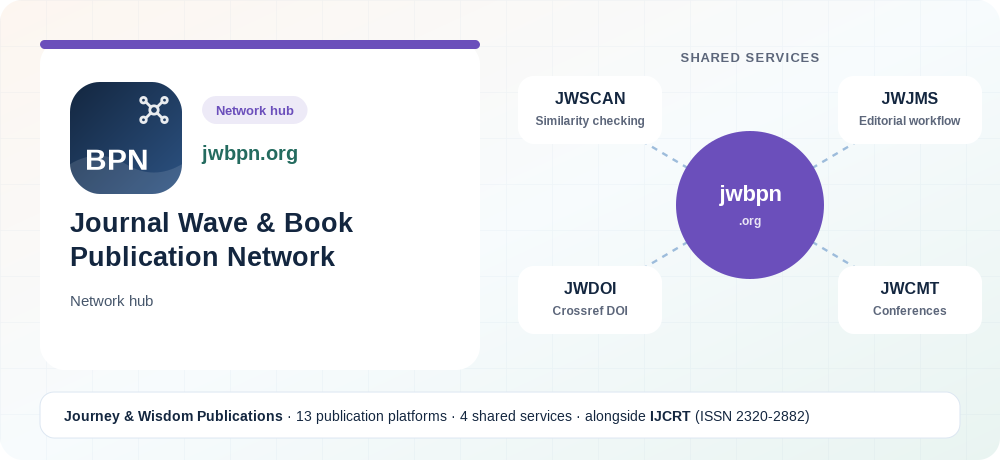
JWBPN (jwbpn.org): the Journal Wave and Book Publication Network connecting journal platforms, book platforms and shared services
2 routesJournal publication and book publication, joined in one network
Not a journalJWBPN routes work; the platforms publish it
13 platformsJournal and book platforms in five families
4 servicesSimilarity, workflow, DOI and conference support on both routes
Your callFormat decided by the author; acceptance by each venue
jwbpn.orgThe network hub online

The network layer

What JWBPN Is: The Joint Between Journals and Books

Most publishers keep journals and books in separate departments that rarely talk. A researcher who finishes a doctoral project, a professor who edits a themed issue or an organiser who closes a conference then has to work out alone which parts of the work belong in a journal, which in a book, and how to stop the two from colliding. The Journal Wave & Book Publication Network (jwbpn.org) exists for that join. The site’s own network article describes it as the network layer connecting book projects to the journals and services around them.

JWBPN is not a journal and does not accept papers for publication in its own name. Its job is routing. It sets the journal platforms of the network — JETIR and its sister journals, and the Wave family — next to the book platforms, JW Book above all, and shows how a single body of research can move through both without duplication. The four shared services (JWSCAN, JWJMS, JWDOI and JWCMT) sit behind both routes, so screening, workflow, identifiers and conference handling work the same way whichever route a piece takes.

This page is written as a route planner. It explains the difference between the two routes, the projects that need both, the rules for moving material from one to the other honestly, and who makes which decision. For the full list of services the publisher offers, see JW Publication; for how a book is actually produced, see JW Book.

Point by point

What the Network Offers Across Both Routes

Twelve things JWBPN and the JW team provide to someone whose work could become articles, books or both.

  1. A format assessment

    Before a venue is chosen, the work is looked at as a whole: is it one finding, several findings or one long argument? The answer decides whether it should be an article, a set of articles, a chapter or a book.

  2. A map of journal platforms

    JETIR and the sister journals listed on the journals page, plus the Wave-family platforms, each with its own scope, policies and charges. JWBPN points to the one whose scope fits.

  3. A map of book platforms

    JW Book for monographs, edited volumes, textbooks, proceedings and thesis-based books, with JW Publication presenting the publisher behind them.

  4. One conversation for mixed projects

    A project that needs two articles and a book later can be planned in one exchange with the JW team instead of three separate enquiries that contradict each other.

  5. Planned order of publication

    Findings first, synthesis later; conference paper first, extended article later. The network helps fix an order that each venue will accept.

  6. Rules for honest reuse

    Clear guidance on what can move from an article into a chapter or a book, what must be declared, and where permission is needed.

  7. Shared screening on both routes

    The same iThenticate by Turnitin reports through JWSCAN screen journal manuscripts and book chapters, so overlap between your own outputs is found before an editor finds it.

  8. Shared workflow records

    Journal platforms keep submissions, reviews and decisions on record through JWJMS; book projects keep their editorial record too. Each output has a history that can be shown later.

  9. Identifiers that fit each format

    ISSN and DOI for journal articles, ISBN for each book format, optional DOIs for books and chapters through JWDOI support — always under the publisher of record’s own prefix.

  10. Event outputs split correctly

    For conferences run on JWCMT, accepted papers can go to a proceedings volume through JW Book or, after the journal’s own review, to a special issue. The network keeps the two decisions apart.

  11. Discovery after publication

    Optional repository deposit and records on the network’s open platforms, OpenRGATE for researchers’ outputs and ORWave for journal records — both part of the same network.

  12. A written quote for any paid service

    Where a service has a charge, the scope and the amount are confirmed in writing before work starts. Each journal publishes its own article charge on its own site.

Architecture

The Journal Side and the Book Side Around One Hub

JWBPN sits between the platforms that publish journal articles and the platforms that publish books; the shared services serve both.

Journal and book platforms around JWBPNJWBPNjournal + bookroutesJETIR and sister journalsPeer-reviewed articles, ISSNand DOIWave platformsJournal articles and booksby familyER SocietyEngineering articles, books,eventsJW BookMonographs, volumes,proceedingsJW PublicationThe publisher and itsservice deskJWSCANSimilarity reports on bothroutesJWJMSSubmission and reviewrecordsJWDOIDOI metadata supportJWCMTConference papers to eitherrouteOpenRGATE and ORWaveDeposit and records, samenetworkJournal and book platforms around JWBPNJWBPNJETIR and sister journalsPeer-reviewed articles, ISSN and DOIWave platformsJournal articles and books by familyER SocietyEngineering articles, books, eventsJW BookMonographs, volumes, proceedingsJW PublicationThe publisher and its service deskJWSCANSimilarity reports on both routesJWJMSSubmission and review recordsJWDOIDOI metadata supportJWCMTConference papers to either routeOpenRGATE and ORWaveDeposit and records, same network
Figure 1 — The JWBPN hub. The platforms that publish journal articles and books are on the right; the shared services and the open platforms that serve both routes are on the left.

The figure is a map, not an org chart. Every platform on it publishes its own scope, editorial process, policies and charges, and nothing on the hub overrides what a platform says about itself. What the hub adds is the joins: the point where a conference hands papers to a book, where a journal community commissions a volume, or where an author’s articles become the raw material of a monograph.

The core decision

Article, Chapter or Book? A Side-by-Side Decision Guide

The format should follow the shape of the work, not the speed of the venue or the points it might earn.

What you needJournal articleChapter in an edited bookWhole book (monograph)
Shape of the workOne finding, method or reviewOne part of a shared themeOne long argument or synthesis
Who it is judged byJournal editor and peer reviewersVolume editors and their reviewersPublisher’s editors or external readers
Usual identifierISSN of the journal + article DOIISBN of the book + optional chapter DOIISBN per format + optional DOI
How readers find itArticle-level search and citation databasesThrough the book and, if registered, the chapter DOILibrary catalogues, book search, the publisher
Best when you needCitable findings others build on quicklyA place in a focused collectionSpace to develop and connect ideas
Can later become part of the other format✓ cited and declared◐ with editors’ and publisher’s agreement◐ chapters can seed articles if new
Figure 2 — The three main formats compared. “Partly” means possible only with permission, declaration and genuinely new material.

Two questions settle most cases. Will other researchers cite a specific result? If yes, that result belongs in a journal article, where it can be found, reviewed and cited on its own. Does the value lie in the connections between results? If yes, a book is the right container, because no single article can hold the whole argument. Projects that answer yes to both are the reason JWBPN exists: they need articles first and a book afterwards, planned together.

A third question is about the reader. Teaching material, practitioner guidance and long historical narrative are written for people who read from start to finish, which is how books are read. Research findings are written for people who search, skim and cite, which is how articles are read. Choosing the format that matches how your reader reads is usually the same as choosing correctly.

Step by step

Planning a Project That Uses Both Routes

Seven steps that turn a body of work into a sequence of outputs, each in the right venue. The figure shows the same plan.

Routing a body of work through JWBPN1InventoryEverything theproject produces2FormatArticle, chapteror book3OrderWhat appearsfirst4VenueJournal or bookplatform5PrepareEach to its ownguidelines6DeclareLinks betweenoutputs7ConnectDOIs, ISBNs,ORCIDRouting a body of work through JWBPN1InventoryEverything the project produces2FormatArticle, chapter or book3OrderWhat appears first4VenueJournal or book platform5PrepareEach to its own guidelines6DeclareLinks between outputs7ConnectDOIs, ISBNs, ORCID
Figure 3 — Seven routing steps. The plan is decided before the first submission, so that each venue receives honest information about the others.
  1. List everything the project will produce — Write down every output you expect: findings ready for a paper, a review, a thesis, conference papers, teaching material, a dataset. Most projects produce more than one kind of output.
  2. Match each output to a format — Decide for each item whether it is a journal article, a chapter, a whole book or a proceedings paper, using the questions on this page: one finding or one argument, who will cite it, how long it is.
  3. Fix the order of publication — Journal articles that report findings usually come first; a book that synthesises them comes later and declares them. Decide the order before anything is submitted, because it governs what each venue will accept.
  4. Ask the JW team which platforms fit — Send the list to the JW team. The reply maps each item to a journal, a book platform or an event route in the network, with the shared services each one would use and a written quote for any service.
  5. Prepare each manuscript for its own venue — Each output follows the guidelines of the venue it goes to: the journal’s template and review, or the book’s proposal and editorial plan. Screen each one for similarity before submission.
  6. Declare the links between outputs — Every later output cites the earlier ones and says how it differs. Cover letters to editors and the preface of a book state what has already appeared and where.
  7. Keep the identifiers connected — Record the DOI, ISSN or ISBN of each output as it appears, link them in your ORCID record and in each later output, so that readers and evaluators can follow the whole project.

JWBPN can suggest a route; it cannot decide acceptance. Each journal applies its own peer review and each book platform its own editorial assessment, and either may decline a piece the plan expected to place there.

Common patterns

Six Projects That Naturally Produce Both Articles and Books

These are the patterns the network sees most often. Each lists the order that keeps both outputs acceptable.

Thesis

Doctoral research

Two or three articles from the core chapters during or soon after the degree, then a book that rewrites the thesis for a wider audience and declares the articles. Publishing the book first can make later articles look like duplicates.

Event

Conference to journal

A paper presented at an event appears in the proceedings; a substantially extended version, with new data or analysis, goes to a journal and cites the proceedings paper.

Theme

Themed call

A journal’s themed issue carries the original research; review-style and practice papers on the same theme become an edited volume with its own introduction.

Project

Funded project

Findings as articles during the grant, then a final synthesis as a book or a long report, with the articles listed as its foundations.

Teaching

Course development

Pedagogical research as an article in an education journal; the course material itself as a textbook.

Synthesis

Review series

A run of review articles on related topics, later revised and updated into a book that adds the connective chapters a series of reviews cannot provide.

The pattern in every case is the same: the journal receives work it can review as original, and the book receives work that adds something the articles could not — connection, context, teaching structure or updated synthesis. When a project cannot meet that test, it usually needs only one route.

Moving material between formats

Moving Material Between Articles and Books Honestly

The licence decides what you may legally reuse; publication ethics decides what you must declare. Both apply.

  1. Check the licence of what has already appeared

    An article published open access under CC BY can be reused with attribution; JETIR, for example, publishes under CC BY 4.0. Material under a restrictive licence or a copyright transfer needs permission from the rights holder.

  2. Declare the earlier version every time

    Cite the earlier article in the chapter, say so in the book’s preface and tell the editor in the cover letter. A licence that allows reuse does not remove the duty to tell readers what is not new.

  3. Add genuinely new material

    A chapter built on an article should do something the article did not — connect it to other work, update it, or extend it. An unchanged article reprinted as a chapter is duplicate publication.

  4. Watch text recycling in methods and introductions

    Reusing your own method description is common and often acceptable when declared; reusing whole introductions and discussions is not. A similarity report shows exactly how much has been carried across.

  5. Respect the order you promised

    Many journals will not consider work that has already appeared in a book. If an article is still to be submitted, keep its findings out of the published book until the article appears.

  6. Keep one version of record per output

    Each output has its own identifier and its own final version. Do not circulate slightly different copies as if they were the same work; link versions instead.

The site’s guide to self-plagiarism and text recycling explains where editors usually draw the line, and the COPE guidance on redundant publication is the reference most journals follow.

Responsibilities

Who Decides What at Each Layer

A network can connect decisions; it cannot take them. These are the layers and the people responsible for each.

Author or project leadDecides the format and the order
  • Article, chapter or book
  • Sequence of outputs
  • Declarations
  • Licence choice where offered
  • Venue choice
Journal editorDecides on an article
  • Scope fit
  • Peer review
  • Accept, revise or reject
  • Prior-publication check
Volume editor or book editorDecides on a chapter or a book
  • Chapter selection
  • Review of chapters
  • Structure of the book
  • Front-matter statement
PublisherDecides identifiers and terms
  • ISSN and DOI for journals
  • ISBN per book format
  • Agreements and charges
  • Corrections policy
Indexing services and institutionsDecide recognition
  • Coverage of a journal or book
  • How outputs are counted
  • Promotion rules
Figure 4 — Five decision layers. JWBPN helps the layers talk to each other; it does not make any of the decisions shown.

Who uses it

Who Finds the Network Layer Useful

Doctoral scholars and recent PhDsPlanning articles from the thesis now and a book later, without the two undermining each other.
Editors of themed issuesDeciding which submissions belong in the issue and which would fit an edited volume on the same theme.
Conference organisersSplitting accepted papers between a proceedings volume and a journal special issue, with separate decisions for each.
Principal investigatorsMapping a funded project’s outputs — articles during the grant, a synthesis at the end.
Teachers and curriculum designersPublishing educational research as articles and course material as a textbook.
Institutions and departmentsSeeing in one place how the network’s journals, books and services fit together before recommending them to staff.

Honest limits

What JWBPN Does Not Do

What the network layer does

  • Help you decide between the journal route, the book route or both
  • Point each output to a platform whose scope fits it
  • Keep screening, workflow and identifier services consistent on both routes
  • Explain what must be declared when material moves between formats
  • Confirm any service scope and charge in writing first

What it does not do

  • Publish anything in its own name — the platforms publish
  • Override a journal’s peer review or a book editor’s selection
  • Promise indexing or a set number of institutional points for any output
  • Make the network’s platforms independent of each other — they share a publisher
  • Replace each platform’s own published policies and charges

Treat any service that promises the same research can be “published twice” — once as an article and once as a chapter, unchanged and undeclared — as a warning sign. Duplicate publication harms the author, not only the publisher.

Getting started

Ask for a Route Plan and a Quote

A useful enquiry describes the whole project, not just the next submission: what the work is, what has already been published or presented, what you hope will appear as articles and as a book, and any deadlines set by a degree, a grant or an event. The JW team replies with a suggested route through the network and a written quote for any service that carries a charge. Journal article charges are published by each journal; JETIR’s are shown below.

Ask about planning your journal and book outputs

There is no fixed price list for this service: each journal, publisher or event starts from a different place, so the JW team replies with what it can do and a written quote. Describe your situation in a few lines.

Practical answers

How-To Questions About Journal Wave & Book Publication Network

How do I decide whether my research should be an article or a book?

Ask whether readers will cite a specific result or value the connections between many results. A specific, testable finding belongs in a journal article. A long argument, a synthesis of several studies or a historical narrative needs the space of a book. If both are true, publish the findings as articles first and write the book afterwards, declaring the articles in it.

How do I publish articles from my thesis and still publish the thesis as a book?

Publish the articles first, each built from a core chapter and rewritten for a journal audience. Then rewrite the thesis as a book that connects and extends them, citing every article and saying in the preface which chapters draw on published work. Check your university’s rules on thesis embargoes and on publishing the thesis in another form.

How do I turn a conference paper into a journal article without duplication?

Extend it substantially: add data, analysis, a fuller literature review or a new discussion, then cite the conference version and mention it in the cover letter. The journal will run its own peer review. An unchanged conference paper resubmitted as an article is treated as duplicate publication.

How do I split a conference’s papers between proceedings and a journal special issue?

Agree both routes before the call for papers opens. The programme committee decides which papers are presented and go into the proceedings; the journal decides, after its own review, which extended papers enter the special issue. Tell authors plainly that these are two decisions, and run the event on a system such as JWCMT so that the records stay separate.

How do I reuse my published article as a book chapter?

Check the licence first: CC BY allows reuse with attribution, while a copyright transfer means asking the journal’s publisher. Then add something new — an update, a link to other chapters, a wider discussion — cite the original, and state the reuse in the chapter note and the book’s front matter.

How do I choose between a journal special issue and an edited volume for a theme?

A special issue suits original research papers that each pass the journal’s peer review and that readers will find through article search. An edited volume suits a mix of reviews, case studies and essays that make most sense read together, with an editors’ introduction tying them up. Some themes support both: research in the issue, synthesis in the book.

How do I plan the publication order for a funded project?

List every expected output against the grant timeline. Put the findings articles first, because they are the evidence funders and reviewers check. Keep datasets and preprints linked to the articles they support, and leave the synthesis book or final report until the findings have appeared, so that it can cite them by DOI.

How do I make sure an editor knows about my related outputs?

Mention every related publication, preprint or submission in the cover letter, with its identifier and a sentence on how the new manuscript differs. Cite the related work in the manuscript too. Editors are far more forgiving of overlap they are told about than of overlap a similarity report reveals.

How do I link my articles and my book so readers can follow the project?

Cite the articles in the book with their DOIs, and once the book appears add it to your ORCID record next to the articles. If the publisher registers chapter DOIs, use those in later articles that build on a chapter. Consistent author names and affiliations across all outputs make the links work.

How do I ask the JW team for a route plan?

Email editor@jetir.org or send a WhatsApp message describing the project: the outputs you expect, what has already appeared or been presented, any deadlines, and whether you want journal articles, a book or both. The reply suggests which network platforms fit each output and gives a written quote for any service with a charge.

How do I check that a network journal or book platform suits my work?

Read the platform’s own scope, review policy and charges on its site, check any ISSN at the ISSN Portal and any DOI at doi.org, and confirm indexing claims at the indexing service itself. The network map shows which platform does what; the platform’s own pages are the authority on its terms.

Ready to publish?

Submit your paper to JETIR

Peer-reviewed, open access, monthly · ISSN 2349-5162 · Crossref DOI · ₹1501 / $59 only after acceptance.

Questions

Journal Wave & Book Publication Network — Frequently Asked Questions

What is JWBPN?
The Journal Wave & Book Publication Network (jwbpn.org) is the layer of the Journey & Wisdom group that connects its journal platforms and book platforms, and the shared services behind them.
Does JWBPN publish papers?
No. It is not a journal. It helps route work to a journal or a book platform in the network; those platforms publish it.
Is JWBPN the same as JW Book?
No. JW Book produces books. JWBPN helps decide whether work should be an article, a chapter, a book or a combination, and connects it to the right platform.
How is JWBPN different from JW Publication?
JW Publication presents the publisher and lists all of its services. JWBPN focuses on the join between journal and book publication.
Can the same research appear as an article and a book chapter?
Only if the chapter adds new material, cites the article and the reuse is declared and permitted by the licence. An unchanged, undeclared reprint is duplicate publication.
Which should come first, the article or the book?
Usually the article. Many journals will not consider findings that have already appeared in a book, while a later book can build on and cite published articles.
Does using JWBPN guarantee acceptance by a network journal?
No. Each journal runs its own peer review and each book platform its own editorial assessment.
Are the shared services the same on both routes?
Yes. JWSCAN, JWJMS, JWDOI and JWCMT serve journal and book projects alike, so screening, records and identifiers work the same way.
Does JWBPN charge for advice?
There is no price list on this page. Any service with a charge is quoted in writing first. Ask at editor@jetir.org or on WhatsApp +91 94260 33211.
Will a book chapter count the same as a journal article for promotion?
That is decided by your institution’s rules and screening committee, not by the publisher. Check the current written rules.
Are the network platforms independent of each other?
No. They belong to the same Journey & Wisdom network and share a publisher; each still publishes its own scope, policies and charges.

Terms to know

Important Keywords

Terms that come up when one body of research is published across journals and books.

  • JWBPN
  • jwbpn.org
  • Journal Wave & Book Publication Network
  • journal and book publication
  • article or book decision
  • book chapter vs journal article
  • thesis to articles and book
  • conference paper extension
  • proceedings and special issue
  • edited volume vs special issue
  • duplicate publication
  • text recycling
  • redundant publication
  • publication order
  • prior publication declaration
  • CC BY reuse
  • ISSN ISBN DOI
  • route planning
  • publication network
  • research output plan
  • shared publishing services
  • monograph synthesis

Publish your own research

Your Findings Come First: Publish the Article in JETIR

In most journal-and-book projects the research article is the first output. JETIR reviews multidisciplinary research articles, reviews and case studies, and publishes them open access so that a later book can cite them.

JETIR at a glance

  • Journal of Emerging Technologies and Innovative Research · ISSN 2349-5162 · monthly · since 2014
  • Transparent, double-blind peer review by subject reviewers
  • Open access under CC BY 4.0 · multidisciplinary scope
  • ₹1501 (Indian authors) / US$59 (foreign authors), charged only after acceptance
  • Indian papers with more than 5 authors: ₹500 per extra author, incl. GST · no extra-author fee for foreign authors

Before you submit

JETIR is a Transparent, Peer-Reviewed, Open Access Journal (Refereed Journal). Following the discontinuation of UGC and UGC-CARE journal listing, JETIR is aligned with UGC's Suggested Parameters for Choosing Peer-Reviewed Journals.

One project, several outputs?

Describe the whole project and get a suggested route through the network’s journals and book platforms. Ready with the research article now? Submit it to JETIR — ₹1501 for Indian authors or US$59 for foreign authors, charged only after acceptance.

Just ₹1501
Publish in a UGC-aligned Peer-Reviewed JournalLow Cost ₹1501 Indian Author$59 USD InternationalPublish in a UGC-aligned Peer-Reviewed Journal₹1501 Indian Authors$59 USD InternationalUGC-aligned peer-reviewed journal · ₹1501 India · $59 Intl
Submit Paper →
Support