JETIR Home › JW Ecosystem › Open Research Wave

Open access & discovery · Journal records and metrics · part of the Journey & Wisdom network

Open Research Wave: Journal Records, Metrics and Evaluation Documents — orwave.org

ORWave is the journal-facing platform of the network’s open-access pair. It keeps a searchable list of journal records, shows its own evaluation score for listed journals, issues dated evaluation documents and holds article records with open copies. It belongs to the same Journey & Wisdom network as JETIR, so everything it records is useful visibility — and none of it is an independent index or a Clarivate metric.

  • Journal listing & profiles
  • ORWave evaluation score
  • Evaluation certificates
  • Same JW network — disclosed
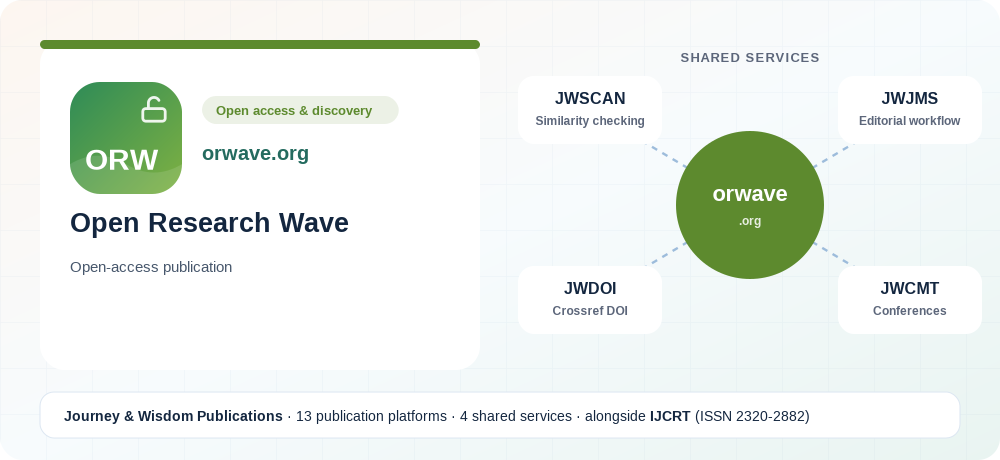
ORWave (orwave.org), Open Research Wave: journal records, the platform evaluation score, evaluation documents and article records, part of the Journey and Wisdom network
Journal recordsA public profile page per listed journal
Own metricORWave evaluation score, labelled as its own
3 documentsScore certificate, peer-review certificate, letter with checklist
On requestRecords are requested, not crawled
Same networkPart of Journey & Wisdom, like JETIR
orwave.orgThe live listing platform

Read this first

ORWave Belongs to the Same Network as JETIR

Relationship. Open Research Wave (orwave.org) is one of the platforms of Journey & Wisdom Publications. JETIR, OpenRGATE, JW Book and the shared services belong to the same network. When ORWave lists, scores or certifies a journal of the network — JETIR included — the network is describing its own member. Read every ORWave record and document with that in mind.

Stating the relationship first is a matter of fairness to the reader. A listing or a certificate is judged by who stands behind it, and a link that is discovered later damages trust far more than one declared at the start. Every page on this site that cites ORWave or its sister platform OpenRGATE says the same thing, and so should any journal that displays an ORWave record.

Within the pair, the two platforms face different users. ORWave faces journals: it lists them, shows a profile for each, calculates its own evaluation score and issues evaluation documents. OpenRGATE faces researchers: preprints, repository deposits, discovery of papers and the gateway an author uses to find a suitable journal. ORWave’s documents carry a seal that reads “Open Access Repository and Preprint”, and it also publishes open-access articles and book chapters, but this page concentrates on the journal side.

Point by point

What ORWave Offers a Journal

Twelve services, from the public listing to the documents, each with the one fact a journal owner should keep in mind.

  1. A public journal record

    One page per journal with its title, cover, publisher and key facts. It is a profile on a related platform — a place where the journal’s facts can be found — not a selection by an outside database.

  2. Listing in a searchable journal list

    Visitors can search the platform by journal and by article, so a listed title appears among the other journals ORWave holds.

  3. Structured journal details

    Website, a submission link, subject areas, frequency, start year, E-ISSN, country, language and yes/no fields for DOI and article charges, all in a consistent layout that authors can compare.

  4. An honest indexing statement

    The record’s description can say where the journal is covered and where it is not. ORWave’s value to readers depends on this text being verifiable.

  5. The ORWave evaluation score

    A figure calculated under ORWave’s own assessment framework for an evaluation year, shown on the record with links to its calculation. It is the platform’s metric, not a Clarivate Journal Impact Factor.

  6. A dated score certificate

    A numbered certificate that states the evaluation year, the score and that it was issued under the issuer’s own methodology and data sources.

  7. A peer-reviewed journal certificate

    A numbered certificate recording that the journal showed a documented peer-review process for the assessment period, with the review type, covering editorial oversight, independent review, ethics and quality assurance.

  8. A letter with a parameters checklist

    A letter with an annexure that checks the journal against UGC’s suggestive parameters for peer-reviewed journals, marking each one fulfilled, not fulfilled or not verified — and stating that it is not a UGC listing.

  9. Article records with open copies

    Published articles can be listed with title, authors, the link to the article on the journal’s own site and a PDF copy held on ORWave, as an extra open copy.

  10. Discovery of journals by authors

    Authors looking for a venue can browse records and compare the facts side by side, which rewards journals whose claims are complete and checkable.

  11. Open-access publication of chapters and articles

    ORWave also publishes articles and book chapters for open reading, with metadata deposited for discovery services, under its own scope and guidelines.

  12. Requests handled through the JW team

    Records, deposits and evaluations are requested by email or WhatsApp; the team confirms the route and any charge in writing first.

Anatomy

What an ORWave Journal Record Contains

Six parts, read from the top of the page down. Most of the record is the journal’s own information; the metric and documents are ORWave’s.

HeaderWho the journal is
  • Journal title linked to its website
  • Cover image
  • Publisher name
Journal detailsFacts an author compares
  • Website and submission link
  • Subject areas
  • Frequency and start year
  • E-ISSN, country, language
  • DOI yes/no, APC yes/no
  • Contact email
Metric lineORWave’s own figure
  • ORWave evaluation score
  • Link to its calculation
  • Downloadable letter
AboutDescription in the journal’s words
  • Aims and scope
  • Characteristics
  • Where indexed and not indexed
Indexing logosServices associated with the journal
  • Each must match a real, checkable record
ArticlesRecords of published papers
  • Title and authors
  • Link to the article page
  • PDF copy on ORWave
Figure 1 — The six parts of an ORWave journal record. Accuracy of the header, details, description and logos is the journal’s responsibility; the metric line is ORWave’s.

Read the record the way an evaluator would. The header and details should match the ISSN Portal record for the same title and medium, character for character. The description should contain nothing the journal’s own site does not also say. Every indexing logo should lead, in one click, to a record at that service. And the metric line should be read as exactly what it is: a score calculated by a platform in the same network, under a method published on orwave.org.

The article list is the part journals most often underuse. An article record with a correct title, the full author list, a link back to the version of record on the journal’s site and an open PDF copy gives readers one more route to the paper. It does not change where the version of record lives: that is still the article page on the journal’s own site, which is the page Google Scholar reads and a Crossref DOI resolves to.

Metrics, honestly

The ORWave Evaluation Score and How It Differs From Other Journal Metrics

Journal owners often ask how to “get an impact factor”. The honest answer starts with which metric, calculated by whom.

What you needPlatform evaluation score (ORWave)Citation-database impact factorSearch-engine citation metrics
Who calculates itORWave, a Journey & Wisdom platformThe company that runs the citation databaseThe search engine, automatically
Can a journal ask for it✓ through the JW team✕ only after selective indexing✕ no request process
Independent of the journal’s publisher✕ same network as JETIR✓✓
Method published✓ calculation linked from each record✓✓
Based mainly onORWave’s assessment frameworkCitations to recent items in indexed journalsCitations found across the web
Appropriate wording on a journal site“ORWave evaluation score 20XX”Only if the journal is actually coveredOnly figures the engine itself shows
Figure 2 — Three kinds of journal metric, compared by type. Only the first can be requested; it is also the only one issued from inside the network.

A citation-database impact factor is calculated only for journals that the database has selected and indexed, from citations recorded in that database; no journal can apply for the number itself. Search-engine metrics such as Google Scholar’s h5-index appear automatically, and only for publications with at least 100 articles in the five-year window, according to Google Scholar’s own metrics page. The ORWave evaluation score is different in kind: a journal can request an evaluation, and ORWave calculates the figure under its own framework for a stated evaluation year.

That makes the ORWave score usable as long as it is described precisely: name the issuer, give the year, say that it is ORWave’s own method, disclose that ORWave belongs to the same network, and never call it a Journal Impact Factor without adding that it is not a Clarivate metric. Described that way it tells a reader something real. Described loosely, as an unqualified “impact factor”, it invites exactly the suspicion that loose impact-factor claims have earned across the industry — see the warning guide on fake impact factors.

Certificates and letters

The Three Evaluation Documents and What Each States It Covers

Each ORWave document is numbered and dated, and each states its own limits. Those limits should travel with it.

Metric

Score certificate

What it records: that the journal was evaluated under ORWave’s journal assessment framework for an evaluation year, and the score assigned.

Stated limit: the score is not a Clarivate Journal Impact Factor; the methodology is the issuer’s own.

Review

Peer-reviewed journal certificate

What it records: that the journal showed a documented scholarly peer-review process for the assessment period, covering editorial oversight, independent review, ethics and quality assurance, and the review type.

Stated limit: it does not establish indexing status, citation impact or accreditation by another organisation.

Checklist

Letter with parameters checklist

What it records: an assessment against UGC’s 35 suggestive parameters for peer-reviewed journals, each marked fulfilled, not fulfilled or not verified.

Stated limit: it is not an approval, endorsement or listing by UGC, and implies no recognition by any external regulatory or indexing authority.

JETIR received one of each in October 2026 and publishes all three in full, with their numbers, dates and stated limits, rather than quoting a figure on its own. Its write-up of the ORWave assessment quotes the documents, the certificate-checking guide shows how to test any such document, and the JETIR indexing and discovery page lists where JETIR is actually recorded. Read the figures there, in context, rather than from a summary.

Five questions to ask of any journal certificate

  1. Who issued it, and are they related to the journal?

    For ORWave the answer is printed on this page: the same Journey & Wisdom network.

  2. Is it numbered and dated?

    A number and a date let anyone refer to the exact document and check it with the issuer.

  3. Is the method published?

    The criteria and data sources should be on the issuer’s own site, not only in the certificate.

  4. Does it say what it does not mean?

    A responsible issuer states the limits. ORWave’s documents do so on their face.

  5. What was not checked?

    A checklist with items marked “not verified” tells you exactly where the assessment stopped. Count those, not only the items fulfilled.

Step by step

How a Journal Gets an ORWave Record, Score and Documents

ORWave does not crawl the web for journals. A record is requested, built from facts the journal supplies, and then checked. Nine steps keep it accurate.

From request to a maintained ORWave record1DisclosureSame network,decidedknowingly2ChooseRecord,articles,evaluation3Own sitefirstFacts visibleat home4Facts packTitle, ISSN,URLs, status5RequestVia the JWteam6Field checkAgainst siteand ISSNPortal7EvaluationScore anddocuments8MaintainYearly reviewFrom request to a maintained ORWave record1DisclosureSame network, decided knowingly2ChooseRecord, articles, evaluation3Own site firstFacts visible at home4Facts packTitle, ISSN, URLs, status5RequestVia the JW team6Field checkAgainst site and ISSN Portal7EvaluationScore and documents8MaintainYearly review
Figure 3 — The ORWave listing route. The evaluation stage (dashed) is optional: a journal can hold a record without asking for a score or documents.
  1. Read the relationship first — ORWave is a platform of the Journey & Wisdom network, the same network as JETIR. Decide whether a record from a related platform is what you want before asking for one.
  2. Choose what you are asking for — A journal record, article records with open copies, an evaluation with documents, or a combination. Each is a separate request and can be asked for alone.
  3. Make your own website complete — Everything a record repeats must already be true and visible on your site: exact title, ISSN, publisher, board, peer-review, ethics, licence and charges pages.
  4. Prepare the journal facts — Title as on the ISSN record, E-ISSN and print ISSN, publisher, website and submission URLs, subject areas, frequency, start year, country, language, DOI and APC status, contact email and a short factual description.
  5. Write a verifiable indexing statement — List only services you can prove with a link, and state the major databases the journal is not in. This text appears on the record.
  6. Send the request through the JW team — Email or WhatsApp the facts. The team passes the request to ORWave and tells you what will happen and any charge before anything is done.
  7. Check the live record field by field — Compare every field with your site and the ISSN Portal, open every link and report anything that does not match.
  8. Read any evaluation result with its limits — If you asked for an evaluation, read what was checked, what was marked not verified and the limits printed on each document before you display anything.
  9. Keep the record current — Update it when frequency, fees, URLs, ISSN or indexing status change, and review it at least once a year.

Timelines and any charges for records or evaluations are confirmed by the JW team when a request is made; this page quotes neither.

Discovery of journals

Where a Journal’s Indexing Evidence Actually Lives

A listing on ORWave is one record among several. Evaluators look for the independent ones first.

Records that show where a journal is coveredYour journalevidence trailISSN PortalConfirms title, ISSN andmediumCrossrefDOI metadata under your ownprefixGoogle ScholarCrawls your article pagesOpenAlexMostly follows your CrossrefDOIsDOAJSelective open-accessdirectorySelective indexesApply and wait for theirdecisionORWave recordSame network: profile andscoreOpenRGATESame network: deposits anddiscoveryRecords that show where a journal is coveredYour journalISSN PortalConfirms title, ISSN and mediumCrossrefDOI metadata under your own prefixGoogle ScholarCrawls your article pagesOpenAlexMostly follows your Crossref DOIsDOAJSelective open-access directorySelective indexesApply and wait for their decisionORWave recordSame network: profile and scoreOpenRGATESame network: deposits and discovery
Figure 4 — The evidence trail around a journal. The two records at upper left are inside the Journey & Wisdom network; the others are kept by independent organisations.

For most new journals the independent records come from three ordinary steps: an ISSN confirmed at the ISSN Portal, Crossref DOIs registered under the journal’s own prefix, and article pages that follow Google Scholar’s inclusion guidelines. OpenAlex, for example, says that journals get in by being in one of the indexes it harvests — for most journals, Crossref — with no separate submission (OpenAlex help). DOAJ and the selective citation databases come later and decide on their own criteria.

An ORWave record sits alongside these, not above them. It is useful because it presents the journal’s facts in a consistent public format and, through the article list, adds open copies. It cannot substitute for any of the independent records, and a journal that leans on it instead of them will look weaker to an evaluator, not stronger. The site’s indexing roadmap sets out the realistic order.

Wording

Describing an ORWave Listing or Score on Your Website

Wording that stays accurate

  • Journal record on ORWave (Open Research Wave), a platform of the Journey & Wisdom network
  • ORWave evaluation score 20XX — ORWave’s own method; not a Clarivate Journal Impact Factor
  • Peer-reviewed journal certificate, ORWave, No. …, dated …
  • Each document shown in full, with its stated limits beside it
  • A date beside every metric, refreshed when the record changes

Wording to avoid

  • “Indexed in ORWave” placed among selective-database logos
  • “Impact factor” with no issuer, year or method
  • Any suggestion that ORWave is independent of the network
  • A checklist summary that hides the items marked not verified
  • Combining scores from different issuers into one headline number

The same principle applies to every badge on a journal homepage. A reader who checks a claim and finds it described exactly as it is will trust the rest of the page; a reader who finds a relationship that was not mentioned will doubt everything. The site’s guide to impact factors versus evaluation scores gives more examples.

Who uses it

Who an ORWave Record Suits, and Who It Does Not

Young journals building a public profileA consistent page that shows title, ISSN, policies and articles in one more place while independent indexing is still ahead.
Editors who want an outside-format assessmentA dated evaluation that says what was checked and what was not — understood as coming from the same network.
Journals with open-licence back issuesArticle records with open copies, linked back to the version of record.
Authors comparing venuesRecords that put frequency, charges, DOI status and indexing statements side by side.
Librarians and research officesA way to see what a network journal declares about itself, to compare with the independent records.
Not suited toA journal looking for independent accreditation or a selective-index badge. Those are earned from outside: DOAJ, COPE membership and the selective databases.

Honest limits

What ORWave Can and Cannot Do for a Journal

ORWave can

  • List your journal with a public, structured record
  • Calculate and show its own evaluation score for a stated year
  • Issue numbered, dated documents that state their own limits
  • Hold article records with open copies linked to your site
  • Help authors discover and compare journals

ORWave cannot

  • Act as an independent accreditor — it is in the same network
  • Index a journal in Scopus, Web of Science, DOAJ or PubMed
  • Give a journal a Clarivate Journal Impact Factor
  • Replace Google Scholar crawling of your own site or your Crossref DOIs
  • Promise citations, submissions or any database’s decision

Requests

Requesting a Record or an Evaluation

Send the journal’s facts in one message, say whether you want a record, article records, an evaluation or all three, and include your indexing statement. The JW team replies with the route, what will be checked and any charge, in writing, before the request goes ahead.

Ask about an ORWave journal record or evaluation

There is no fixed price list for this service: each journal, publisher or event starts from a different place, so the JW team replies with what it can do and a written quote. Describe your situation in a few lines.

Practical answers

How-To Questions About Open Research Wave

How do I get my journal listed on ORWave?

Collect the facts a record shows — exact title as on the ISSN record, ISSN, publisher, website and submission links, subjects, frequency, start year, country, language, DOI and charge status, contact email, a short description and an honest indexing statement — and send them to editor@jetir.org or on WhatsApp. The team forwards the request, confirms any charge first and tells you when the record is live, so you can check every field.

How do I get an ORWave evaluation score for my journal?

Ask for an evaluation when you request the record, or later. ORWave assesses the journal under its own framework for an evaluation year and shows the score on the record with a link to its calculation. Before you display it, read the method on orwave.org and describe the figure as ORWave’s own score, with the year and the same-network disclosure.

How do I read the parameters checklist in an ORWave letter?

Count all three columns, not only the first. “Fulfilled” means confirmed from the journal’s details and policies on record; “not fulfilled” means checked and missing; “not verified” means not checked in that assessment. A long not-verified column is not a failure, but it limits what the letter can be said to show, and the letter itself states it is not a UGC listing.

How do I check that an ORWave record for my journal is correct?

Open the record and compare it line by line with your homepage and with the ISSN Portal: title spelling, ISSN and medium, publisher, frequency and start year. Click every link, including the submission link and the contact email. Check that each indexing logo leads to a real record and that the article list matches your published issues. Report any difference to the JW team.

How do I add my published articles to ORWave?

Ask for article records with the journal request or separately. Each record needs the article title, the full author list, the link to the article page on your site and a PDF copy. Deposit only articles whose licence allows open redistribution — CC BY does — and make sure the copy matches the version of record.

How do I display an ORWave certificate on my journal website?

Show the whole document, not a cropped badge. Next to it, name the issuer, say that ORWave is a platform of the Journey & Wisdom network, give the number and date, and quote the limits the document states. If it is the score certificate, add that the score is not a Clarivate Journal Impact Factor.

How do I find journals in my subject on ORWave?

Use the platform’s search by journal or browse records by subject, then compare frequency, charges, DOI status and the indexing statements. Treat the list as a starting point: confirm each journal’s ISSN at the ISSN Portal, open a few DOIs at doi.org and check indexing claims at the indexing services before you submit.

How do I explain an ORWave score to a promotion or evaluation committee?

Present it as what it is: a score calculated by ORWave for a named year under ORWave’s own method, from a platform in the same network as the journal. Put the journal’s independent records — ISSN, Crossref DOIs, Google Scholar presence — first. Committees decide which metrics they accept; check their written rules.

How do I update my journal’s ORWave record after a change?

Send the change to the JW team as soon as it happens: a new frequency, a new URL, a changed charge, a new ISSN after a title change, or a new indexing status. Then re-check the record. An outdated record misleads authors and reflects on the journal, so review it at least once a year even without changes.

How do I tell an ORWave listing from indexing in a selective database?

Ask who chose the journal. A selective database evaluates a journal against published criteria and can refuse it; an ORWave record is requested by the journal and built from its own facts on a platform of the same network. Both can be useful, but only the first is indexing in the sense evaluators mean.

How do I verify a journal certificate from any issuer?

Check the issuer’s identity and its relationship to the journal, look for a number and a date, find the method on the issuer’s own site, read the stated limits and note what was not checked. Then confirm the underlying facts independently — ISSN at the ISSN Portal, DOIs at doi.org, indexing at the indexing service.

How do I prepare a journal before asking for an ORWave evaluation?

Publish the documents an assessor looks for: a peer-review policy that says how many reviewers and what type of review, an ethics and malpractice statement, a corrections and retractions policy, a licence and copyright page, a charges page, the editorial board with affiliations, and the archive of issues. An evaluation can only confirm what is visible.

Ready to publish?

Submit your paper to JETIR

Peer-reviewed, open access, monthly · ISSN 2349-5162 · Crossref DOI · ₹1501 / $59 only after acceptance.

Questions

Open Research Wave — Frequently Asked Questions

Is ORWave independent of JETIR?
No. Open Research Wave is a platform of Journey & Wisdom Publications, the same network that publishes JETIR.
Is an ORWave listing the same as indexing?
No. It is a public record on a platform of the same network, requested by the journal. Indexing in Scopus, Web of Science, DOAJ or PubMed is decided only by those services.
Is the ORWave score an impact factor?
It is ORWave’s own evaluation score, shown on a certificate titled as an impact factor certificate. ORWave’s documents state that it is not a Clarivate Journal Impact Factor.
How is the ORWave score calculated?
Under ORWave’s own assessment framework and data sources for a stated evaluation year. The method is described on orwave.org, which is the authoritative source.
What documents does ORWave issue to journals?
A score certificate, a peer-reviewed journal certificate and a letter with a checklist against UGC’s suggestive parameters. Each is numbered, dated and states its own limits.
Does the ORWave letter mean a journal is UGC approved?
No. The checklist is ORWave’s assessment against UGC’s suggestive parameters, and the letter states that it is not an approval, endorsement or listing by UGC.
Can any journal ask for an ORWave record?
Yes, by request through the JW team. The journal supplies its facts, and the record should match what its own website and the ISSN Portal show.
Does ORWave charge journals?
There is no price list on this page. Any charge for a record or an evaluation is confirmed in writing before the request goes ahead. Ask at editor@jetir.org or on WhatsApp +91 94260 33211.
Will an ORWave record get my articles into Google Scholar?
No. Google Scholar reads your own article pages and their meta tags. A record on another platform does not replace that.
What is the difference between ORWave and OpenRGATE?
They are sister platforms in the same network. ORWave serves journals with records, scores and documents; OpenRGATE serves researchers with preprints, repository deposits and discovery of papers.
Where can I see JETIR’s ORWave documents?
On the JETIR site, which publishes all three 2026 documents in full with their stated limits, alongside the independent records listed on its indexing and discovery page.
Does ORWave still publish articles and chapters?
Yes. Open-access publication of articles and book chapters is part of the platform, under its own scope and guidelines; this page covers its journal-facing side.

Terms to know

Important Keywords

Terms that come up when a journal asks for an ORWave record, score or certificate.

  • ORWave
  • orwave.org
  • Open Research Wave
  • ORWave journal record
  • journal listing platform
  • journal profile page
  • ORWave evaluation score
  • journal impact factor certificate
  • evaluation score vs JIF
  • peer-reviewed journal certificate
  • UGC suggestive parameters checklist
  • journal evaluation document
  • journal indexing evidence
  • indexing statement
  • journal discovery
  • list of journals
  • article records
  • same-network disclosure
  • certificate verification
  • Clarivate Journal Impact Factor
  • Google Scholar h5-index
  • journal metrics honesty

Publish your own research

JETIR Publishes Its Own ORWave Documents in Full

JETIR is in the same network as ORWave and shows its ORWave documents with their limits, next to its independent records. To publish your own research there, start with the author guidelines.

JETIR at a glance

  • Journal of Emerging Technologies and Innovative Research · ISSN 2349-5162 · monthly · since 2014
  • Transparent, double-blind peer review by subject reviewers
  • Open access under CC BY 4.0 · multidisciplinary scope
  • ₹1501 (Indian authors) / US$59 (foreign authors), charged only after acceptance
  • Indian papers with more than 5 authors: ₹500 per extra author, incl. GST · no extra-author fee for foreign authors

Before you submit

JETIR is a Transparent, Peer-Reviewed, Open Access Journal (Refereed Journal). Following the discontinuation of UGC and UGC-CARE journal listing, JETIR is aligned with UGC's Suggested Parameters for Choosing Peer-Reviewed Journals.

Want a record that tells the truth about your journal?

Send your journal’s facts and ask about an ORWave record or evaluation — with the relationship and the limits stated from the start. Have a research paper of your own? Submit it to JETIR — ₹1501 for Indian authors or US$59 for foreign authors, charged only after acceptance.

Just ₹1501
Publish in a UGC-aligned Peer-Reviewed JournalLow Cost ₹1501 Indian Author$59 USD InternationalPublish in a UGC-aligned Peer-Reviewed Journal₹1501 Indian Authors$59 USD InternationalUGC-aligned peer-reviewed journal · ₹1501 India · $59 Intl
Submit Paper →
Support