JETIR Home › JW Ecosystem › JWDOI

Shared service · DOI registration support · Journey & Wisdom Publications

JWDOI: Low-Cost DOI Registration Support for Journal Owners — jwdoi.org

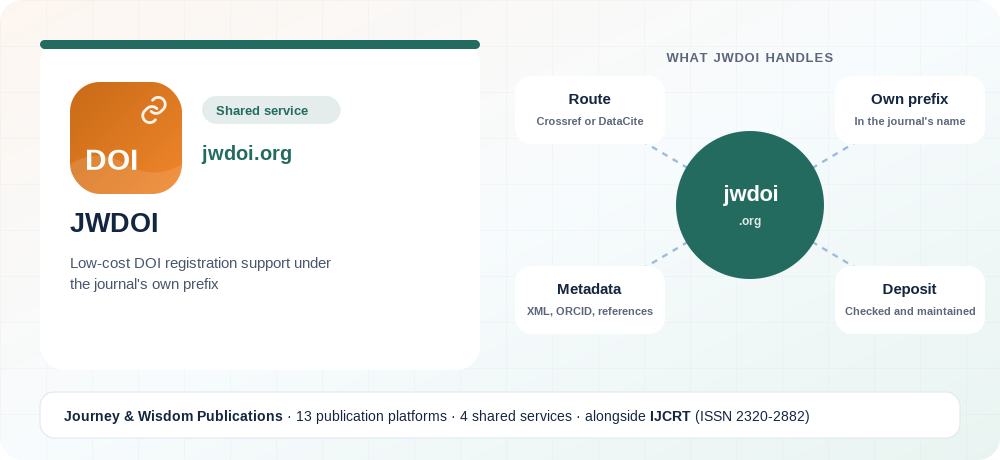
JWDOI helps journal owners obtain DOIs at the lowest sensible cost. It guides the journal into Crossref — directly or through an official Crossref Sponsor — or into DataCite through a member organisation, so the DOIs sit under the journal’s own prefix, and then prepares and deposits the metadata for every issue.

  • Your own DOI prefix
  • Crossref or DataCite route
  • Metadata prepared & deposited
  • Not a Sponsor itself
JWDOI (jwdoi.org): choosing a Crossref or DataCite route, the journal's own prefix, metadata preparation and deposit
Own prefixDOIs registered under the journal's own membership
2 agenciesCrossref (direct or via a Sponsor) or DataCite
US$200Lowest Crossref annual fee tier (2026), paid to Crossref
US$1.00Crossref fee per current journal article in 2026
79GEM countries with no Crossref fees (India not included)
On quoteJWDOI service charges confirmed in writing

The product

What JWDOI Is — and What It Is Not

JWDOI (jwdoi.org) is the Journey & Wisdom service that helps journal owners get Digital Object Identifiers without overpaying and without the technical work becoming a second job. A DOI gives each article a permanent link of the form https://doi.org/10.xxxx/yyyy that keeps working when your website changes, and the metadata registered with it lets citation databases, discovery tools and other publishers link to your articles.

The service has two halves. The first is getting the journal registered with a DOI registration agency on the most economical route that is genuinely available to it: Crossref, either directly or through an official Crossref Sponsor, or DataCite, through a member organisation that offers registration to journals. The second is doing the DOI work after that: preparing the metadata for each issue, depositing it, checking the result and keeping the records correct for years.

Two boundaries matter, and this page states them plainly. JWDOI is not a Crossref Sponsor and is not an accredited Crossref Service Provider; when a Sponsor is the right route, JWDOI helps you choose one from Crossref’s official list and prepare the application. And your DOIs belong under your prefix. The network’s own Crossref prefix, 10.56975, belongs to IJ Research Organization (Crossref member 36514) and is used only for the group’s own journals. It is never offered to other journals, and you should be cautious of anyone who offers to register your articles under their prefix.

Why does this matter? A journal that owns its prefix and membership can move website, change its publishing partner or stop using JWDOI without losing a single DOI. A journal whose DOIs sit under someone else’s prefix depends on that party forever.

Point by point

What JWDOI Provides

The full scope of the service, from the first question about cost to long-term maintenance.

  1. A route recommendation with real fees

    A written comparison of the routes open to your journal — Crossref direct, Crossref through a Sponsor, DataCite through a member organisation — using each organisation’s published fees for your country and size, so the cheapest valid route is visible before you commit.

  2. GEM eligibility check

    Crossref’s Global Equitable Membership waives membership and registration fees for organisations whose mailing and billing addresses are in one of 79 listed countries. Checking this first can change the whole plan; India, Indonesia and Malaysia are among the countries not on the list.

  3. Application preparation

    The organisation details, contact roles, journal titles, ISSNs and website information the registration agency or Sponsor asks for, prepared so the application goes through without back-and-forth.

  4. Prefix and account set-up

    Once the agency issues your prefix, JWDOI helps set up the account, records who holds the main login, and works only with the access you grant.

  5. DOI suffix pattern

    A suffix scheme that is short, unique and never needs to change — for example based on year, volume and article number — documented so any future editor can follow it.

  6. Landing-page check

    Every DOI must lead to its own live page for the article. JWDOI checks your article pages, metadata tags and PDF links before the first deposit.

  7. Metadata preparation

    Titles, all authors in order, ORCID iDs, affiliations, abstract, licence, publication dates, volume, issue, pages or article number, full-text URL and the reference list, assembled into the deposit format the agency expects.

  8. Deposits and verification

    Issue-by-issue deposits, review of the submission log for errors and warnings, and spot checks at doi.org so every DOI resolves to the right article.

  9. Reference deposit and linking

    Crossref requires members to link the references in their articles to other DOIs; depositing your own reference lists is optional but strongly encouraged. JWDOI handles both so your citations count and connect.

  10. OJS plugin configuration

    For journals on Open Journal Systems, configuration of the Crossref or DataCite export plugin so deposits run from the journal system instead of by hand. See JWJMS for OJS work.

  11. Corrections, retractions and updates

    Metadata updates when a URL, title, author name or licence changes, and correct handling of corrections and retractions so the record tells readers the truth about an article.

  12. Back issues and growth

    Registration of earlier issues, a Crossmark update policy if you want one, and a periodic look at your participation report to find gaps in your metadata.

The identifier

Anatomy of a Journal DOI

Parts of a DOI linkhttps://doi.org/resolver10.5555prefix: your membership/separatorjabc.2026.4.2.017suffix: your patternParts of a DOI linkhttps://doi.org/resolver10.5555prefix: your membership/separatorjabc.2026.4.2.017suffix: your pattern
Figure 1 — A DOI link has a resolver, a prefix and a suffix. 10.5555 is Crossref’s example prefix; your journal receives its own prefix when it joins, and chooses its own suffix pattern.

The prefix identifies the registrant — your organisation — and is issued by the registration agency when you join. The suffix is chosen by you and must be unique within your prefix; it should carry no meaning that might change, such as a section name. The resolver at doi.org sends readers to whatever URL you last registered, which is why a DOI survives a website move as long as the metadata is updated. Crossref’s display guidelines ask for DOIs to be shown as full links, https://doi.org/10.xxxx/xxxxx, rather than with a “doi:” label.

Architecture

Who Holds What: Journal, Agency, Sponsor and JWDOI

Parties in a journal DOI set-upYour DOIrecordowned by the journalYour journalMember, owns the prefix andaccountCrossrefRegistration agency forjournalsCrossref SponsorOptional: billing, support,feesDataCite memberAlternative route via amemberJWDOIPrepares and deposits, withyour accessdoi.org resolverSends readers to your pageLanding pageOne live page per articleDiscovery servicesRead the deposited metadataParties in a journal DOI set-upYour DOIrecordYour journalMember, owns the prefix and accountCrossrefRegistration agency for journalsCrossref SponsorOptional: billing, support, feesDataCite memberAlternative route via a memberJWDOIPrepares and deposits, with your accessdoi.org resolverSends readers to your pageLanding pageOne live page per articleDiscovery servicesRead the deposited metadata
Figure 2 — Who holds what. The journal owns the membership, prefix and records; JWDOI works with the access the journal grants and can be replaced without losing a DOI.

A Crossref Sponsor is an organisation in Crossref’s official Sponsor programme. It gives administrative, billing, technical and language support to small organisations, which still become full Crossref members with their own vote, and it may charge its own fees. Crossref has paused accepting new Sponsor organisations in most regions, but members can still join through existing Sponsors. On the DataCite side, a member organisation or consortium can offer DOI registration to journals; DataCite records are not found in Crossref’s search and APIs, which matters if your readers and indexers rely on Crossref.

Compared

Four Routes to DOIs, Compared

Each route is legitimate for some journals. The right one depends on your country, size and how much support you need.

What you needCrossref directCrossref via a SponsorDataCite via a memberZenodo shared prefix
DOIs under the journal’s own prefix✓✓✓✕ Zenodo's 10.5281
DOI resolves to the journal’s own article page✓✓✓✕ always zenodo.org
Records in Crossref search and APIs✓✓✕✕
Reference linking and Cited-by✓✓◐ different services✕
Eligible for Crossref Similarity Check✓✓✕✕
Annual feeFrom US$200Crossref fee + Sponsor’s own fees, or GEM waiverSet by the member or consortiumNone
Per-article feeUS$1.00 current (2026)As Crossref, plus any Sponsor chargeNo DataCite per-DOI fee below 100,000 a yearNone
Suitable for journal articles✓✓✓✕ against Zenodo's policy for bulk journal use
Figure 3 — Route comparison. Fees are those published by Crossref and DataCite (checked 14 November 2026); JWDOI’s own service charge is quoted separately.

The published fees behind the comparison

ItemFeeSource / note
Crossref annual membership, revenue or expenses under US$1,000US$200Crossref fees page, 2026
Crossref annual membership, US$1,000 to 1 millionUS$275Higher tiers rise with revenue
Crossref journal article, current record (2026)US$1.00Current = published 2024–2026
Crossref journal article, back-year record (2026)US$0.15Published 2023 or earlier
Crossref from 1 January 2027US$0.95 / 0.20 / 0.06Three prices by record type; back-year records free
Crossref GEM membersNo membership or registration fee79 countries; mailing and billing address must be in the list
DataCite direct member organisationEUR 2,000 a yearDataCite fee model
DataCite consortium organisationEUR 200–700 a yearShared infrastructure fee by country; no per-DOI fee below 100,000 DOIs a year

Zenodo is an excellent free archive for datasets, supplementary files and preprints, but it is not a substitute for journal DOIs: its DOIs use Zenodo’s prefix, always resolve to zenodo.org, and Zenodo lists bulk journal uploads made to avoid DOI fees as unsuitable content. Moving from Zenodo DOIs to Crossref DOIs.

Low cost, honestly

How JWDOI Keeps DOI Costs Low

“Low cost” here means not paying for things you do not need and not paying twice for mistakes — not cutting corners on ownership.

Check GEM before anything else

If your organisation’s mailing and billing addresses are in a GEM country, Crossref membership and registration fees are waived. For eligible journals this is the cheapest possible route.

Use the right fee tier

Crossref’s annual fee is based on publishing revenue or expenses. Most new journals belong in the lowest tiers; JWDOI helps you state the figure correctly.

Compare Sponsors honestly

Sponsors may charge their own fees for the support they give. JWDOI sets out what each candidate Sponsor publishes so you can weigh support against cost.

Register once, correctly

Failed or wrong deposits cost time and can confuse indexers. Clean metadata and a fixed suffix pattern avoid repeat work.

Plan back issues around fee changes

Back-year records cost US$0.15 each in 2026 and become free from 2027 under Crossref’s announced fee change, while new content must still be registered when it is published.

Automate with your journal system

A configured OJS or JWJMS export removes manual XML work for every issue, which is where most hidden costs sit.

What JWDOI will not do to lower the price: register your articles under another organisation’s prefix, skip landing pages, or deposit metadata it has not checked. Those shortcuts look cheap and become expensive the first time the journal changes partner, website or name.

Who uses it

Who JWDOI Is For

New journalsJournals planning DOIs in their first year that want the membership and prefix set up correctly from the start.
Journals with Zenodo DOIsJournals that started with free Zenodo DOIs and now want their own prefix for new and back-issue content.
University and society journalsDepartments and societies with academic editors but no one who wants to learn XML deposits.
Journals in GEM countriesPublishers that may qualify for fee-free Crossref membership and need help applying.
Proceedings and book publishersPublishers registering DOIs for conference papers, books and chapters as well as articles.
Journals that inherited a messTitles with missing deposits, broken URLs or DOIs under someone else’s prefix that need a clean plan forward.

Step by step

How the JWDOI Process Runs

JWDOI process from readiness to maintenance1ReadinessSite, ISSN,policies2RouteGEM, Sponsor,DataCite3ApplyIn your ownname4PrefixAccount andaccess5PatternSuffix andlanding pages6MetadataXML for eachissue7VerifyLog anddoi.org check8MaintainUpdates foryearsJWDOI process from readiness to maintenance1ReadinessSite, ISSN, policies2RouteGEM, Sponsor, DataCite3ApplyIn your own name4PrefixAccount and access5PatternSuffix and landing pages6MetadataXML for each issue7VerifyLog and doi.org check8MaintainUpdates for years
Figure 4 — The JWDOI process. Steps 1–4 happen once; steps 5–8 repeat with every issue.
  1. Check readiness — Confirm the journal has a working website, an ISSN or a clear plan for one, published policies and a landing page for every article.
  2. Compare the routes with real fees — JWDOI checks your country against the Crossref GEM list, compares joining Crossref directly with joining through an official Crossref Sponsor, and sets out the DataCite option, with each party’s published fees.
  3. Apply in the journal’s own name — The journal (or its publishing organisation) applies to Crossref or the chosen Sponsor, or to a DataCite member organisation. JWDOI prepares the application details; the membership is yours.
  4. Receive your prefix and give access — The registration agency issues the prefix to your organisation. You keep the account and grant JWDOI the access it needs to deposit on your behalf.
  5. Fix the suffix pattern and landing pages — Agree a DOI suffix pattern that never needs to change and check that each article has its own live landing page before anything is deposited.
  6. Prepare and deposit the metadata — Authors, ORCID iDs, affiliations, abstract, licence, dates, pages or article numbers, full-text URL and references go into the deposit for each issue.
  7. Verify every DOI — The submission log is checked for errors and warnings, and DOIs are opened at doi.org to confirm they land on the right page.
  8. Maintain the records — URLs, corrections, retractions, title changes and back issues are updated so every DOI keeps resolving for as long as the journal exists.

What gets deposited

What Goes Into Each DOI Record

ElementWhy it mattersPractical note
Title, authors in orderThe basis of every citationSpell names as the authors do; keep the order of the published article
ORCID iDsConnects the article to the author’s recordCollect at submission, not at publication
Affiliations and ROR IDsLets institutions find their outputNeeds Crossref schema 5.3.0 or later; current recommendation is 5.5.0
AbstractDiscovery services show and index itPlain text, no formatting codes
LicenceTells readers and machines how they may reuse itFor open access, a Creative Commons licence such as CC BY 4.0
Dates, volume, issue, pages or article numberPlaces the article in the journal recordUse the same values as the article page and PDF
Full-text URLNeeded for Similarity Check and text miningSimilarity Check needs full-text links for at least 90% of content
ReferencesReference linking is a membership obligationDepositing your reference list is optional but strongly encouraged
Updates and retractionsKeeps the scholarly record honestRegister corrections and retractions; a Crossmark policy is optional

Good metadata is what makes a DOI worth having. A DOI registered with only a title and a URL works as a link, but it does little for citation counts, discovery or the journal’s reputation with indexers. See depositing references with Crossref and displaying DOIs on article pages.

Years later

Keeping DOIs Working After the First Deposit

  1. Website moves

    When the domain or URL structure changes, every registered URL must be updated so DOIs keep resolving. JWDOI can prepare bulk URL updates.

  2. Title changes

    A significant title change needs a new ISSN and a new title record; DOIs already registered stay with the old title.

  3. Back issues

    Earlier issues can be registered at any time, issue by issue, with the same suffix pattern carried backwards.

  4. Corrections and retractions

    Notices get their own records and the original article’s metadata is updated so readers following the DOI see the current status.

  5. Membership renewals

    Crossref invoices in early January with payment due by mid-February; membership cannot be paused, and cancelling must happen before the due date to avoid the new year’s fee.

  6. If a journal stops

    DOIs keep resolving to the last registered URL, so the journal should arrange preservation; Crossref can redirect to archived copies held by Portico or CLOCKSS.

Honest limits

What JWDOI Does Not Do

What JWDOI does

  • Explain every route with the agencies’ published fees
  • Prepare applications made in the journal’s own name
  • Prepare, deposit and verify metadata with the access you grant
  • Maintain records, updates, back issues and corrections

What JWDOI does not do

  • Act as a Crossref Sponsor or accredited Crossref Service Provider
  • Register your articles under the network’s prefix 10.56975
  • Promise indexing — a DOI is an identifier, not an index listing
  • Decide your membership: Crossref, the Sponsor or DataCite member does

A DOI does not make an article peer reviewed, indexed or high quality. It makes it findable and citable. Be wary of offers that sell DOIs as a sign of indexing or approval.

Charges

JWDOI Charges and Quotes

Two kinds of cost are involved, and they should never be mixed up. The registration agency’s fees (and any Sponsor’s fees) are paid by the journal to that organisation at their published rates. JWDOI’s service charge covers the preparation, deposit and maintenance work, and depends on the route, the number of articles and back issues, and whether the journal runs on OJS, JWJMS or a custom site. There is no public JWDOI price list; the team quotes in writing after a short look at your journal.

Ask about DOIs for your journal

There is no fixed price list for this service: each journal, publisher or event starts from a different place, so the JW team replies with what it can do and a written quote. Describe your situation in a few lines.

Authors who simply need a DOI for a paper published in JETIR do not need JWDOI: JETIR offers Crossref DOIs for its own papers on request — see how DOIs work at JETIR.

Practical answers

How-To Questions About JWDOI

How do I get a DOI prefix for my journal at low cost?

First check whether your organisation qualifies for Crossref GEM (fee-free) by its mailing and billing address. If not, compare joining Crossref directly at the lowest fee tier with joining through an official Crossref Sponsor, and consider DataCite through a member organisation. JWDOI sets out these options with published fees for your case.

How do I join Crossref through a Sponsor?

Pick a Sponsor from Crossref’s official Sponsors list that covers your region, contact it with your organisation and journal details, and sign its agreement and Crossref’s membership terms. Your journal becomes a full Crossref member with its own prefix; the Sponsor handles billing and support and may charge its own fees.

How do I know whether Crossref or DataCite is better for my journal?

For journal articles, Crossref is the usual agency: its records feed reference linking, Cited-by and Similarity Check, and many discovery tools read Crossref metadata. DataCite can register articles too, but its records are not in Crossref’s search and APIs. Choose DataCite mainly if your organisation already belongs to a DataCite consortium.

How do I choose a DOI suffix pattern?

Use something short and stable, for example a journal code with year, volume, issue and article number. Avoid section names, author names or anything that might change. Write the pattern down so future editors follow it.

How do I register DOIs for articles already published?

Register back issues issue by issue under your prefix, after checking that every old article has a working landing page. Back-year records cost US$0.15 each at Crossref in 2026 and become free from 2027.

How do I deposit references with Crossref?

Include each article’s reference list in the deposit, with DOIs where they exist. Depositing references is optional but strongly encouraged; putting Crossref DOI links in your published reference lists is an obligation of membership.

How do I add ORCID iDs to DOI metadata?

Collect authenticated ORCID iDs from authors at submission, show them on the article page and include them in the deposit. Writing works to authors’ ORCID records directly needs the ORCID Member API, which is a paid ORCID membership.

How do I display DOIs correctly on article pages?

Show each DOI as a full link, https://doi.org/10.xxxx/yyyy, on the article landing page and ideally in the PDF and the how-to-cite text. Crossref’s display guidelines advise against “doi:” labels and old dx.doi.org links.

How do I update a DOI when my website changes?

Redeposit the metadata with the new URLs for every affected article, then test a sample at doi.org. Set up 301 redirects from old URLs as well, so links that bypass the DOI still work.

How do I correct or retract an article that has a DOI?

Publish the correction or retraction notice on its own page, register it, and update the original article’s metadata so the relationship is recorded. Never delete the original record or reuse its DOI.

How do I check whether a DOI is registered?

Paste the full link into a browser: a registered DOI resolves through doi.org. For Crossref DOIs you can also search the title at search.crossref.org or look up the journal in Crossref’s title list.

How do I move from Zenodo DOIs to my own prefix?

Keep existing Zenodo DOIs as they are, join Crossref or DataCite, and register new content under your own prefix. Back-file articles can also receive Crossref DOIs; the two DOIs are simply not linked to each other.

Ready to publish?

Submit your paper to JETIR

Peer-reviewed, open access, monthly · ISSN 2349-5162 · Crossref DOI · ₹1501 / $59 only after acceptance.

Questions

JWDOI — Frequently Asked Questions

Is JWDOI a Crossref Sponsor?
No. JWDOI is not a Crossref Sponsor and not an accredited Crossref Service Provider. When a Sponsor is the best route, it helps you choose one from Crossref’s official list and prepare the application.
Will my DOIs be under my journal's own prefix?
Yes. Your journal joins in its own name and receives its own prefix. JWDOI deposits on your behalf with the access you grant, and you can change partner without losing any DOI.
Can my journal use the prefix 10.56975?
No. 10.56975 belongs to IJ Research Organization (Crossref member 36514) and is used only for the network’s own journals.
How much does JWDOI charge?
There is no public price list. Crossref, Sponsor or DataCite fees are paid to those organisations at their published rates; JWDOI quotes its own service charge in writing. Ask at editor@jetir.org or WhatsApp +91 94260 33211.
Is Crossref free for Indian journals?
No. India is not on Crossref’s GEM list, so Indian members pay the normal fees, which start at US$200 or US$275 a year for small publishers plus per-article registration fees.
Does a DOI get my journal indexed?
No. A DOI is a persistent identifier with registered metadata. Indexing services decide separately on their own criteria, although good Crossref metadata does help discovery tools find your articles.
Do I need an ISSN before I get DOIs?
Registering journal articles is much simpler with an ISSN, and Crossref’s Metadata Manager requires one for journal articles. Online journals often receive an ISSN only after their first issues, so plan the order with JWDOI.
Can JWDOI register DOIs for conference papers and books?
Yes, where the publisher of the proceedings or book is a member of the registration agency. Proceedings series need an ISSN; one-off volumes do not, and an ISBN is strongly encouraged.
What is the difference between a Sponsor and a service provider?
A Sponsor is part of Crossref’s membership programme and supports members administratively and with billing. A service provider registers content using a member’s credentials. In both cases the journal is the member and keeps its prefix.
Can I stop using JWDOI later?
Yes. The membership, prefix and records are yours, so you can take the work in-house or to another partner at any time without changing a single DOI.
How do authors of JETIR papers get a DOI?
JETIR offers Crossref DOIs for its own published papers on request, under the network’s prefix. Authors use JETIR’s DOI page, not JWDOI.
Are Zenodo DOIs the same as journal DOIs?
No. Zenodo DOIs are DataCite DOIs on Zenodo’s shared prefix 10.5281, they always resolve to zenodo.org, and they are not in Crossref. They suit datasets and supplementary files, not a journal’s articles.

Terms to know

Important Keywords

The DOI and Crossref terms used on this page.

  • JWDOI
  • jwdoi.org
  • DOI registration
  • low-cost DOI
  • Crossref membership
  • Crossref Sponsor
  • DataCite
  • DOI prefix
  • DOI suffix
  • GEM countries
  • content registration fee
  • metadata deposit
  • Crossref XML
  • reference linking
  • ORCID iD
  • ROR ID
  • landing page
  • back-year DOIs
  • Crossmark
  • Cited-by
  • Similarity Check eligibility
  • Zenodo DOI
  • DOI display guidelines

Publish your own research

Need a DOI for Your Own Paper? Publish With JETIR

JWDOI is for journals. If you are an author, JETIR publishes multidisciplinary research after transparent peer review and offers Crossref DOIs for its papers on request.

JETIR at a glance

  • Journal of Emerging Technologies and Innovative Research · ISSN 2349-5162 · monthly · since 2014
  • Transparent, double-blind peer review by subject reviewers
  • Open access under CC BY 4.0 · multidisciplinary scope
  • ₹1501 (Indian authors) / US$59 (foreign authors), charged only after acceptance
  • Indian papers with more than 5 authors: ₹500 per extra author, incl. GST · no extra-author fee for foreign authors

Before you submit

JETIR is a Transparent, Peer-Reviewed, Open Access Journal (Refereed Journal). Following the discontinuation of UGC and UGC-CARE journal listing, JETIR is aligned with UGC's Suggested Parameters for Choosing Peer-Reviewed Journals.

Planning DOIs for your journal?

Tell the JW team your country, publisher name and article volume; JWDOI replies with the routes open to you and a written quote. Authors with a finished paper can submit it to JETIR instead.

Just ₹1501
Publish in a UGC-aligned Peer-Reviewed JournalLow Cost ₹1501 Indian Author$59 USD InternationalPublish in a UGC-aligned Peer-Reviewed Journal₹1501 Indian Authors$59 USD InternationalUGC-aligned peer-reviewed journal · ₹1501 India · $59 Intl
Submit Paper →
Support