JETIR Home › JW Ecosystem › International Journal Publication

Wave family · Interdisciplinary manuscripts · Journey & Wisdom Publications

International Journal Publication: A Home for Cross-Field Papers — ijpublication.org

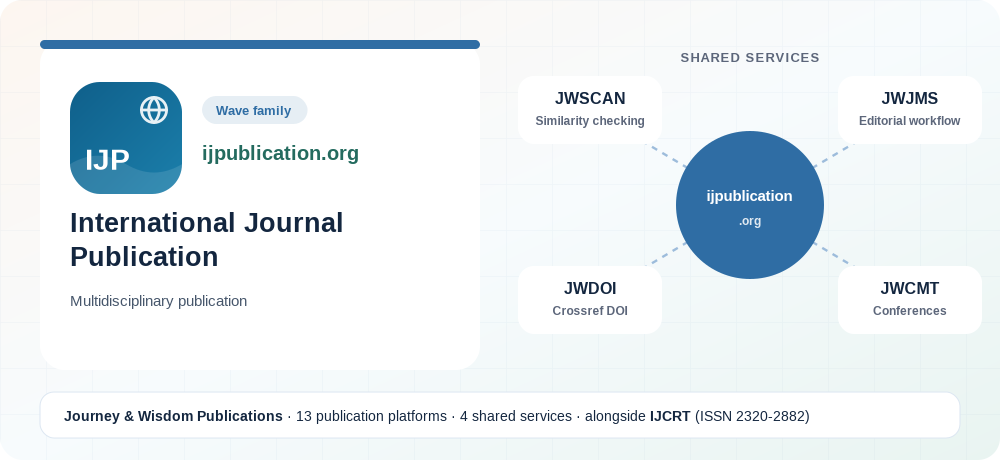
International Journal Publication is a journal platform and knowledge hub of the Journey & Wisdom network with a broad, multidisciplinary remit. The group’s journals are published through it, its guides explain how papers that span several fields are scoped, reviewed and written, and every JW service — from similarity checks to DOI support and books — is available from the same platform.

  • Papers that span fields
  • Reviewer pairing across disciplines
  • Keywords for two audiences
  • All JW services on request
International Journal Publication (ijpublication.org), a Journey & Wisdom journal platform and knowledge hub for interdisciplinary and multidisciplinary research
Broad remitScience, engineering, management, humanities, social sciences
HubJournal platform with guides on cross-field research
Wave familyOne of six Wave platforms in the network
4 servicesSimilarity, workflow, DOI and conference support
Books tooCross-disciplinary volumes via JW Book
ijpublication.orgJournals, scope and charges on its own site

The platform

What International Journal Publication Is

International Journal Publication (ijpublication.org) belongs to the Wave family of the Journey & Wisdom network. Like the other hub sites of the family, it is a journal platform and knowledge hub for the group’s journals, and the place from which the group offers publication and all of its services. Its remit is broad — journal articles and academic books across science, engineering, management, humanities and the social sciences — which makes it the natural platform for research that does not sit comfortably inside one discipline.

That last point shapes this page. Papers that combine fields are common and valuable: an engineer and an economist modelling energy prices, a sociologist and a data scientist studying online behaviour, a nurse and a statistician evaluating a community programme. They are also harder to place, harder to review and harder to find later than single-field papers. A broad scope helps them get through the door, but it does not solve the rest. Good scoping, honest classification, the right mix of reviewers and writing that serves two audiences do.

The sections below set out what International Journal Publication offers, how interdisciplinary work differs from multidisciplinary and transdisciplinary work, how a cross-field paper is classified and reviewed, and how to write and present it so that both communities can use it. Related questions are covered elsewhere in the family: International Journal Wave deals with authors in different countries rather than different fields, and Journal & Research Wave with the reporting standards for primary studies.

Point by point

What International Journal Publication Offers Cross-Field Authors

Twelve things the platform and the JW team provide, seen from the side of a researcher whose work spans disciplines.

  1. Journals with a wide subject remit

    The group’s journals on ijpublication.org cover a broad range of subjects, so a paper that combines fields is not rejected simply for falling between two narrow scopes.

  2. Guides on cross-field research

    The knowledge hub explains how to frame a paper that draws on more than one discipline, choose keywords, request suitable reviewers and write methods that two readerships can follow.

  3. Book publication for cross-disciplinary volumes

    Edited volumes that bring several disciplines to one problem, and monographs with a broad readership, go to JW Book, which handles ISBNs, editing and production.

  4. Similarity screening via JWSCAN

    Drawing on several literatures raises the risk of unattributed overlap. JWSCAN produces iThenticate reports that list each matched source so it can be cited or rewritten.

  5. A review record in JWJMS

    When a paper has reviewers from different fields, JWJMS keeps each report and the editor’s reasoning together, so conflicting advice is resolved on the record.

  6. DOI metadata via JWDOI

    For journals that register DOIs, JWDOI deposits titles, abstracts, keywords and references so the article can be found by search tools serving either community.

  7. Interdisciplinary conferences via JWCMT

    JWCMT can run events with tracks from several disciplines and allocate reviewers per track, with a route to proceedings or a special issue.

  8. Open access and discovery

    Open Research Wave and Open Research Gate — both in the same Journey & Wisdom network — help keep the work free to read and deposited where both communities search.

  9. A scholar record across fields

    Researchers who publish in several disciplines can have papers scattered across indexes. ScholarRPN connects them to one profile.

  10. Help for editors of broad-scope journals

    Editors launching or running a multidisciplinary title can ask about journal set-up and the JW workflow, review and DOI services behind it.

  11. Written answers before any work

    Journal charges are stated on each journal’s pages; JW service charges are confirmed in writing first. JWSCAN publishes its own rates.

  12. One contact for every request

    Write to editor@jetir.org or WhatsApp +91 94260 33211 with the service or question; the team routes it to the right platform.

Definitions

Multidisciplinary, Interdisciplinary and Transdisciplinary Work

The three words are often used interchangeably, but they describe different kinds of paper — and each is reviewed and written slightly differently.

KindWhat it meansTypical paperWhat reviewers check
MultidisciplinarySeveral disciplines look at one topic side by side; each keeps its own methodsA climate study with separate hydrology, agriculture and policy sectionsEach part on its own field’s terms
InterdisciplinaryMethods or theories from different fields are combined into one approachA machine-learning model of disease spread built with epidemiologistsWhether the combination is sound, not only each piece
TransdisciplinaryResearchers work with practitioners or communities to frame the problem togetherA water-management study co-designed with farmers and local officialsWhether non-academic knowledge is used and credited properly
Single-field with borrowed toolsOne discipline uses a technique from another without changing its frameAn education study using a standard statistical testCorrect use of the borrowed tool

Why the distinction matters in practice: a multidisciplinary paper can often be reviewed by a set of specialists who each read their own section, while an interdisciplinary paper needs at least one reviewer who can judge whether the combination itself works. A transdisciplinary paper adds a further question — how the views of people outside academia shaped the work — and usually needs a section on how they were involved and acknowledged. Telling the editor which kind of paper you have written makes the review faster and fairer.

Where an interdisciplinary paper draws fromYour paperone question,several fieldsNatural sciencesMeasurement, experiment,modelsEngineeringDesign, systems, simulationHealth sciencesClinical and population dataSocial sciencesSurveys, behaviour,institutionsManagementOrganisations, markets,decisionsHumanitiesTexts, history, ethics,meaningData and computingAlgorithms, large datasetsPractice and policyPractitioners, communities,lawWhere an interdisciplinary paper draws fromYour paperNatural sciencesMeasurement, experiment, modelsEngineeringDesign, systems, simulationHealth sciencesClinical and population dataSocial sciencesSurveys, behaviour, institutionsManagementOrganisations, markets, decisionsHumanitiesTexts, history, ethics, meaningData and computingAlgorithms, large datasetsPractice and policyPractitioners, communities, law
Figure 1 — The fields a cross-field paper commonly combines. Most interdisciplinary papers draw on two or three of these, not all eight; naming which ones is the first step in scoping.

Before you submit

Scoping and Classifying a Paper That Crosses Fields

A cross-field paper that is classified well reaches the right editor, the right reviewers and, later, the right readers.

Scoping

State the problem first, the fields second

Open the abstract with the problem, then say which disciplines you combine and why both are needed. Readers decide in the first two sentences whether the paper is for them.

Scoping

Choose a home discipline

Every paper needs one set of conventions for structure and citation. Pick the field closest to your main contribution and follow it consistently.

Classifying

Use subject codes where the journal asks

If the submission form offers subject categories, choose a primary and a secondary category rather than the vaguest available option.

Classifying

Pick keywords from each vocabulary

The same idea has different names in different fields. Include the term each community would search for; see how to select keywords.

Classifying

Write a title both fields would click

Avoid jargon that only one community knows. A good test: would a researcher from either side recognise the problem from the title alone?

Submission

Explain the fit in the cover letter

Tell the editor in two sentences why the journal’s scope covers the combination and what expertise a fair review needs.

A common mistake is to submit a cross-field paper to whichever journal has the broadest name. Breadth of scope is necessary but not sufficient: the journal should already publish work that combines the fields you combine, or at least publish papers from both. Look at its recent issues. If you would cite three or four of its recent articles, it is probably a good fit; if you would cite none, the editor will notice too. The guides on selecting a multidisciplinary journal and when a multidisciplinary journal is the right choice go into this in depth.

Peer review

How Reviewers Are Paired for a Cross-Field Paper

Interdisciplinary papers are reviewed best by a pair or trio of reviewers whose expertise covers each side of the combination. The flow shows how that usually works.

Reviewer pairing for an interdisciplinary manuscript1Editor readsWhich fields arecombined2Field A reviewerJudges method anddata3Field B reviewerJudges theory orcontext4Bridge reviewerJudges thecombination5Reports comparedConflicts identified6Editor decidesReasons on therecordReviewer pairing for an interdisciplinary manuscript1Editor readsWhich fields are combined2Field A reviewerJudges method and data3Field B reviewerJudges theory or context4Bridge reviewerJudges the combination5Reports comparedConflicts identified6Editor decidesReasons on the record
Figure 2 — A common pattern for reviewing interdisciplinary work. The dashed stage — a reviewer who works across both fields — is ideal but not always available; editors then weigh the two specialist reports together.

The usual difficulty is that reviewers from different fields give contradictory advice. A statistician asks for a larger sample; a historian asks for more archival context; each is right within their field and neither knows what the other asked. The editor’s job is to read the reports together and tell the author which requests matter most for the paper’s claims. As an author, you can help by answering each reviewer in their own terms and by pointing out, politely, when two requests conflict and how you resolved it.

Authors can also help at submission. Use the cover letter to describe the kinds of expertise a fair review needs — “one reviewer with experience in survey methods and one in labour economics” — rather than naming people. Never suggest co-authors, supervisors, recent collaborators or colleagues at your own institution; editors check, and a suggested reviewer with a conflict damages trust in the whole submission. The guide to double-blind review explains how anonymity is kept on both sides.

Compared

Single-Field and Interdisciplinary Papers Compared

The differences are not in quality but in what the author has to do to make the paper work for its readers and reviewers.

What you needSingle-field paperInterdisciplinary paper
Readers share the same vocabulary✓✕ define terms for each side
Methods can be described briefly✓◐ explain for the other field
Literature review covers one field✓✕ two or more literatures
Reviewers come from one community✓◐ usually a pair or trio
Conflicting reviewer requests◐ sometimesCommon — resolve them on the record
Keywords from one vocabulary✓✕ include each field’s terms
Choice of journalMany narrow-scope optionsFewer journals that publish the combination
Risk of hidden text overlap◐Higher — borrowing from several literatures
Readers after publicationOne communityTwo or more, searching in different places
Figure 3 — What changes when a paper crosses fields. Items described in words have no simple yes or no answer.

Writing for two audiences at once

The most useful habit is to imagine one reader from each field and write for both. In the introduction, explain why the problem needs both disciplines, in terms each reader accepts. In the methods, give the reader from the other field enough to judge the approach — a sentence on why a technique was chosen, a reference to a standard text, a note on assumptions. Define every term that carries a different meaning in each field (“model”, “significance”, “validity” and “network” are common offenders). In the discussion, say what each community should take from the result. A short glossary or a figure that maps concepts across the fields can save reviewers much time.

Who uses it

Who International Journal Publication Is For

Interdisciplinary research teamsGroups whose members come from different departments and need a venue whose scope covers the whole combination.
Researchers changing fieldsScholars moving from one discipline into another, whose first papers in the new field still draw on the old one.
Applied and problem-led researchersPeople working on a real-world problem — health, energy, water, education — that no single discipline can address.
Editors of broad-scope journalsEditors who need reviewers from several fields and a record of how conflicting reports were weighed.
Editors of cross-disciplinary booksVolume editors bringing several disciplines to one theme, who need ISBN, editing and production through JW Book.
Students with hybrid thesesDoctoral and master’s students whose thesis sits between two departments and who want to publish chapters as articles.

Step by step

From Cross-Field Idea to Submitted Paper

Nine author-side steps, from naming the fields to making the published paper findable by both communities.

The exact submission route, review model and charges for each journal are stated on ijpublication.org. The steps below cover what is in the author’s hands — the decisions that make an interdisciplinary paper easier to review and easier to find.

  1. Name the fields your paper joins — Write one sentence that states the problem and the two or three disciplines whose methods or theories you combine; if you cannot, the paper is not ready.
  2. Find the journal whose scope covers the combination — On ijpublication.org, read each journal’s aims and scope and its recent papers; choose the one that already publishes work spanning the same fields.
  3. Choose a home discipline for the framing — Decide which field’s conventions the paper follows for structure and citation style, and say so in the cover letter.
  4. Write methods for the reader from the other field — Explain each method in enough detail that a specialist from the other discipline can judge it, and define terms that carry different meanings in each field.
  5. Pick keywords from both vocabularies — Choose five to eight keywords that include the main term each community would search for, plus the specific method or setting.
  6. Suggest the kinds of expertise needed — In the cover letter, name the expertise a fair review needs — for example, one reviewer in statistics and one in public health — without naming close colleagues.
  7. Run an optional JWSCAN check — Papers that borrow wording from several literatures can carry hidden overlap; a JWSCAN report helps you fix attribution before submission.
  8. Submit and answer each reviewer in their own terms — After review, respond to each reviewer’s comments in the language of their field, and show where you clarified the method for the other audience.
  9. Make the published paper findable from both sides — Use the title and abstract terms from both fields, give a clear subject classification and share the article where each community reads.

Cross-field papers sometimes take longer to review because editors need reviewers from more than one community. This page does not quote review times; ask the journal if a deadline matters to you.

After publication

Making a Cross-Field Paper Findable by Both Communities

A paper that combines fields can be invisible to both: too technical for one community’s search terms, too applied for the other’s. Discovery tools rely on metadata — title, abstract, keywords, subject classification, references — so the work done at submission pays off here. Make sure the deposited metadata includes the full abstract and keywords, and that references are deposited where the journal registers DOIs, because citation links are how readers from one field follow a trail into another.

After publication, share the article where each community actually reads: a subject repository for one field, a professional network or practitioner newsletter for the other, a conference in each. Add the paper to your ORCID record so it appears on your profile whichever index a reader uses. The guides on keywords for discoverability and promoting a published paper cover these steps, and the Research Wave page explains post-publication dissemination in full.

Honest limits

What a Broad Scope Does Not Do

What the platform does

  • Publishes the group’s journals with a wide subject remit
  • Explains how cross-field papers are scoped, reviewed and written
  • Offers every JW service through one contact
  • States journal charges on each journal’s own pages
  • Confirms JW service charges in writing first

What it cannot do

  • Accept a paper because its scope is broad — review still decides
  • Make a weak combination of fields into a strong one
  • Promise reviewers in every niche combination
  • Guarantee recognition by a particular discipline’s committee
  • Promise indexing in any database

Some promotion and assessment systems are organised by discipline and value papers in “their” journals. Before submitting a cross-field paper, check how your institution counts work published outside your department’s core list, and keep the written answer.

Contact

Questions and Quotes

Each journal on ijpublication.org states its own charges. JW services — similarity reports, DOI support, conference or journal management, book publication — are quoted per request because the work differs from case to case; JWSCAN lists its rates on its own page. Tell the team the fields your work spans and what you need.

Ask about International Journal Publication and the JW services

There is no fixed price list for this service: each journal, publisher or event starts from a different place, so the JW team replies with what it can do and a written quote. Describe your situation in a few lines.

Practical answers

How-To Questions About International Journal Publication

How do I tell whether my paper is interdisciplinary or multidisciplinary?

Ask whether the disciplines are combined or placed side by side. If your method or argument would not work without both fields, it is interdisciplinary. If separate sections apply different fields to the same topic and could stand alone, it is multidisciplinary. Say which in your cover letter; it tells the editor what kind of reviewers to look for.

How do I choose which field’s format to follow?

Follow the conventions of the field closest to your main contribution — usually the one whose readers are most likely to cite you. Use that field’s structure and citation style throughout, but explain anything a reader from the other field would need. Mixing two formats in one paper confuses reviewers from both sides.

How do I write a literature review that covers two fields?

Organise it around the problem, not the disciplines. For each part of the problem, summarise what each field has found and where they disagree or ignore each other. End by showing the gap your combination fills. Keep it proportionate: reviewers expect the key works from each side, not everything.

How do I explain a method to readers from another discipline?

Give one sentence on what the method does and why you chose it, cite a standard reference, state the assumptions and say how you checked them. Move technical detail into an appendix or supplementary file so the main text stays readable for both audiences.

How do I choose keywords for a cross-field paper?

List the terms each community uses for your main concept, method and setting, then pick five to eight that cover both. Check how they are used in recent papers in each field. Avoid repeating title words only; keywords should add search terms the title lacks.

How do I suggest reviewers for an interdisciplinary paper?

Describe the expertise needed rather than relying on names: for example, a reviewer in clinical trials and one in health economics. If the journal asks for names, suggest people with no recent collaboration, shared institution or supervision link, from more than one country, and state your reason for each.

How do I respond when reviewers from different fields disagree?

Answer each reviewer fully, then add a short note to the editor explaining the conflict and the choice you made, with reasons. Where possible, satisfy both — for example, add a sensitivity analysis and a paragraph of context. Never ignore a comment because another reviewer said the opposite.

How do I publish a cross-disciplinary edited book?

Define the theme so that each chapter answers it from its own discipline, commission chapters with a common template, and write an introduction that connects them. For ISBN, editing and production, contact JW Book with a short proposal and chapter list; you receive a scope and quote.

How do I make my interdisciplinary paper easier to find?

Use terms from both fields in the title and abstract, pick a primary and secondary subject category, and make sure references are deposited where DOIs are registered. After publication, share it where each community reads and add it to your ORCID record.

How do I check whether a broad-scope journal is right for my paper?

Read its aims and scope, then its last two or three issues. If it publishes papers from both of your fields — or better, papers combining them — it is a candidate. Check its ISSN on the ISSN Portal and its peer-review policy before you decide.

How do I ask the JW team for help with a cross-field project?

Write to editor@jetir.org or WhatsApp +91 94260 33211 with the fields involved and what you need: a similarity report, conference management for a multi-track event, journal management or a book. You receive a written scope and quote before any work starts.

Ready to publish?

Submit your paper to JETIR

Peer-reviewed, open access, monthly · ISSN 2349-5162 · Crossref DOI · ₹1501 / $59 only after acceptance.

Questions

International Journal Publication — Frequently Asked Questions

What is International Journal Publication?
International Journal Publication (ijpublication.org) is a Wave-family journal platform and knowledge hub with a broad, multidisciplinary remit. The group’s journals are published through it, and all JW services can be requested from it.
What subjects does ijpublication.org cover?
Its remit spans science, engineering, management, humanities and the social sciences. Each journal on the platform states its own aims and scope; check those for your topic.
Is a multidisciplinary journal less rigorous than a specialist one?
Not by definition. Rigour depends on the peer-review process and the reviewers chosen. A broad scope means editors must find reviewers from several fields, which the platform’s review record helps document.
Can a single-field paper be published through International Journal Publication?
Yes, if it fits a journal’s scope. The broad remit simply means papers that cross fields are not turned away for falling between narrow scopes.
Is International Journal Publication part of JETIR?
No. JETIR (ISSN 2349-5162) is a separate multidisciplinary journal in the same network with its own editors and charges. Publishing in one does not publish your work in the other.
How many reviewers does an interdisciplinary paper get?
That depends on the journal’s published peer-review policy. A common pattern is at least two reviewers chosen so that each field in the paper is covered.
Does a broad scope help with indexing?
No. Indexing services judge journals on their own criteria, including fit between scope and content. A broad scope is neither an advantage nor a guarantee.
Can I publish an edited volume that spans disciplines?
Yes, through JW Book, the network’s book platform, which handles ISBNs, editing and production. Charges are quoted on request.
Does the platform offer similarity checking for cross-field papers?
Yes, through JWSCAN, which runs iThenticate by Turnitin and returns a source-by-source report. JWSCAN publishes its own rates.
What is transdisciplinary research?
Research in which academics work with practitioners or communities to define and study a problem together. Papers should explain how non-academic partners were involved and acknowledged.
Are JW service prices listed on this page?
No. JW service charges depend on the work and are confirmed in writing on request at editor@jetir.org or WhatsApp +91 94260 33211. JWSCAN lists its rates on its own page.

Terms to know

Important Keywords

Terms that come up when scoping, reviewing and writing papers that span more than one discipline.

  • International Journal Publication
  • ijpublication.org
  • interdisciplinary research
  • multidisciplinary research
  • transdisciplinary research
  • cross-field manuscript
  • broad-scope journal
  • aims and scope
  • subject classification
  • research keywords
  • reviewer pairing
  • conflicting reviewer comments
  • writing for two audiences
  • literature review across fields
  • methods explanation
  • cover letter
  • cross-disciplinary edited volume
  • discoverability
  • knowledge hub
  • Wave family
  • JWSCAN similarity check
  • peer review

Publish your own research

JETIR Also Welcomes Work Across Disciplines

JETIR, a separate journal in the same network, has a multidisciplinary scope and transparent double-blind review. If your cross-field paper is ready, its guidelines and submission page are linked below.

JETIR at a glance

  • Journal of Emerging Technologies and Innovative Research · ISSN 2349-5162 · monthly · since 2014
  • Transparent, double-blind peer review by subject reviewers
  • Open access under CC BY 4.0 · multidisciplinary scope
  • ₹1501 (Indian authors) / US$59 (foreign authors), charged only after acceptance
  • Indian papers with more than 5 authors: ₹500 per extra author, incl. GST · no extra-author fee for foreign authors

Before you submit

JETIR is a Transparent, Peer-Reviewed, Open Access Journal (Refereed Journal). Following the discontinuation of UGC and UGC-CARE journal listing, JETIR is aligned with UGC's Suggested Parameters for Choosing Peer-Reviewed Journals.

Working across two or more fields?

Ask the JW team about a journal on ijpublication.org or any JW service. Ready to submit a multidisciplinary paper now? JETIR charges ₹1501 for Indian authors and US$59 for foreign authors, only after acceptance.

Just ₹1501
Publish in a UGC-aligned Peer-Reviewed JournalLow Cost ₹1501 Indian Author$59 USD InternationalPublish in a UGC-aligned Peer-Reviewed Journal₹1501 Indian Authors$59 USD InternationalUGC-aligned peer-reviewed journal · ₹1501 India · $59 Intl
Submit Paper →
Support