JETIR Home › JW Ecosystem › Journal & Research Wave

Wave family · Original studies & research reports · Journey & Wisdom Publications

Journal & Research Wave: Reporting Original Research — jrwave.org

Journal & Research Wave is where the Journey & Wisdom group publishes original studies, empirical work and research reports. Besides hosting the group’s journals, it acts as a knowledge hub on how primary research should be reported — study-type checklists, data availability, replications and negative results — and it is a front desk for every JW service, from similarity screening to DOI support and books.

  • Original and empirical studies
  • Reporting checklists by study type
  • Data availability
  • Replications and negative results
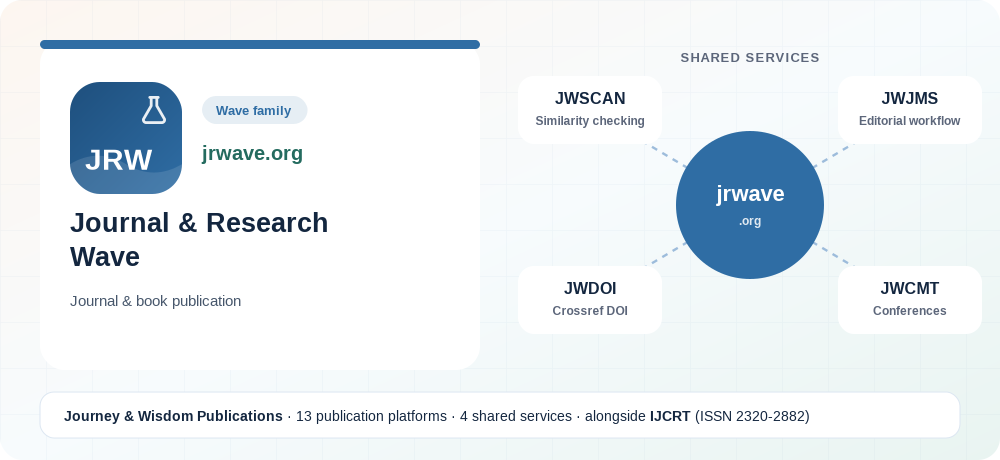
Journal & Research Wave (jrwave.org), a Journey & Wisdom journal platform and knowledge hub for original studies, empirical work and research reports
Research outputOriginal studies, empirical work, reports
Knowledge hubGuides on reporting primary research
Sister siteSits alongside JAPWave in the Wave family
Articles + booksStudies as papers or collected volumes
JW servicesScreening, workflow, DOI, conferences, books
jrwave.orgJournals, scope and charges on its own site

The platform

What Journal & Research Wave Is

Journal & Research Wave (jrwave.org) sits alongside Journal & Publication Wave in the Wave family, with an emphasis on research output: original studies, empirical work and research reports, published as journal articles or gathered into books. Its owner’s definition applies to all seven Wave and society hub sites — a journal platform and knowledge hub for the group’s journals, through which publication and all JW services are provided — and on jrwave.org that definition is given a research-methods focus.

Primary research is the core of the scholarly record. A review, an opinion piece or a commentary can be read and judged on its arguments; a primary study can only be judged if it reports what was done, to whom, how it was measured and what was found — completely and honestly. Much of the waste in research comes not from bad studies but from studies reported so poorly that no one can use, check or repeat them. Reporting standards exist to fix that, and they are the main subject of this page.

You will find what the platform provides, which reporting checklist suits which kind of study, how data availability works in practice, how research reports and technical reports differ from journal articles, and why replications and negative results deserve publication. Neighbouring topics live elsewhere: writing for readers in another country on the International Journal Wave page, and production after acceptance on the JAPWave page.

Point by point

What Journal & Research Wave Offers Researchers

Twelve things a researcher reporting primary work can get from jrwave.org and the network behind it.

  1. Journals for original research

    The group’s journals on jrwave.org publish original studies, empirical work and research reports across fields, each under its own stated scope and review policy.

  2. Guidance on reporting by study type

    The knowledge hub points authors to the right reporting checklist for trials, observational studies, reviews, qualitative work, diagnostic studies, case reports and laboratory experiments.

  3. Room for complete methods

    Supplementary files can carry protocols, full instruments, extra tables and code, so the main text stays readable without dropping detail a replicator needs.

  4. Data-availability practice

    Authors are guided to deposit data and code where possible and to state access honestly; the data-availability template shows the expected wording.

  5. A place for research reports

    Project reports, technical reports and longer research reports can be published or collected into books, giving funded work a citable home beyond the final grant report.

  6. Respect for null and negative findings

    Well-conducted studies with null results and careful replications are treated as contributions, not failures, when the methods are sound.

  7. Similarity screening via JWSCAN

    JWSCAN runs iThenticate by Turnitin, useful for methods sections where standard phrasing and earlier protocols must be cited properly.

  8. Recorded methodological review via JWJMS

    Reviewer reports and author responses on design, analysis and reporting are kept together in JWJMS, so methodological decisions are traceable.

  9. Identifiers for articles, data links and reports via JWDOI

    Where a journal registers DOIs, JWDOI deposits metadata that can include references and links to data, under the journal’s own prefix.

  10. Collected studies as books via JW Book

    A series of linked studies, a thesis or a large project’s outputs can become a monograph or edited volume through JW Book.

  11. Conference routes via JWCMT

    Preliminary results presented at events run on JWCMT can later be reported in full as a journal article that adds the complete methods and data.

  12. Repository and researcher records

    Open Research Gate (same network) supports deposit, and ScholarRPN links a researcher’s studies into one profile.

By study type

Which Reporting Checklist Fits Which Study

Reporting guidelines are checklists of what a paper must contain for a given study design. The EQUATOR Network keeps a library of them; the table names them by type.

Common study types and the kind of reporting checklist that applies (named by type; find current versions in the EQUATOR Network library)
Study typeChecklist to look forItems reviewers check first
Randomised controlled trialTrial reporting checklist and flow diagramRegistration, randomisation, allocation concealment, blinding, all outcomes
Observational study (cohort, case-control, cross-sectional)Observational-study reporting checklistSetting, eligibility, variables, bias, missing data, confounders
Systematic review or meta-analysisSystematic-review reporting checklist with flow diagramProtocol, search strategy, selection, risk of bias, synthesis
Qualitative researchQualitative-research reporting checklistResearcher position, sampling, data collection, analysis, saturation
Diagnostic accuracy studyDiagnostic-accuracy reporting checklistReference standard, test thresholds, flow of participants
Clinical case reportCase-report reporting checklistConsent, timeline, interventions, outcomes, patient perspective
Study protocolProtocol reporting checklistObjectives, design, outcomes, sample size, analysis plan
Laboratory or animal experimentPre-clinical or animal-research checklistSample size, randomisation, blinding, housing, ethics
Quality-improvement or programme evaluationImprovement-study reporting checklistContext, intervention, measures, unintended effects
Question and designWhy and how
  • Research question
  • Hypotheses
  • Study design named
  • Registration if required
Participants or materialsWho or what was studied
  • Setting and dates
  • Eligibility
  • Sampling
  • Sample size reasoning
Measures and proceduresWhat was done
  • Variables defined
  • Instruments cited
  • Protocol
  • Blinding where used
AnalysisHow results were obtained
  • Planned analyses
  • Software and versions
  • Missing data
  • Added analyses labelled
ResultsWhat was found
  • All planned outcomes
  • Effect sizes
  • Confidence intervals
  • Flow of participants
Data, materials and declarationsWhat stands behind it
  • Data statement
  • Code and materials
  • Ethics and consent
  • Funding and conflicts
Figure 1 — Six layers of a fully reported study. Reporting checklists differ by design, but nearly all of them ask for items in each of these layers.

Three points help authors use these checklists well. First, use the checklist while writing, as a list of things to include, rather than ticking it afterwards; a checklist completed at the end often reveals missing information that can no longer be collected. Second, give page or line numbers for each item when the journal asks for the completed checklist, so reviewers can find them. Third, a checklist is about reporting, not about quality: a perfectly reported study can still have a weak design, and the reviewers will say so.

Not every field has a formal checklist. Engineering experiments, economics models and humanities fieldwork often do not; in those cases, the principle is the same — report enough for another researcher to understand, judge and repeat the work — and the journal’s author guidelines and the norms of the field fill the gap. Guides on reporting in medical research, mixed methods and quasi-experimental designs give field-specific detail.

Behind the results

From Raw Data to an Honest Data-Availability Statement

A data-availability statement is only as good as the work behind it. The flow shows the stages, starting at the design of the study rather than at submission.

From data plan to data-availability statement1PlanConsent coverssharing2CollectDocumentvariables3CleanKeep raw andclean copies4De-identifyProtectparticipants5DepositRepository withan ID6CiteData in thereference list7StateWhere and how toaccessFrom data plan to data-availability statement1PlanConsent covers sharing2CollectDocument variables3CleanKeep raw and clean copies4De-identifyProtect participants5DepositRepository with an ID6CiteData in the reference list7StateWhere and how to access
Figure 2 — Seven stages from data plan to statement. The dashed stage (de-identification) applies when data come from people; skipping it is the most common reason data cannot be shared later.

The critical stage is the first. If the consent form participants signed did not allow their anonymised data to be shared, the data cannot be shared later, however good the intentions. Plan for sharing at the ethics-approval stage. Then document variables as you collect them — a codebook written months later is never complete — and keep both the raw and cleaned datasets with a record of every transformation.

For deposit, choose a repository that gives each dataset a persistent identifier: a subject repository used in your field, your institution’s repository, or a general-purpose archive such as Zenodo, which issues DataCite DOIs for uploaded datasets and supplementary material. Cite the dataset in the reference list like any other source. Finally, write the statement to match reality.

Best

Openly available

“The data supporting this study are openly available in [repository] at [DOI], under [licence].”

Acceptable with reason

Available with restrictions

“The data contain personal information and are available from [repository or committee] to qualified researchers under a data-use agreement.”

Acceptable with reason

Third-party data

“Data were obtained from [source] under licence and can be requested from [source]; the authors cannot redistribute them.”

When true

No new data

“No new data were created or analysed in this study.” Use only for purely theoretical or review work.

Weak

On request only

“Available from the corresponding author on reasonable request.” Weak: give a reason and a durable route if you must use it.

Increasingly expected

Code and models

“Analysis code is available at [repository] at [DOI]; software versions are listed in the methods.”

Compared

Research Articles, Research Reports and Technical Reports

Primary research can be published in several forms. They differ in length, review and purpose, and an author should choose the form before writing.

What you needOriginal research articleResearch reportTechnical reportReplication study
Presents new primary data or analysis✓✓◐ often applied or project data✓ repeats an earlier study
Peer reviewed before publication✓Depends on venue — askOften not; check the venue✓
Typical lengthJournal word limitLonger, fuller detailAs long as the work needsJournal word limit
Main readerResearchers in the fieldFunders, policy makers, researchersPractitioners, engineers, clientsResearchers checking a finding
Follows a reporting checklist✓◐ where the design has one◐ rarely formal✓ plus the original protocol
Novelty expected✓◐✕✕ value lies in confirmation
Citable with a persistent identifier✓ where DOIs are registered✓ if published with one◐✓ where DOIs are registered
Figure 3 — Four forms of primary research output. A research report published on jrwave.org follows the policy of the journal or series that publishes it; ask which review model applies.

A research report is often the right form for funded projects whose full results do not fit a journal word limit, for evaluations commissioned by an agency, or for studies whose readers are policy makers rather than specialists. A technical report documents methods, designs, tests or data in detail, frequently in engineering and computing, and is valued for completeness rather than novelty. Neither replaces a journal article for career purposes in most systems, but both can be cited and both can be the source from which shorter articles are drawn — provided the article cites the report and the overlap is declared.

Honest science

Replications, Null Results and Negative Findings

When only positive, surprising results are published, the literature exaggerates effects and other researchers waste years chasing findings that do not hold. Publishing careful replications and well-conducted studies with null results corrects that bias. A null result from a study with adequate sample size, sound measurement and a pre-specified analysis is informative: it tells others where not to look, or narrows the size an effect could have.

To report a null or negative result well, state the hypothesis and analysis you planned in advance (ideally registered), report the effect estimate with its confidence interval, show whether the study had enough power to detect a meaningful effect, and avoid spinning the result into something it is not. For a replication, cite the original study precisely, report any differences in sample, setting or procedure, and compare effect sizes rather than only significance. Editors reviewing such papers judge the design and execution — the same as for any study — not the direction of the result.

Practices that make primary research more trustworthy

  1. Pre-registration

    Registering hypotheses, outcomes and analysis plans before data collection separates planned from exploratory findings.

  2. Reporting all outcomes

    Selective reporting of only the outcomes that “worked” is a form of bias; report everything planned and say which analyses were added later.

  3. Effect sizes and intervals

    An effect size with a confidence interval tells readers how large and how certain a finding is; a p-value alone does not.

  4. Sharing materials

    Instruments, protocols and code let others replicate the study exactly; deposit them with identifiers.

The guide to pilot studies and the meta-analysis primer cover two designs where these practices are particularly important.

Who uses it

Who Journal & Research Wave Serves

Empirical research groupsTeams running trials, surveys, experiments or fieldwork who want their studies reported to recognised standards.
Authors of research and project reportsResearchers whose funded projects produced long reports that deserve a citable, published home.
Doctoral researchersStudents turning thesis chapters into original-research articles, who need to learn reporting checklists early.
Replication and meta-research teamsResearchers who repeat published studies or report null findings and want them judged on method.
Scholars collecting a body of workAuthors gathering a series of related studies into a monograph or edited volume through JW Book.
Editors of empirical journalsEditors who want reporting checklists, data statements and recorded methodological review built into their workflow.

Step by step

Reporting and Submitting a Study, Step by Step

Nine author-side steps from naming the study design to answering methodological review. Each journal’s own process is stated on jrwave.org.

Most of these steps happen before submission, which is the point: a study that is reported well at the first attempt is reviewed faster and revised less. The steps assume a quantitative or qualitative empirical study; theoretical papers and reviews skip the data steps but keep the rest.

  1. Identify your study design precisely — Name the design in one phrase — randomised trial, cohort, cross-sectional survey, qualitative interview study, systematic review, laboratory experiment — because the reporting checklist depends on it.
  2. Download the matching reporting checklist — Find the checklist for that design in the EQUATOR Network library or the journal’s guidelines and keep it open while you write, not after.
  3. Check ethics and registration records — Have the ethics approval number, consent procedure and, for trials or reviews that require it, the registration identifier ready to quote in the methods.
  4. Write methods someone could repeat — Describe sampling, setting, variables, instruments, analysis and software with versions in enough detail that another team could repeat the study.
  5. Report every planned outcome — Present all outcomes you set out to measure, including those that did not reach significance, with effect sizes and confidence intervals rather than p-values alone.
  6. Deposit data and code and write the statement — Place data and code in a suitable repository where possible, cite them with identifiers and write a data-availability statement that matches what you did.
  7. Screen the text with JWSCAN if you choose — Methods sections reuse standard wording; an optional JWSCAN report shows where to cite or rephrase before an editor asks.
  8. Submit through jrwave.org with the checklist — Upload the manuscript, the completed checklist with page numbers, declarations and supplementary files through the journal’s submission route.
  9. Respond to methodological review — Answer each reviewer point with the change made and its location; if you disagree, give the methodological reason and a reference.

This page does not quote review times or fees for journals on jrwave.org; each journal states its own. JW service charges are quoted in writing on request.

Honest limits

What Reporting Standards Cannot Do

What good reporting achieves

  • Lets reviewers judge the study on what was actually done
  • Lets other researchers repeat, combine or build on it
  • Makes null and negative results usable
  • Reduces requests for missing information during review
  • Supports trust in the journal that publishes it

What it cannot do

  • Turn a weak design into a strong one
  • Replace ethics approval or consent
  • Guarantee acceptance — reviewers still judge the science
  • Promise indexing of the journal in any database
  • Make data shareable if consent did not allow it

If a study involved people, animals or sensitive data, the ethics approval and consent must exist before data collection. No reporting checklist or journal can approve research retrospectively. See how to write an ethics approval statement.

Contact

Getting in Touch About Research Publication

Article charges for journals on jrwave.org are published by each journal. JW services — similarity reports, DOI and metadata support, journal management, book publication for collected studies, conference management — are priced per request after the team understands the work; only JWSCAN publishes fixed rates, on its own page.

Ask about Journal & Research Wave and the JW services

There is no fixed price list for this service: each journal, publisher or event starts from a different place, so the JW team replies with what it can do and a written quote. Describe your situation in a few lines.

Practical answers

How-To Questions About Journal & Research Wave

How do I find the right reporting checklist for my study?

Name your design first, then search the EQUATOR Network library by that design, or read the journal’s author guidelines, which often name the checklist expected. If your design is a variant — for example, a cluster trial or a pilot study — look for the extension that matches it.

How do I complete a reporting checklist for submission?

Work through each item and write the page or line number where it is reported. If an item does not apply, write “not applicable” with a reason. If it applies but is missing, add it to the manuscript rather than leaving it blank. Upload the completed checklist as a supplementary file.

How do I write a methods section that others can replicate?

Describe the design, setting and dates, participants or samples and how they were selected, every variable and how it was measured, instruments with references, the analysis plan and the software with versions. Put long protocols in supplementary material and link them from the text.

How do I report a null or negative result?

State the hypothesis and planned analysis, report the effect estimate with its confidence interval, comment on statistical power, and interpret the result without exaggeration. Explain what the finding rules out. Do not change the primary outcome after seeing the data.

How do I publish a replication of someone else’s study?

Cite the original exactly, follow its protocol as closely as possible, report every difference in sample, setting or materials, and compare effect sizes. Consider contacting the original authors for materials. Present the result as confirmation, partial confirmation or non-confirmation, with the evidence.

How do I write a data-availability statement when data cannot be shared?

Give the reason — participant privacy, a third-party licence, commercial confidentiality — and a route for qualified researchers to request access, such as a data committee or the original data owner. Avoid an unexplained “available on request”.

How do I cite a dataset in my paper?

Include it in the reference list with creators, year, title, repository and persistent identifier, for example a DOI. Mention it in the methods and in the data-availability statement. Citing data gives its creators credit and lets readers find it.

How do I turn a project report into a journal article?

Select one clear question the report answers, rewrite the introduction and discussion for researchers, report the methods to the relevant checklist and cut to the journal’s length. Cite the full report and declare the overlap in your cover letter.

How do I present statistics so reviewers trust them?

Report exact p-values, effect sizes and confidence intervals, name every test and why it was chosen, check and report assumptions, and handle missing data explicitly. The guide on reporting statistical tests gives examples.

How do I collect several of my studies into a book?

Write a linking introduction and conclusion, update each study and cite where it was first published, and check that you hold the rights to reuse published material. Send a proposal to JW Book for ISBN, editing and production; you receive a written quote.

How do I request JW services for an empirical journal?

Email editor@jetir.org or message +91 94260 33211 on WhatsApp, saying what the journal publishes and what you need: similarity screening, a workflow with checklist uploads, DOI metadata or conference support. The team replies with a scope and a written quote.

Ready to publish?

Submit your paper to JETIR

Peer-reviewed, open access, monthly · ISSN 2349-5162 · Crossref DOI · ₹1501 / $59 only after acceptance.

Questions

Journal & Research Wave — Frequently Asked Questions

What is Journal & Research Wave?
Journal & Research Wave (jrwave.org) is the research-output site of the Wave family: the group publishes journals of original studies and research reports through it, it explains how primary research should be reported, and any JW service can be requested from it.
How is Journal & Research Wave different from JAPWave?
They sit side by side. JAPWave is defined by handling publication end to end; Journal & Research Wave by its emphasis on research output — original studies, empirical work and research reports.
What is a reporting guideline?
A checklist of what a paper must contain for a particular study design, so readers can judge and repeat the work. The EQUATOR Network keeps a library of them.
Do journals on jrwave.org publish negative results?
Well-conducted studies with null or negative results can be published where they fit a journal’s scope; they are judged on design and execution, not on the direction of the result.
What is a research report?
A longer account of a study or project, often written for funders or policy makers, that can be published as a citable document or collected into a book.
Do I have to share my data?
You must state honestly where data are and how they can be accessed. Open sharing is encouraged; restrictions are acceptable with a clear reason and a route to access.
Can a technical report be published on the platform?
Research and technical reports can be published or collected into books on the platform; the review model depends on the journal or series, so ask before you submit.
Is jrwave.org connected to JETIR?
Both belong to the Journey & Wisdom network, but JETIR (ISSN 2349-5162) is its own journal with its own review and fees. A paper submitted to one does not appear in the other.
Does following a checklist mean my paper will be accepted?
No. Checklists improve reporting, but reviewers and editors still judge the design, analysis and contribution.
Will the journals on jrwave.org be indexed in major databases?
Indexing is decided by each database on its own criteria; no platform can promise it. Check any indexing claim on the database’s website.
Can I get my dataset a DOI?
Yes, through a data repository that issues persistent identifiers, such as a subject repository or a general archive. Cite that DOI in your article.
Where do I ask about JW service charges?
At editor@jetir.org or WhatsApp +91 94260 33211. Each request receives a written quote; JWSCAN lists its own rates on its page.

Terms to know

Important Keywords

Terms researchers meet when reporting original studies and research reports to a recognised standard.

  • Journal & Research Wave
  • jrwave.org
  • primary research
  • original research article
  • empirical study
  • research report
  • technical report
  • reporting guideline
  • reporting checklist
  • EQUATOR Network
  • randomised trial reporting
  • observational study reporting
  • systematic review reporting
  • qualitative research reporting
  • data availability statement
  • dataset citation
  • replication study
  • null results
  • negative findings
  • pre-registration
  • effect size and confidence interval
  • research methods
  • knowledge hub

Publish your own research

Original Research Is Also Welcome at JETIR

JETIR, a separate journal in the same network, publishes original research across disciplines after transparent double-blind review. If your study is written up and ready, its guidelines and submission page are below.

JETIR at a glance

  • Journal of Emerging Technologies and Innovative Research · ISSN 2349-5162 · monthly · since 2014
  • Transparent, double-blind peer review by subject reviewers
  • Open access under CC BY 4.0 · multidisciplinary scope
  • ₹1501 (Indian authors) / US$59 (foreign authors), charged only after acceptance
  • Indian papers with more than 5 authors: ₹500 per extra author, incl. GST · no extra-author fee for foreign authors

Before you submit

JETIR is a Transparent, Peer-Reviewed, Open Access Journal (Refereed Journal). Following the discontinuation of UGC and UGC-CARE journal listing, JETIR is aligned with UGC's Suggested Parameters for Choosing Peer-Reviewed Journals.

Reporting a study or a research project?

Ask the JW team about journals on jrwave.org, publishing a research report or any JW service. If your article is ready now, JETIR reviews it first and invoices only after acceptance: ₹1501 for authors in India, US$59 for authors elsewhere.

Just ₹1501
Publish in a UGC-aligned Peer-Reviewed JournalLow Cost ₹1501 Indian Author$59 USD InternationalPublish in a UGC-aligned Peer-Reviewed Journal₹1501 Indian Authors$59 USD InternationalUGC-aligned peer-reviewed journal · ₹1501 India · $59 Intl
Submit Paper →
Support